What the reciprocity agreement actually does
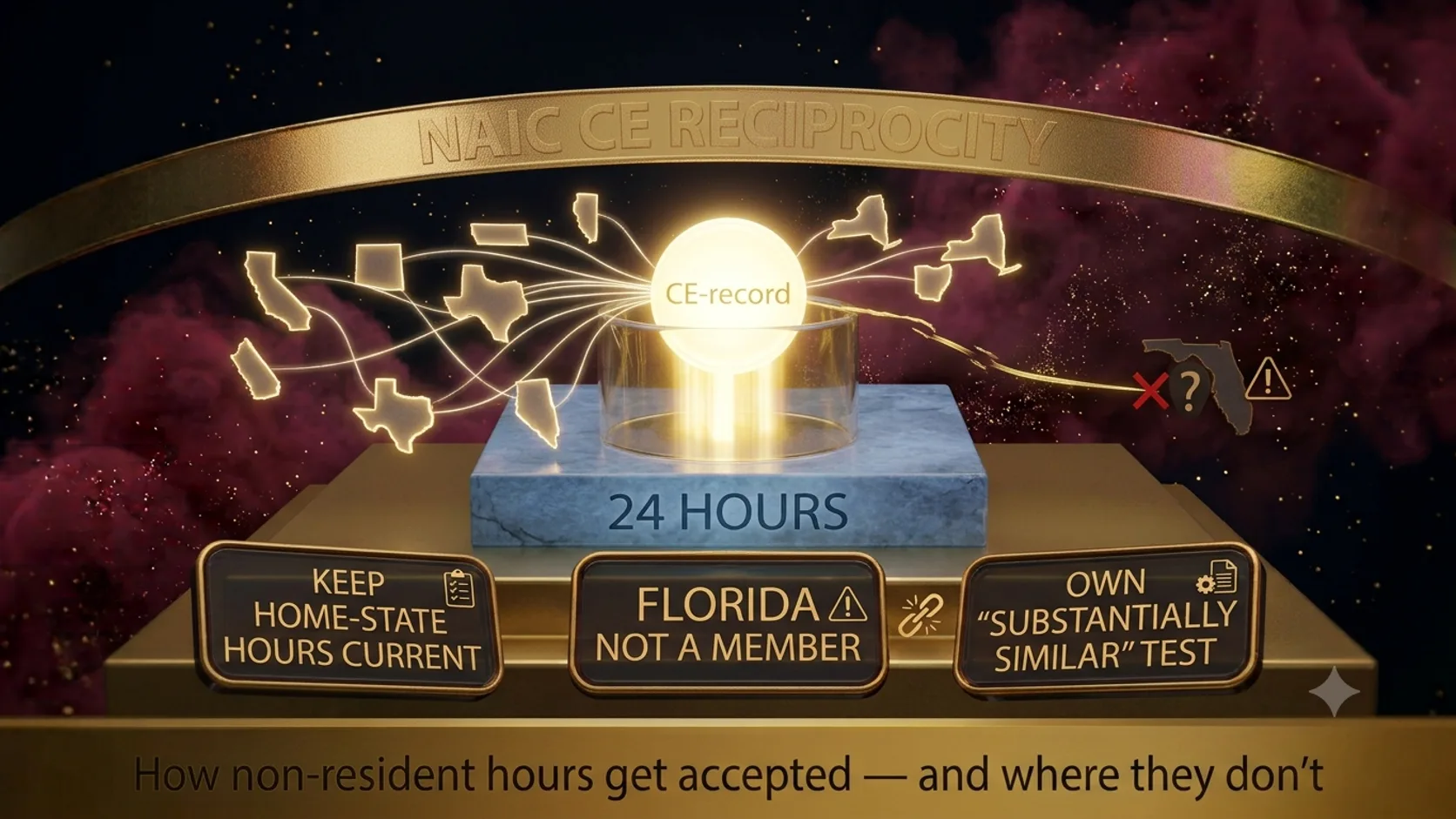
The NAIC Continuing Education Reciprocity agreement is a compact among state regulators. Its core promise: a non-resident producer who satisfies their home state's CE requirement is treated as satisfying the CE requirement of every other member state where they hold a non-resident license. The non-resident states do not add their own hour counts on top.
There is a second, less visible piece. The agreement also streamlines course approval: when a CE provider's home state substantively reviews and approves a course, other member states accept that approval instead of re-reviewing the course, as long as it does not conflict with their own law. That is why a national provider can offer one course that counts in dozens of states.
What a non-resident member state still checks
Reciprocity is not a blank check. A member state can still require a producer to complete a course on that state's own law or ethics if it has one — the agreement defers to existing state law. And the producer's home-state CE has to actually be current; if it lapses, the non-resident licenses that were riding on it are exposed.
The state also verifies status through the shared reporting systems. Because completions flow through Sircon and the NIPR Producer Database, a non-resident state can see the producer's home-state CE record without a filing. A producer who assumes reciprocity but whose home-state record shows a gap will find the non-resident renewal blocked.
Florida is outside the agreement
Florida is one of a small number of non-members of the NAIC CE Reciprocity agreement, along with several U.S. territories. That does not mean every non-resident producer owes a full set of Florida CE hours — but it does mean the exemption comes from Florida's own regulations, which a producer should read rather than assume.
In broad terms, Florida exempts a non-resident producer from Florida CE if the producer is a resident of and licensed in a state that has substantially similar CE requirements and the producer is in compliance there. The practical effect is close to reciprocity for most producers from mainstream CE states, but the eligibility test is Florida's own, applied to the producer's specific home state.
Where Florida's own rules leave gaps
Because Florida's non-resident exemption depends on the home state having substantially similar requirements, a producer from a state with an unusually light CE requirement, or from a state Florida does not treat as comparable, can end up owing Florida hours directly. A producer whose home state stops requiring CE, or who moves to such a state, can lose the exemption without any notice from Florida.
Florida also runs its own adjuster reciprocity lists separately, and the designated-home-state carve-out described in the adjuster guide on this site means DHS adjusters always owe full Florida CE. A non-resident producer selling in Florida should confirm their specific exemption status in the state's licensing portal rather than relying on the general reputation of reciprocity.
Worked example: a producer adding a Florida non-resident license
A producer resident in a state with a standard 24-hour biennial CE requirement adds a Florida non-resident life license. Because her home state's requirements are substantially similar to Florida's and she is compliant at home, Florida does not impose its own CE hours on her non-resident license.
Two years later she relocates to a state with a much lighter CE rule and completes a Change of Resident State. Her Florida license converts to non-resident from the new state. She now has to check whether Florida still treats her new home state as comparable — if not, she may owe Florida CE directly, even though nothing about her Florida license changed.
A reciprocity checklist for non-resident licenses
- Keep your resident-state CE current — every reciprocal non-resident license depends on it
- For each non-resident state, check whether it still requires its own law or ethics course despite reciprocity
- Pull your Sircon/NIPR transcript each cycle to confirm your home-state record is clean
- Treat Florida separately: confirm your exemption under Florida's own substantially-similar test
- Re-check Florida eligibility after any Change of Resident State
- Remember designated-home-state adjuster licenses never reciprocate — they owe full hours
The bottom line
For member states, CE reciprocity means one thing: keep your home-state hours current and your non-resident licenses are covered, subject to the occasional state-law course. Florida sits outside the agreement and reaches a similar result through its own substantially-similar test — which is fine until your home state changes or your home-state requirement thins out, at which point the Florida exemption can quietly disappear.
Primary and official sources used for this guide
NAIC — Continuing Education ReciprocityOfficial NAIC page describing the CE Reciprocity agreement and the reciprocal course-approval process.↗AgentSync — NAIC CE ReciprocityExplains how reciprocity works in practice, which jurisdictions are non-members, and the limits of the agreement.↗NIPR — Understand Insurance Continuing Education RequirementsPrimary source on resident vs. non-resident CE and electronic reporting through Sircon/NIPR.↗Florida Department of Financial Services — Continuing EducationOfficial source for Florida's non-resident CE exemption test and its status outside the NAIC agreement.↗Source pages can change. Check the current text and effective date before relying on an hour requirement, a reporting deadline, or a course approval.
Written for licensed agents, not issued by a regulator. Insurance License CE Desk has no connection to any state department of insurance or CE provider. Hour requirements, ethics credits, and compliance deadlines are set state by state and do change, so your department of insurance, or the CE tracking vendor it uses, has the final word on what your transcript needs.