Adjuster licensing does not look like producer licensing
Not every state licenses independent or public adjusters at all. Roughly two-thirds do. That patchwork creates a problem: an adjuster living in a non-licensing state has no resident license to build non-resident licenses on top of.
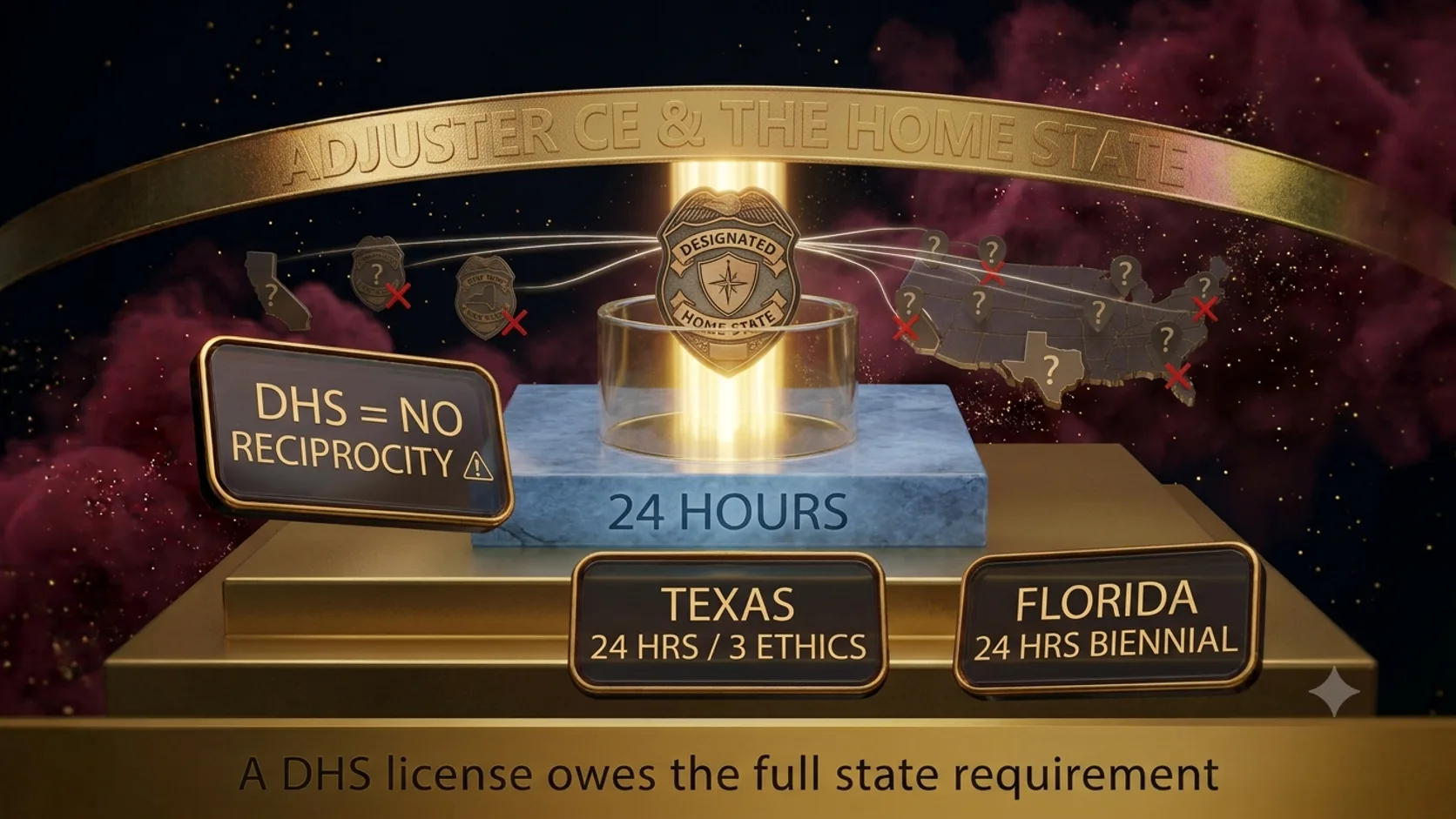
The industry's fix is the designated home state, or DHS. An adjuster who resides in a state that does not license adjusters can designate a licensing state as their home state, take that state's resident adjuster exam and pre-licensing, and hold what functions as a resident license there even though they do not live there. Texas and Florida are by far the most common choices.
The CE requirement follows the license, and DHS means full hours
For an ordinary non-resident adjuster license, most states apply CE reciprocity: if the adjuster keeps their resident (or designated home) state's CE current, the non-resident state does not impose its own hours. This is why an adjuster licensed in fifteen states usually only has to satisfy one state's CE.
A designated home state license is the exception. Because it stands in for a resident license, the DHS adjuster must complete that state's entire CE requirement directly — there is no upstream resident state to reciprocate from. Florida's own guidance is explicit that its non-resident adjuster CE reciprocity lists do not apply to holders of the Florida DHS adjuster license, who must complete Florida's CE requirement in full.
What Texas and Florida actually require of a DHS adjuster
Texas requires 24 hours of CE every two-year term, including 3 hours of ethics, with at least half of the hours in classroom or classroom-equivalent format. A Texas DHS adjuster completes this exactly as a Texas resident adjuster would.
Florida requires 24 hours of CE every two years for all-lines adjusters, including a mandatory ethics or law-and-ethics component. A Florida DHS adjuster completes Florida's full 24 hours rather than relying on a reciprocity credit. In both states, once the DHS state's CE is satisfied, the adjuster's other non-resident adjuster licenses generally reciprocate from it.
Choosing between Texas and Florida as a DHS
Both states let a non-resident designate them, and both have broad reciprocity with other licensing states, so an adjuster can often work nationally from either. The CE differences are modest — both land at 24 hours biennially with an ethics component — but the exam, pre-licensing, and renewal mechanics differ, and Texas's classroom-equivalent floor is a structural rule Florida does not mirror in the same way.
The bigger practical consideration is which state's CE and renewal calendar an adjuster wants to manage long-term, since the DHS choice is not something to change casually. An adjuster already holding a non-resident license in one of the two states sometimes converts that into the DHS designation rather than starting fresh.
Public adjusters are tracked separately
Public adjusters — who represent policyholders rather than insurers — are licensed and regulated separately from independent and company adjusters in most states that license them at all. Florida maintains a distinct non-resident public adjuster reciprocity list, and the DHS carve-out applies there too: a Florida DHS public adjuster completes Florida's CE directly.
An adjuster who does both independent and public adjusting should not assume one license's CE covers the other. They are often different license types with their own hour counts and their own renewal dates.
Worked example: an adjuster in a non-licensing state going national
An adjuster living in a state that does not license adjusters wants to handle catastrophe claims across the Gulf and Southeast. He designates Texas as his home state, completes Texas pre-licensing and the exam, and receives a Texas DHS all-lines adjuster license.
To keep it, he completes Texas's full 24 hours every two years, including 3 ethics hours and at least 12 classroom-equivalent hours. He then adds non-resident adjuster licenses in Florida, Louisiana, Mississippi, and several other states — and because those reciprocate from his Texas CE, he does not complete separate hours for each. If he had instead chosen Florida DHS, the same logic would apply with Florida's 24 hours as the base.
An adjuster CE checklist
- Determine whether your resident state licenses adjusters — if not, you need a designated home state
- Choose Texas or Florida as DHS based on exam, renewal, and CE-calendar preference, not just familiarity
- Complete the DHS state's full CE requirement directly — reciprocity does not apply to a DHS license
- Texas DHS: 24 hours biennially, 3 ethics, at least half classroom-equivalent
- Florida DHS: 24 hours biennially with the mandated ethics/law component
- Keep independent-adjuster and public-adjuster CE and renewals tracked as separate licenses
The bottom line
For most non-resident adjuster licenses, keeping one state's CE current covers the rest through reciprocity. The designated home state license breaks that pattern: it functions as a resident license, so the DHS adjuster owes that state's full CE — 24 hours biennially in both Texas and Florida — with no upstream state to reciprocate from. Picking the DHS is effectively picking which CE regime you will live under.
Primary and official sources used for this guide
WebCE — Insurance Adjuster License Reciprocity & Designated Home State InfoExplains which states license adjusters, how the designated home state works, and how adjuster CE reciprocity operates.↗Florida Department of Financial Services — Non-Resident All-Lines Adjuster Reciprocating StatesOfficial statement that CE reciprocity lists do not apply to Florida designated-home-state adjuster licensees.↗Florida Department of Financial Services — Continuing EducationPrimary source for Florida's 24-hour adjuster CE requirement and ethics component.↗Texas Department of Insurance — Agent Continuing EducationPrimary source for Texas's 24-hour requirement, 3 ethics hours, and the at-least-half classroom-equivalent floor for adjusters and agents.↗Source pages can change. Check the current text and effective date before relying on an hour requirement, a reporting deadline, or a course approval.
Written for licensed agents, not issued by a regulator. Insurance License CE Desk has no connection to any state department of insurance or CE provider. Hour requirements, ethics credits, and compliance deadlines are set state by state and do change, so your department of insurance, or the CE tracking vendor it uses, has the final word on what your transcript needs.