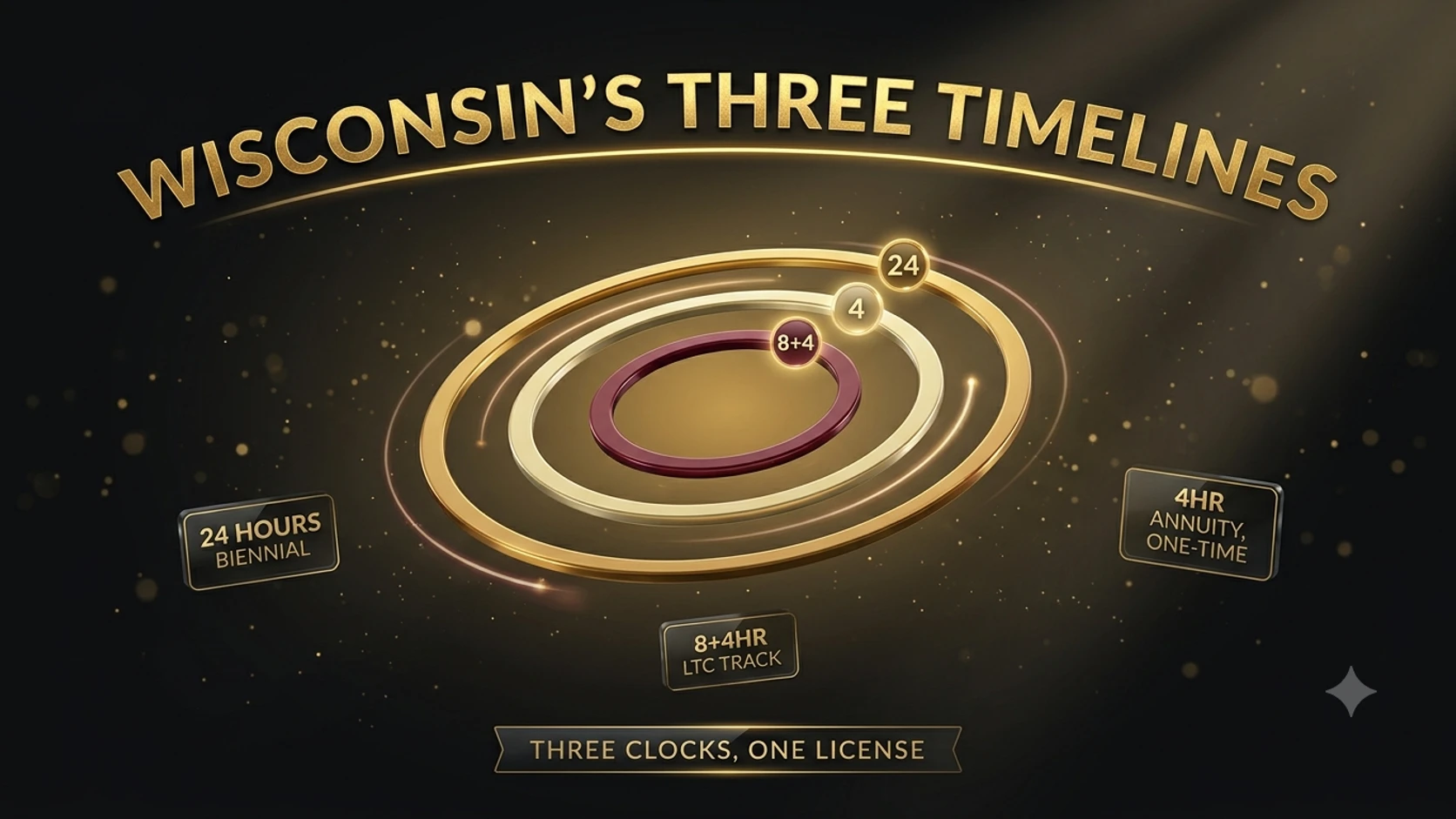
The baseline: 24 hours, same-day deadline, zero flexibility
Wisconsin producers must complete 24 hours of continuing education every two-year license term, including 3 hours of ethics. Resident producer licenses expire biennially on the last day of the licensee's birth month, and CE is due on that exact same day — no separate earlier completion buffer is built into the rule the way Michigan (45 days) or Maryland (15 days) structure theirs.
No credits can be carried over into the next license term under any circumstances, and a course cannot be repeated for credit more than once within a two-year term. All CE credit hours must be completed BEFORE submitting the renewal application, meaning the same-day deadline is effectively earlier in practice than it might first appear.
Annuity Best Interest training: a specific rule for newer licensees
Producers (Wisconsin refers to them as intermediaries) licensed on or after October 1, 2022 must complete a one-time, 4-hour Annuity Best Interest Certification Training course before selling, soliciting, or negotiating any annuity business in Wisconsin. This date-based trigger means the requirement applies based on when a producer was licensed, not simply whether they currently sell annuities — a producer licensed before that date may be governed by a different transition rule.
Unlike the long-term care add-on described below, this specific Annuity Best Interest course does not appear to carry an ongoing refresher requirement in the same way — it is framed as a one-time prerequisite tied to the October 2022 licensing cutoff, though producers should confirm current requirements directly given how recently this rule took effect.
Long-term care: initial 8 hours, then 4 hours every renewal
Wisconsin intermediaries must complete an initial 8-hour Long-Term Care Certification Training course before selling LTC products at all. After that initial course, they must complete an ongoing 4-hour LTC training every subsequent renewal — a recurring add-on structurally identical to Tennessee's and Wisconsin's neighboring states' LTC rules, layered on top of, not counted within, the standard 24-hour general requirement.
A producer holding both annuity and long-term care selling authority in Wisconsin therefore faces three distinct training obligations across their career: the one-time 4-hour annuity course (if licensed after October 2022), the one-time 8-hour LTC course before their first LTC sale, and the recurring 4-hour LTC refresher every renewal after that — all separate from their standard 24-hour general CE.
Renewal timing
The renewal date and CE due date are the same: the last day of the licensee's birth month, every two years. Given the lack of any explicit completion buffer built into the rule, Wisconsin producers should treat their actual internal deadline as somewhat earlier than the stated due date to leave room for any provider reporting delay.
Worked example: a producer newly authorized to sell both annuities and LTC
A Wisconsin producer licensed in 2023 (after the October 2022 cutoff) decides to add both annuity and long-term care products to her practice. Before her first annuity sale, she completes the one-time 4-hour Annuity Best Interest course; before her first LTC sale, she separately completes the one-time 8-hour LTC certification course — two distinct training blocks totaling 12 hours, on top of her standard biennial 24-hour CE requirement.
At each subsequent renewal, she budgets her standard 24 hours (including 3 ethics) plus the recurring 4-hour LTC refresher, while the annuity course remains a one-time item she doesn't need to repeat.
Tracking three separate compliance clocks at once
A Wisconsin producer selling both annuities and long-term care faces a genuinely more complex compliance picture than the state's headline 24-hour figure suggests: the biennial 24-hour general requirement runs on the standard birth-month cycle, the one-time 4-hour annuity course (for producers licensed after October 2022) is a single career milestone rather than a recurring item, and the LTC track combines a one-time 8-hour initial course with a recurring 4-hour requirement at every subsequent renewal.
Because the annuity course requirement is date-triggered based on licensing date rather than tied to a specific renewal cycle, a producer should complete it before their very first annuity transaction regardless of where they happen to be in their broader 24-hour CE cycle — waiting until a convenient renewal period to knock it out, if that delay means selling annuities beforehand without the training, would put the producer out of compliance with the underlying sales authorization rule, not just a CE technicality.
The Wisconsin Office of the Commissioner of Insurance's producer portal shows a completion history that can help a multi-track producer confirm which of these three separate obligations (general biennial, one-time annuity, recurring LTC) remain outstanding at any given point, which is a more reliable check than trying to track all three manually across different timelines.
Non-resident intermediaries: reciprocity, minus a 2-hour Wisconsin-specific block
Wisconsin exempts non-resident intermediaries from its CE structure entirely if they've completed CE in a home state with requirements substantially similar to Wisconsin's — and unlike some states, Wisconsin doesn't require non-residents to submit proof of that home-state compliance to the Office of the Commissioner of Insurance.
The exemption doesn't extend to everything, though: annuity training and Long-Term Care Partnership (LTCP) training apply to resident and non-resident intermediaries alike, and even a non-resident who's satisfied another state's LTC training must still separately complete Wisconsin's own initial 2-hour block covering Wisconsin-specific Medicaid and long-term care information before that broader reciprocity applies.
The bottom line
Wisconsin's zero-carryover, no-repeat structure keeps the general 24-hour requirement straightforward on its own; it's the annuity and long-term care add-ons — one date-triggered, one recurring — that turn a single compliance clock into three.
A producer selling only one of the two specialty products (annuities without LTC, or vice versa) faces a simpler version of this picture, with just one add-on to track alongside the standard biennial requirement rather than the full three-clock picture that applies to a producer selling both.
Primary and official sources used for this guide
Wisconsin Office of the Commissioner of Insurance — Continuing EducationPrimary/official source for Wisconsin's CE hours, the annuity/LTC add-on certifications, and non-resident reciprocity.↗Source pages can change. Check the current text and effective date before relying on an hour requirement, a reporting deadline, or a course approval.
Written for licensed agents, not issued by a regulator. Insurance License CE Desk has no connection to any state department of insurance or CE provider. Hour requirements, ethics credits, and compliance deadlines are set state by state and do change, so your department of insurance, or the CE tracking vendor it uses, has the final word on what your transcript needs.