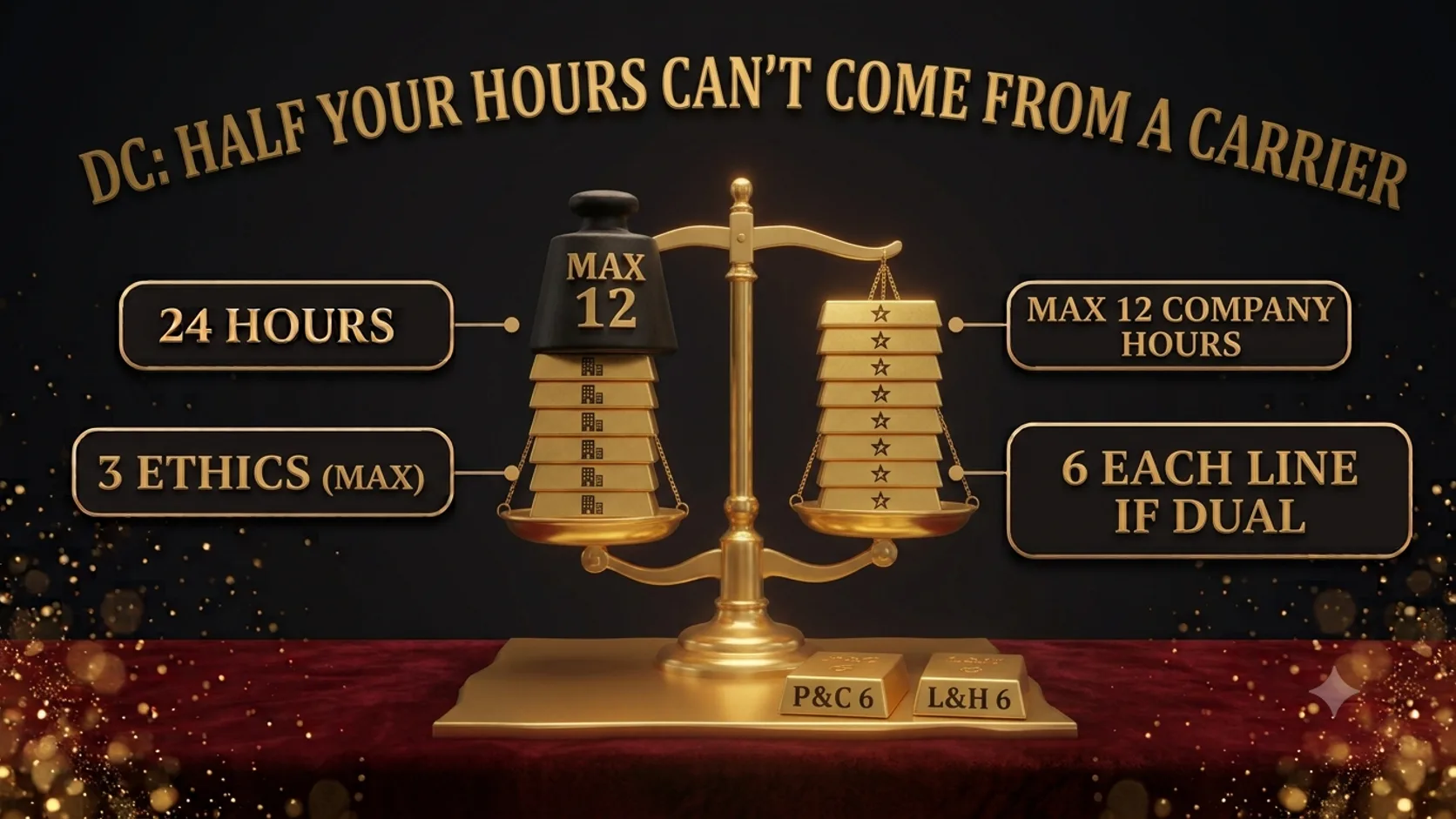
24 hours: 21 general, 3 ethics — and only 3 ethics
The District of Columbia, regulated by the Department of Insurance, Securities and Banking (DISB), requires 24 CE hours per two-year license term for producers holding a major line of authority — 21 general hours and 3 ethics hours.
DC caps the ethics contribution: no more than 3 ethics hours can be applied toward the 24-hour total. A producer who takes a 6-hour ethics course still only gets 3 hours of it credited and needs 21 genuinely general hours, which is the opposite of states that let ethics overage count as general credit.
The 50% company-course cap
No more than 50% of the 24-hour requirement — 12 hours — can come from company-sponsored courses. A producer whose carrier offers a full internal CE catalog can use it for half the requirement, and the remaining 12 hours have to come from an independent approved provider.
This is the DC-specific limit most likely to leave a captive-agency producer short, because a carrier's free catalog can look like it covers the whole requirement on paper. A producer who relied entirely on the carrier catalog would clear 24 hours and still fail the check.
The 6-hour-per-line minimum for dual-line producers
A producer who holds both a property/casualty license and a life/health license must complete a minimum of 6 hours in each line of authority. The 21 general hours cannot all be concentrated in one line.
A dual-line producer should map their transcript against both the 6-hour P&C minimum and the 6-hour L&H minimum, not just the 24-hour total, before filing the renewal.
Birth-month renewal, the 15-business-day buffer, and the lapse path
The DC license term ends on the last day of the licensee's birth month, every two years. DISB recommends completing CE within 15 business days of the expiration date to qualify for renewal, so the credits post in time.
A late renewal is possible for 30 days after expiration, with a late fee equal to double the license fee. At the end of that 30-day window the license lapses. Within 365 days of expiration the producer can still reinstate — paying a penalty of twice the unpaid renewal fee and submitting a letter swearing whether DC business was conducted during the lapse — without retaking the exam. Past one year, a new application is required.
How completions are reported, and what to keep
DC-approved providers report completions to DISB electronically, and the producer's CE record is what DISB verifies at renewal — including whether the company-sponsored portion stayed under the 12-hour cap and whether each line met its 6-hour minimum.
Note which courses came from a carrier and which from an independent provider, and keep the certificates for a few years. If DISB questions the 50% company-course cap at renewal, that record — carrier versus independent — is what settles it, and it is not something the transcript itself always makes obvious.
Non-resident producers
A non-resident licensed in DC relies on their home state's CE requirement, provided the home state has one and the producer stays in good standing there. The 24-hour count, the 50% company cap, and the per-line minimum are resident rules.
A producer unable to comply because of military service or another extenuating circumstance can request a waiver of the renewal procedures, including a waiver of the exam requirement or any penalty.
Worked example
A captive-agency producer holding both P&C and life authority has a carrier catalog that would cover all 24 hours for free. Under the 50% cap she can only count 12 of those company hours, so she takes 12 from the carrier and 12 from an independent provider.
She allocates the independent 12 as her 3-hour ethics course plus content that brings each line to at least 6 hours, and finishes three weeks before her birth-month deadline so the credits clear DISB's 15-business-day window.
The bottom line
DC's 24-hour, 3-ethics count is standard, but two limits shape the schedule: the 50% cap on company-sponsored hours and the 6-hour minimum in each line for dual-line producers. A captive-agency producer should plan for 12 hours from an outside provider, and watch the sharp 30-day cliff after expiration — past it, the license lapses.
Split the plan into a 3-hour ethics course, at least 6 hours in each line you hold, and general hours to fill the rest, with no more than 12 hours from any carrier catalog. Finish about three weeks before the birth-month deadline so the credits clear DISB's 15-business-day window, and keep proof of which courses were independent in case the company-course cap is checked.
Primary and official sources used for this guide
DC Department of Insurance, Securities and Banking — Continuing Education InformationPrimary/official source for the District's 24-hour requirement, the 3-hour ethics cap, the 50% company-course cap, the dual-line minimum, and the 15-business-day buffer.↗DC DISB — Reinstatement of LicensesOfficial source for DC's 30-day late-renewal window, the double-the-license-fee penalty, the 365-day reinstatement with a sworn business-activity statement, and the military/hardship waiver.↗Source pages can change. Check the current text and effective date before relying on a threshold, waiting period, or required form.