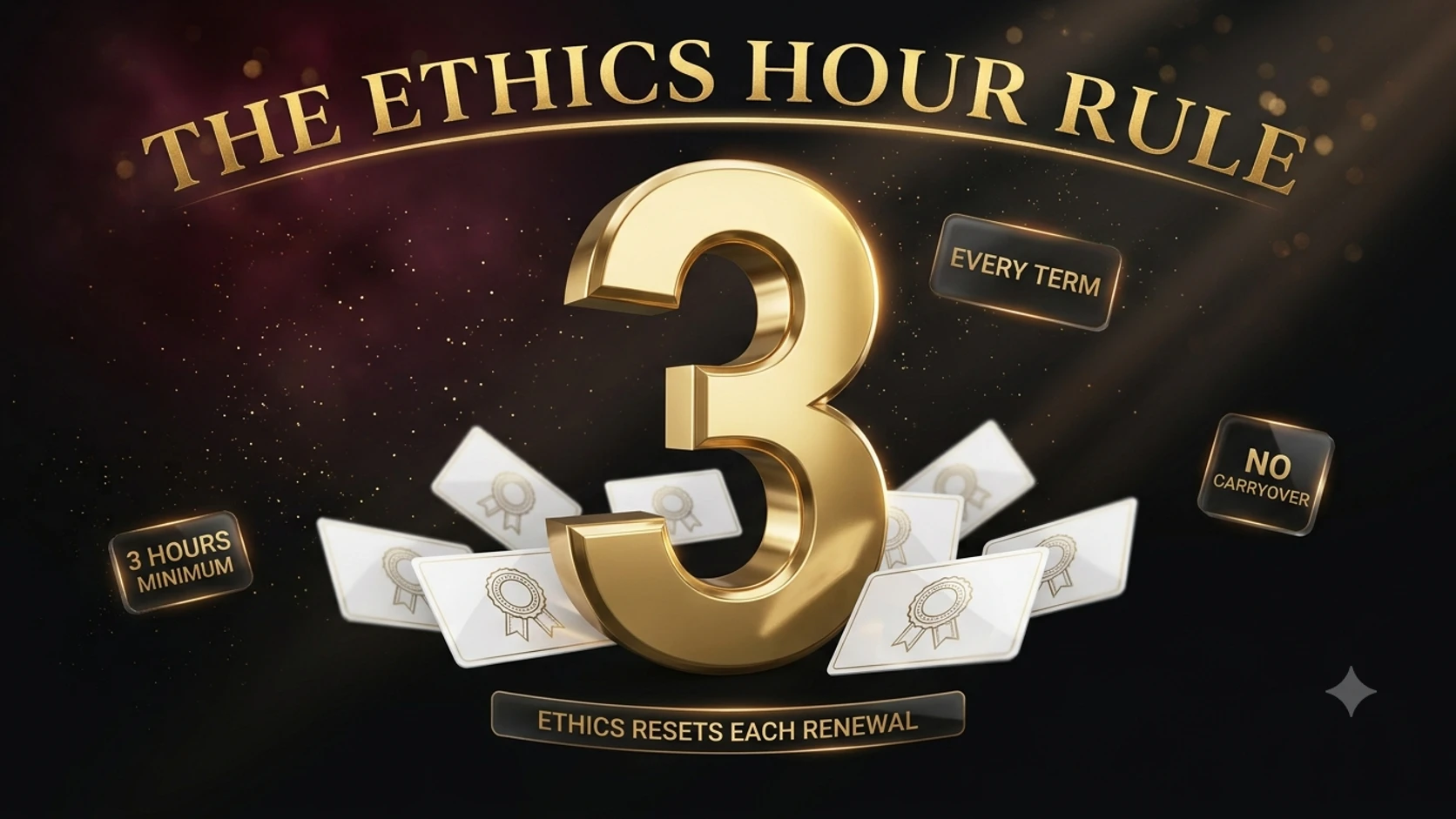
The ethics hours are a floor, not a suggestion
Most states that require continuing education carve out a specific number of hours — commonly around 3, though it varies by state — that must be completed in an ethics-designated course, separate from and in addition to satisfying the overall hour total. A producer who completes their full hour requirement entirely in product or sales training, with no ethics course at all, is not compliant even though the total-hour math looks right.
This is one of the most common late-renewal surprises: a producer tracks the total number correctly but doesn't realize the ethics portion is a distinct checkbox the state's system verifies separately.
Ethics hours reset every cycle — they don't bank forward
An ethics course completed in one renewal cycle satisfies that cycle only. It does not carry forward and reduce or eliminate the ethics requirement in the next cycle, even in states that allow producers to carry forward excess general CE hours. Treat the ethics course as a recurring line item on every renewal, not a one-time box to check.
Some states also require the ethics course to specifically reference that state's insurance code or regulatory framework rather than accepting a generic national ethics module — check whether your state's ethics requirement is state-specific before assuming any ethics-labeled course from any provider will satisfy it.
What counts as an 'ethics' course in the state's system
Course providers file their course catalog with each state's insurance department, and the state — not the provider's own marketing label — determines whether a given course is classified as satisfying the ethics sub-requirement. A course titled generically as 'professional responsibility' or 'insurance law and ethics' from an approved provider is usually the safest bet, but the classification that matters is the one on file with the regulator.
Before purchasing a course specifically to satisfy an ethics requirement, confirm through the state's CE course lookup tool (most run through Sircon or PSI) that the specific course is currently approved and coded for the ethics category, not just broadly 'CE-eligible.'
What ethics courses actually cover, and why regulators require them separately
Ethics-designated CE exists because state insurance departments have found that general product-knowledge training doesn't reliably cover the conduct-related failures that generate the most consumer complaints: misrepresentation, inadequate needs analysis, failure to disclose conflicts of interest, and mishandling of client funds or personal information. A producer can be technically expert in a product line and still commit an ethics violation, which is why nearly every state carves ethics out as its own mandatory category rather than folding it into general CE.
Typical ethics course content includes state-specific unfair trade practices statutes, fiduciary duty standards, suitability and best-interest requirements (increasingly important since the NAIC's 2020 model regulation on annuity best-interest standards was adopted by most states), data privacy obligations under state insurance information-privacy laws, and case-study discussions of real disciplinary actions taken against producers.
Because ethics hours almost universally cannot carry over between renewal periods, a producer should treat the ethics course as a recurring, non-negotiable line item on every renewal checklist rather than something to be satisfied opportunistically whenever a convenient course happens to come up. Waiting until the final weeks before a deadline to search for an ethics course is one of the more common — and avoidable — reasons producers miss compliance.
Ethics approval doesn't travel automatically between states
Producers who complete CE across multiple states should be especially careful here, since a course approved as ethics-designated in one state isn't automatically approved that way in every other state where the producer holds a license — the same underlying content may need separate state-specific approval, and a producer assuming portability across states can end up with a course that satisfies one license's ethics requirement but not another's. Checking each state's approved-course database individually, using the course's official approval number for that specific state, is the only way to be certain.
Why the 3-hour figure varies more than it first appears
The "commonly around 3 hours" ethics figure cited above hides real variation once you look state by state. New York breaks its ethics-adjacent requirement into three separate 1-hour mandatory topics (Insurance Law, Ethics/Professionalism, and Diversity, Inclusion and Elimination of Bias) rather than one combined 3-hour block. Arizona doubles it to 6 hours, proportional to its four-year renewal cycle rather than the two-year cycle most states use. Maryland caps ethics credit at exactly 3 hours and refuses to let any excess count toward the general total at all — the opposite of states that let excess ethics hours downgrade into general credit.
A producer building a CE plan around "roughly 3 hours of ethics" as a mental default should treat that figure as a starting assumption to verify against the specific state's rule, not a number to rely on directly, given how much the actual structure — total hours, topic breakdown, and carryover treatment — differs beneath that similar-sounding headline number.
Some states go further on format rather than hours: Illinois requires its 3 ethics hours to be completed live, in a classroom or real-time webinar, while self-paced online coursework — otherwise acceptable for general hours — doesn't satisfy the ethics portion specifically. Indiana ties the requirement to line of authority rather than applying it universally: property & casualty-only producers owe no ethics hours at all, while life, health, and annuity producers owe the standard 3-hour block.
The bottom line
Ethics CE isn't a formality layered on top of the real requirement — regulators consistently treat it as its own distinct, non-negotiable category precisely because conduct failures are a persistent source of consumer harm regardless of how technically skilled a producer is. Scheduling it early, every single term, is worth the small extra planning effort.
Primary and official sources used for this guide
NIPR — Understand Insurance Continuing Education RequirementsPrimary/official source describing the general ethics sub-requirement pattern across states.↗Sircon Education Lookup ToolUsed by most state insurance departments to publish approved-course status, including ethics classification.↗Source pages can change. Check the current text and effective date before relying on an hour requirement, a reporting deadline, or a course approval.
Written for licensed agents, not issued by a regulator. Insurance License CE Desk has no connection to any state department of insurance or CE provider. Hour requirements, ethics credits, and compliance deadlines are set state by state and do change, so your department of insurance, or the CE tracking vendor it uses, has the final word on what your transcript needs.