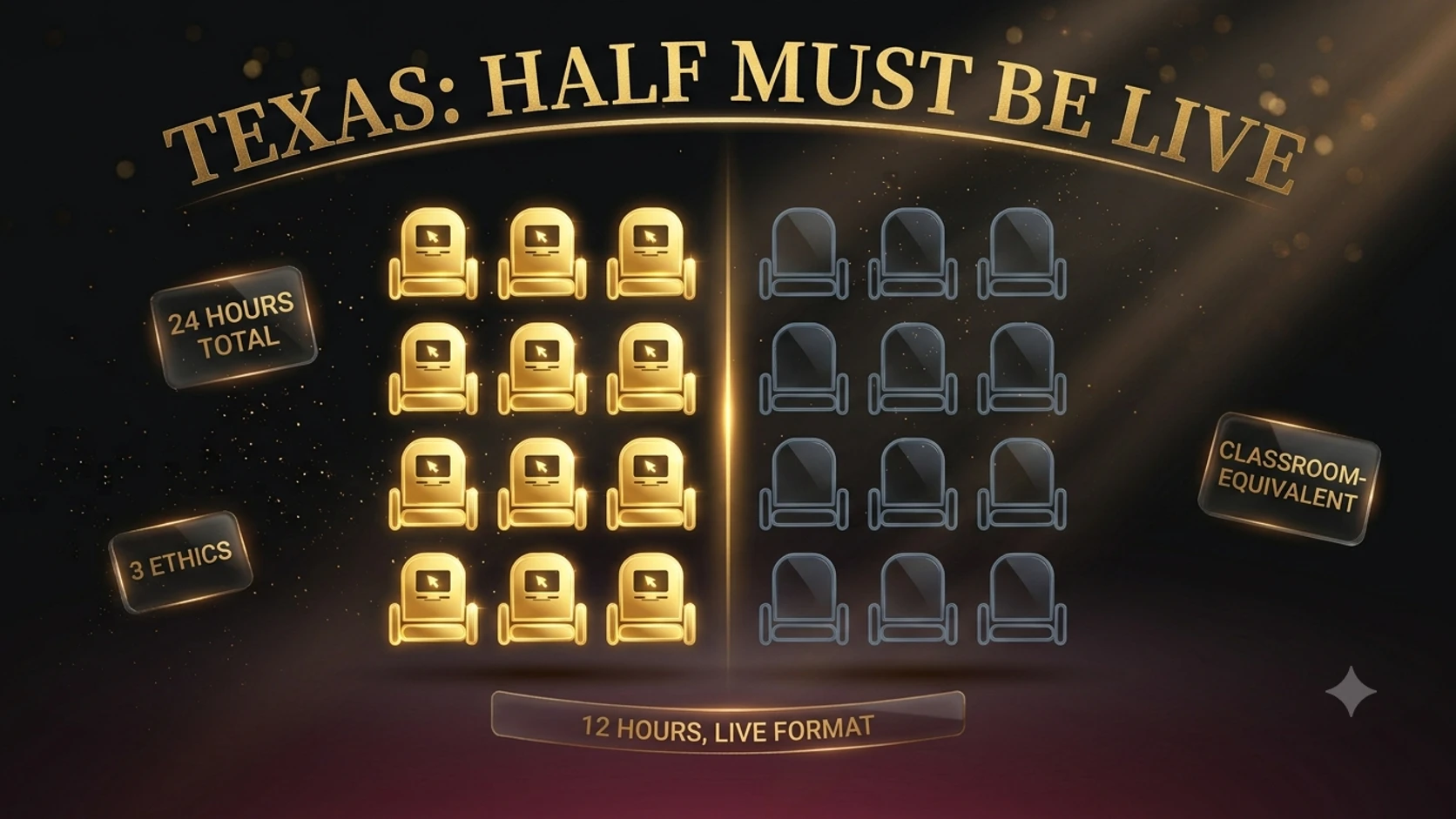
24 hours, birth-month renewal, and a classroom-equivalent floor
Texas requires resident producers to complete 24 hours of continuing education during each two-year license cycle, with the license itself renewing on the last day of the producer's birth month every two years rather than a fixed calendar date. Limited-lines license holders face a reduced 10-hour requirement for the same cycle.
A detail that trips up producers used to fully self-paced online CE in other states: Texas requires at least half of the total CE hours to be classroom or classroom-equivalent instruction, which includes approved interactive online courses but excludes purely self-paced, non-interactive formats for that half of the requirement. A producer planning to complete the entire 24 hours through the fastest self-paced course available may find that plan doesn't satisfy the classroom-equivalent minimum.
The ethics hours grew from 2 to 3 in 2022 — check which version an old source describes
The ethics and consumer-protection portion of Texas's CE requirement increased from 2 hours to 3 hours for licenses expiring on or after September 30, 2022. This did not change the overall 24-hour total — it simply reallocated how many of those 24 hours must specifically be ethics-designated. An older article or course-provider page written before that change may still describe the outdated 2-hour figure.
Confirm the current ethics-hour figure directly against the Texas Department of Insurance's own CE page rather than a course provider's marketing copy, especially if the source you're reading doesn't show a recent update date.
What happens if you miss the deadline
Failing to complete the required CE by the renewal deadline can subject a Texas producer to a fine, or to suspension, revocation, or cancellation of the license, depending on how the department handles the specific case. Texas Department of Insurance guidance recommends completing CE at least 30 days before the deadline specifically to leave time for provider reporting to post before the cutoff.
As with most states, the practical risk near a deadline isn't usually the coursework itself — it's the reporting lag between finishing a course and that completion actually appearing on the state's record.
Worked example: a property & casualty agent with a mixed course plan
An agent holding a Texas property & casualty license plans her 24-hour cycle: a 3-hour classroom-equivalent ethics and consumer-protection course, 9 additional hours of interactive online classroom-equivalent coursework (bringing her classroom-equivalent total to 12, meeting the half-of-24 minimum), and 12 hours of self-paced product-specific CE for the remainder.
She schedules everything to finish by early in her birth month rather than the actual last day, giving the standard 30-day buffer Texas recommends before the completion needs to show up on her Sircon record.
How Texas compares to its most commonly cross-shopped neighbor states
Producers licensed in both Texas and a neighboring state like Oklahoma or Louisiana sometimes assume the requirements are broadly similar given regional proximity, but the specific figures — total hours, ethics hours, and classroom-equivalent minimums — vary meaningfully state by state and should never be assumed to transfer directly. Texas's classroom-equivalent minimum in particular is a distinctive feature not shared by every neighboring state.
Non-resident reciprocity, and what happens when it doesn't exist
Texas exempts non-resident producers from its 24-hour CE structure as long as they've met their home state's CE and renewal requirements — but that exemption depends entirely on reciprocity actually existing between Texas and that home state. A handful of states don't have reciprocity with Texas, and a non-resident producer licensed in one of those states owes the full 24 hours of Texas CE each renewal period regardless of what they've completed at home.
Texas's own renewal fee is $50 per line of authority — a producer holding both property & casualty and life/health authority pays $100 total, not a single flat fee — and license renewal can be filed up to 90 days before the expiration date, giving Texas producers a wider early-renewal window than many two-year-cycle states allow.
Texas gives producers a separate 90-day post-expiration window during which the license is technically expired (and the producer cannot transact business) but can still be renewed rather than formally reinstated. Missing that 90-day window but staying within one year triggers a different, more expensive path: reinstatement requires completing outstanding CE, paying a $50 fine per deficient CE hour (capped at $500), new fingerprints, a new application, and separate application and reinstatement fees.
What Texas's ethics and classroom-equivalent rules actually require
Texas's 3-hour ethics/consumer protection requirement isn't a single generic module — approved courses must cover the Insurance Industry Code of Ethics and the state's specific legal duties governing producer conduct, unfair trade and claims practices regulated by the Texas Department of Insurance, the state's unfair claims settlement practices act, and the 'good faith' standard that governs the insurer-insured relationship, typically closing with real-world ethical-decision scenarios and a required exam rather than passive video viewing.
"Classroom-equivalent" has a specific technical meaning under Texas Department of Insurance rules rather than just implying any interactive-sounding course: qualifying online courses must enforce forced progression (no skipping ahead), timed seat-time tracking, unit quizzes requiring a minimum 70% passing score, and in some cases bio-data verification confirming the registered student is actually the one completing the material. A course that merely lets a producer read material and take one final exam — even if marketed as interactive — doesn't meet this bar and only counts toward the self-paced half of the requirement.
The bottom line
Texas's distinguishing feature — the 12-hour classroom-equivalent floor — is easy to overlook if a producer plans their CE purely around the total hour count without checking course format. Filtering specifically for classroom-equivalent designation when selecting courses is the one habit that prevents an otherwise-complete 24 hours from falling short of Texas's actual requirement, and confirming a course's TDI-approval status directly rather than trusting a provider's own "interactive" label is the safest way to avoid that shortfall.
Primary and official sources used for this guide
Texas Department of Insurance — Agent Continuing EducationPrimary/official source for Texas CE hour, ethics, and classroom-equivalent requirements.↗AgentSync — Texas Insurance Licensing & Regulatory ComplianceSecondary source for Texas's non-resident reciprocity, per-line renewal fee, and 90-day post-expiration window.↗Texas Insurance Training Academy — What If a Producer Lets Their License Lapse?Secondary source for Texas's per-hour CE fine and reinstatement process.↗Source pages can change. Check the current text and effective date before relying on an hour requirement, a reporting deadline, or a course approval.
Written for licensed agents, not issued by a regulator. Insurance License CE Desk has no connection to any state department of insurance or CE provider. Hour requirements, ethics credits, and compliance deadlines are set state by state and do change, so your department of insurance, or the CE tracking vendor it uses, has the final word on what your transcript needs.