24 hours, 3 in ethics or law
Hawaii requires 24 CE hours per two-year license term for resident producers, with 3 of those hours in ethics or insurance law. Hawaii treats ethics and law as an interchangeable category for that carve-out, so a 3-hour course on Hawaii insurance statutes and producer duties satisfies the same requirement a 3-hour ethics course would.
For a single-line producer — property/casualty only, or life/health only — that is the whole picture: 21 general hours in the licensed line plus the 3 ethics-or-law hours, in any approved format. The complexity only appears when a producer holds both major lines.
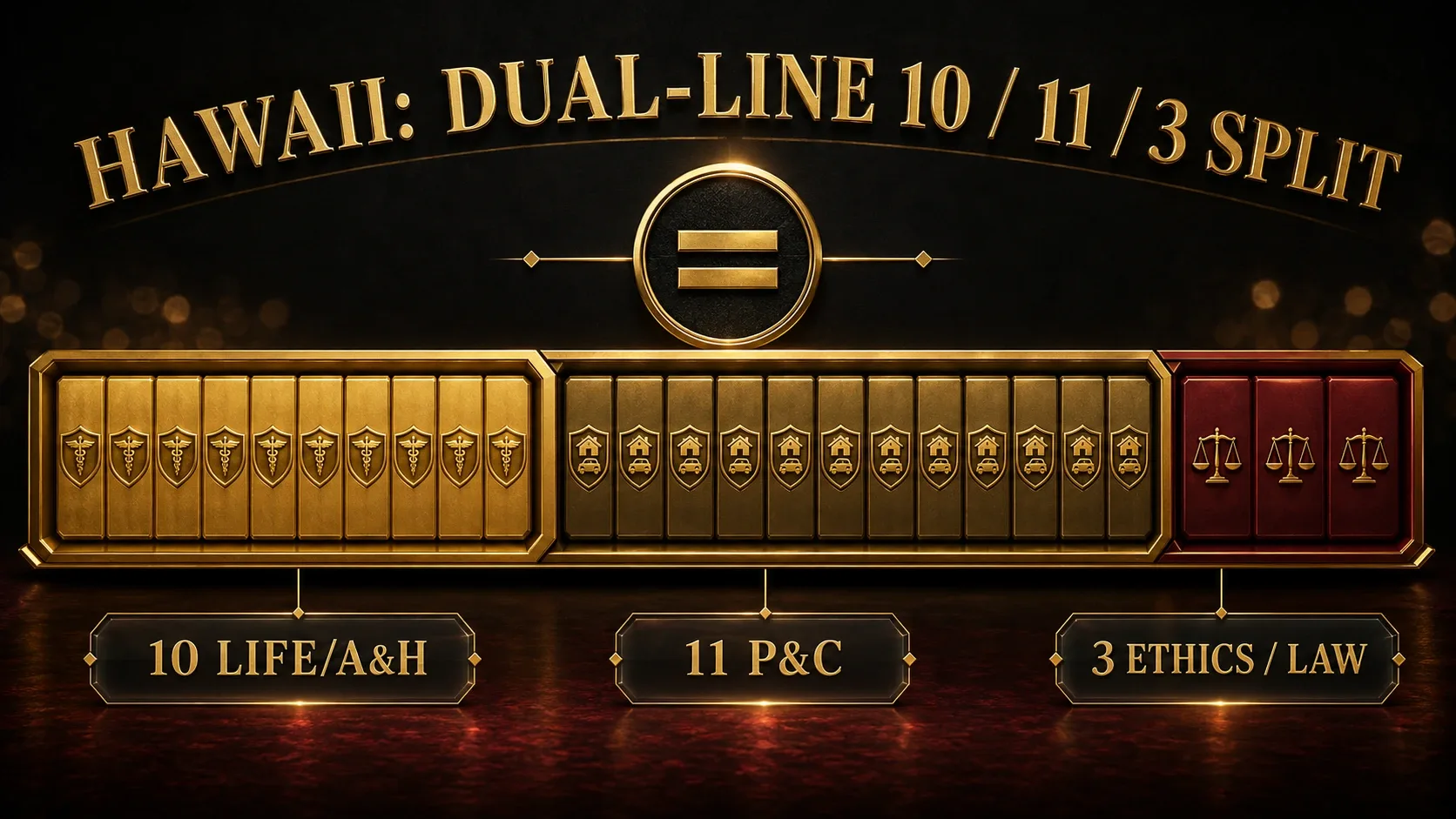
The multi-line split: 10 L&H, 11 P&C, 3 ethics or law
A producer licensed in both life/health and property/casualty cannot pool the 21 general hours freely across the two lines. Hawaii requires a specific allocation: 10 hours in life and health, 11 hours in property and casualty, and the 3 ethics-or-law hours on top, for the same 24-hour total.
This is the Hawaii-specific rule most likely to leave a dual-line producer short in one category. A transcript showing 24 total hours can still be non-compliant if, for example, all 21 general hours were P&C and the life-and-health minimum was never met. Before filing, a dual-line producer should map the transcript against both line minimums, not just the total — the state's system checks the breakdown, not the sum.
The birth-month cycle and the 15-day buffer
The Hawaii license comes up for renewal in the licensee's birth month every two years, with the odd/even calendar year keyed to the birth month: a producer whose birthday falls in an even-numbered month renews in even years, and an odd-numbered birth month renews in odd years. The Insurance Division system assigns the exact day within that month, so a producer should read it off the license record rather than assume the last day.
Hawaii requires CE to be completed no later than 15 days before the renewal due date. A producer who finishes inside that 15-day window may be unable to renew electronically, may see the license drop to inactive status, and can face a penalty fee to reactivate — a self-inflicted lapse purely from cutting the timing close.
No carryover, no repeats, and the exemptions
Hawaii does not allow excess CE credit to carry forward, and a course may not be taken more than once inside the same two-year term.
An individual holding only a limited license, or a resident producer who has been licensed less than two years at the time of their first renewal, is exempt from the requirement. Non-resident producers in good standing with their home state are also exempt under standard reciprocity. Everyone else — the large majority of resident producers — owes the full 24 with the line split.
If the license lapses
Hawaii has no grace period and no ordinary late renewal: a producer who misses the deadline is lapsed the next day and cannot transact insurance business. The base renewal fee is $90, and a late renewal, where allowed at all, runs $270.
A lapsed producer has one year from the expiration date to reinstate by completing all outstanding CE and paying a $200 reinstatement penalty — roughly $300 with the renewal fee. Miss the one-year window and the only path is to relicense from the start, including the exam. There is no partial-credit reinstatement after that point.
How completions are reported, and what to keep
Hawaii-approved providers report completions to the Insurance Division electronically, and the producer's CE record is what the Division verifies at renewal. Because the 15-day pre-renewal cutoff is enforced on the reported date, a producer needs providers to have reported — not just to have finished the course — with time to spare.
A misreported course matters more in Hawaii than in most states: filed under the wrong line, it can throw off the 10-hour life-and-health or 11-hour property-and-casualty minimum even when the 24-hour total is right. Keep every course certificate for a few years, and at renewal read the line-by-line breakdown on the Insurance Division record rather than trusting the total.
Non-resident producers
A non-resident whose home state has its own CE requirement meets Hawaii's obligation by staying compliant there. The 24-hour count, the 10/11 line split, and the ethics-or-law carve-out are all resident rules that do not apply on top of home-state compliance.
The reciprocity covers the general requirement. Product-specific training tied to a Hawaii sale should still be confirmed against a current Insurance Division bulletin before relying on a home-state course to cover it.
Worked example
A producer licensed in both L&H and P&C, born in June of an even year, renews in June of even years. She plans: a 3-hour ethics-or-law course, 11 hours of P&C content, and 10 hours of L&H content — hitting each line minimum exactly, for 24 total.
She schedules the last course for late April, comfortably outside the 15-day pre-renewal window, so the credits post to her Insurance Division record without forcing a paper renewal or a reactivation fee. In early June she checks the record to confirm both line totals show correctly before she files.
The bottom line
Hawaii's 24-hour, 3-ethics-or-law count is standard, but the 10/11 line split for dual-line producers is the trap — a full 24 hours concentrated in one line fails. Add the no-grace-period reinstatement path and the 15-day pre-renewal cutoff, and Hawaii rewards a producer who maps hours to both lines and finishes well ahead of the birth-month deadline.
Primary and official sources used for this guide
Hawaii Department of Commerce and Consumer Affairs — Producers Continuing EducationPrimary/official source for Hawaii's 24-hour requirement, the multi-line 10/11 split, ethics-or-law carve-out, and the 15-day buffer.↗Hawaii Insurance Division — How to Apply for, Reinstate or Reactivate an Insurance LicenseOfficial source for Hawaii's renewal and late fees, the no-grace-period rule, and the one-year reinstatement window with the $200 penalty.↗Source pages can change. Check the current text and effective date before relying on a threshold, waiting period, or required form.