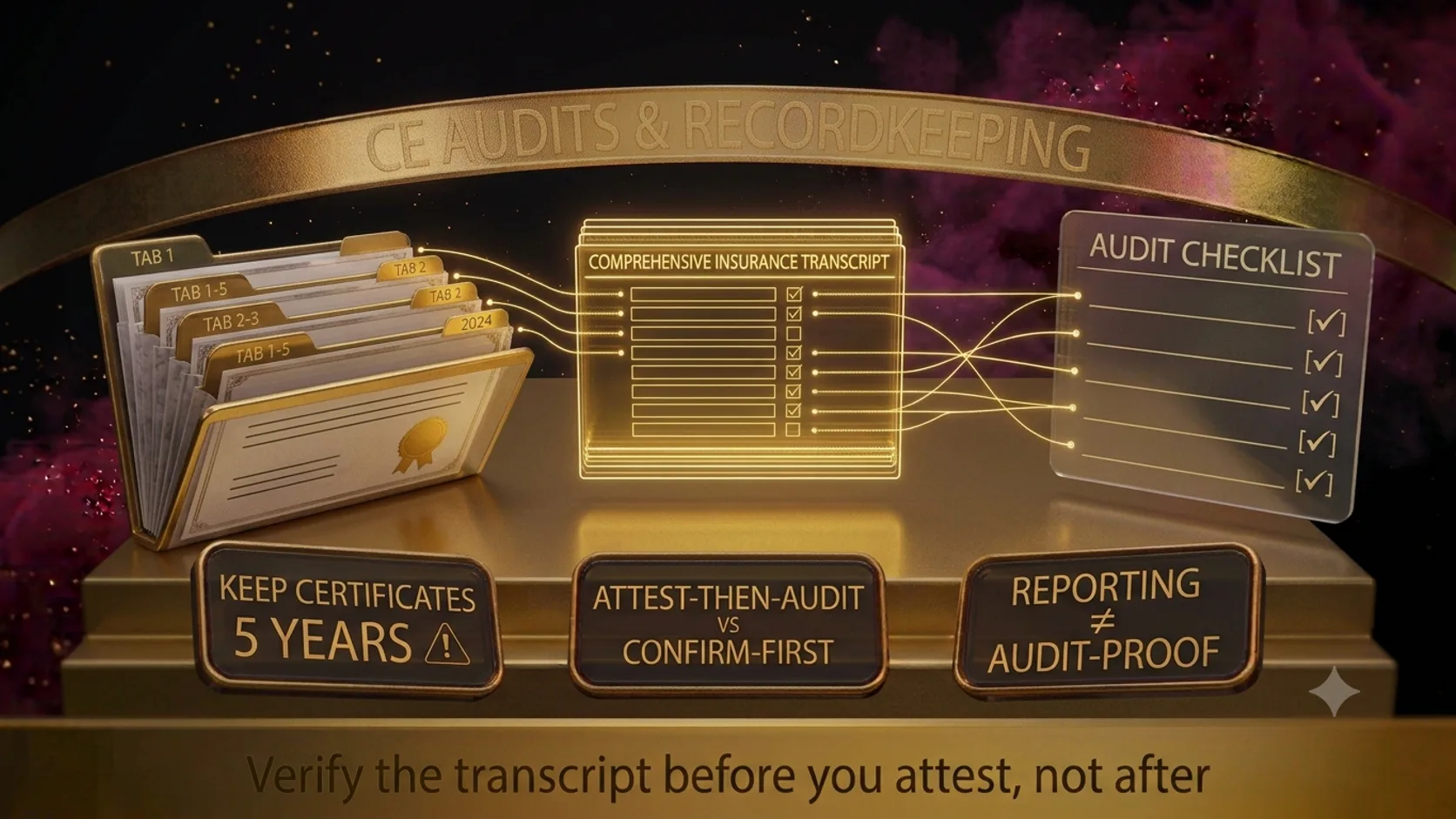
Electronic reporting is not the same as being audit-proof
In most states today, an approved CE provider reports each completion to the state through Sircon or the NIPR Producer Database within a few business days. That feed is what populates a producer's CE transcript and what a renewal system checks automatically.
It does not eliminate the producer's own recordkeeping duty. Departments still reserve the right to audit a license — to ask the producer to produce evidence that the hours on the transcript actually happened. A provider that closed, a completion that never transmitted, or a data error can all leave the transcript wrong, and the producer is the one who has to fix it.
Keep your certificates — five years is the common benchmark
Guidance from multiple departments points to the same practice: keep each course's certificate of completion for at least five years. That mirrors the retention period providers are typically required to maintain their own attendance records, so the two sets of records line up if an audit compares them.
A certificate should show the producer's name and license number, the course title and approval number, the provider, the completion date, and the credit hours by category. A screenshot of a transcript is not a substitute — the certificate is the primary document a department asks for.
Two ways states verify at renewal
Some states require the producer to attest to CE compliance at renewal and then audit a sample of licenses afterward, asking the selected producers to submit certificates. Others require certificates to be uploaded or CE to be confirmed compliant in the system before the renewal will process at all.
A producer should know which model their state uses. In an attest-then-audit state, a renewal can go through while the CE record is actually short, and the problem surfaces months later during the audit — with penalties attached. In a confirm-before-renewal state, the shortfall blocks the renewal immediately, which is unpleasant but at least visible.
What an audit finding actually costs
If an audit shows a producer was short on hours at renewal, the consequences generally include completing the missing CE, a fine or administrative penalty, and sometimes a probationary notation on the license. If the shortfall was because a provider failed to report, the producer still has to prove completion — the certificate is what saves them.
A finding that a producer renewed while non-compliant is more serious than simply missing a deadline, because the renewal attestation is a signed statement. A shortfall discovered afterward can draw a separate penalty for the inaccurate attestation on top of the penalty for the missing hours.
Provider audits run in parallel
States also audit CE providers and instructors directly — observing courses, reviewing materials, and checking that reported completions match attendance records. A provider that loses approval, or whose course is retroactively disqualified, can invalidate hours producers already relied on.
A producer cannot control this, but choosing established providers with long-standing multi-state approvals reduces the risk of taking a course that later gets pulled. Keeping the certificate matters here too: it documents that the producer completed an approved course in good faith at the time.
Worked example: a producer selected for audit
Eight months after renewing, a producer receives an audit notice asking for certificates for all 24 hours claimed. Twenty-one hours match cleanly. For one 3-hour course, the provider's report never reached the state, so the transcript shows only 21.
Because the producer kept the certificate of completion, she submits it, the department credits the 3 hours, and the audit closes with no penalty. A producer without the certificate would have had to retake a course and likely pay a fine for renewing while the record showed a shortfall.
A recordkeeping checklist
- Download and save the certificate of completion for every CE course, not just the transcript
- Keep certificates at least five years, matching the provider retention period
- Confirm each certificate shows your license number, the approval number, hours by category, and the date
- Pull your Sircon/NIPR transcript before you attest to compliance at renewal, not after
- Know whether your state audits after renewal or confirms compliance before processing it
- Favor established multi-state providers to reduce the risk of a course losing approval later
The bottom line
Electronic reporting made CE tracking easier but did not transfer the recordkeeping duty away from the producer. Keep every certificate of completion for five years, verify the transcript before attesting at renewal, and an audit becomes a paperwork exercise rather than a fine. The producers who get penalized are almost always the ones who trusted a transcript they never checked.
Primary and official sources used for this guide
Washington Office of the Insurance Commissioner — Procedures, Reporting, and RecordkeepingOfficial source on provider reporting timelines and the five-year attendance-record retention requirement.↗California Department of Insurance — Certificate of Completion FAQStates that the licensee should retain the certificate of completion for at least five years for verification.↗NAIC — State Licensing Handbook, Chapter 14 (Continuing Education)Describes state CE audit and provider-oversight practices and the licensee's verification responsibility.↗Source pages can change. Check the current text and effective date before relying on an hour requirement, a reporting deadline, or a course approval.
Written for licensed agents, not issued by a regulator. Insurance License CE Desk has no connection to any state department of insurance or CE provider. Hour requirements, ethics credits, and compliance deadlines are set state by state and do change, so your department of insurance, or the CE tracking vendor it uses, has the final word on what your transcript needs.