Both the course and the provider have to be approved
A CE course earns credit in a given state only when that state has approved both the course itself and the provider offering it. A course approved in one state is not automatically approved in another — though under the NAIC reciprocal approval process, a course a provider's home state has substantively reviewed is generally accepted by other member states unless it conflicts with their law.
This is why a producer should confirm a course carries an approval number for the specific state and license type they need before enrolling. A course approved for property and casualty in a state does not necessarily carry life and health approval there, and a nationally marketed course may simply not be filed in a particular state.
What counts as the 'same course'
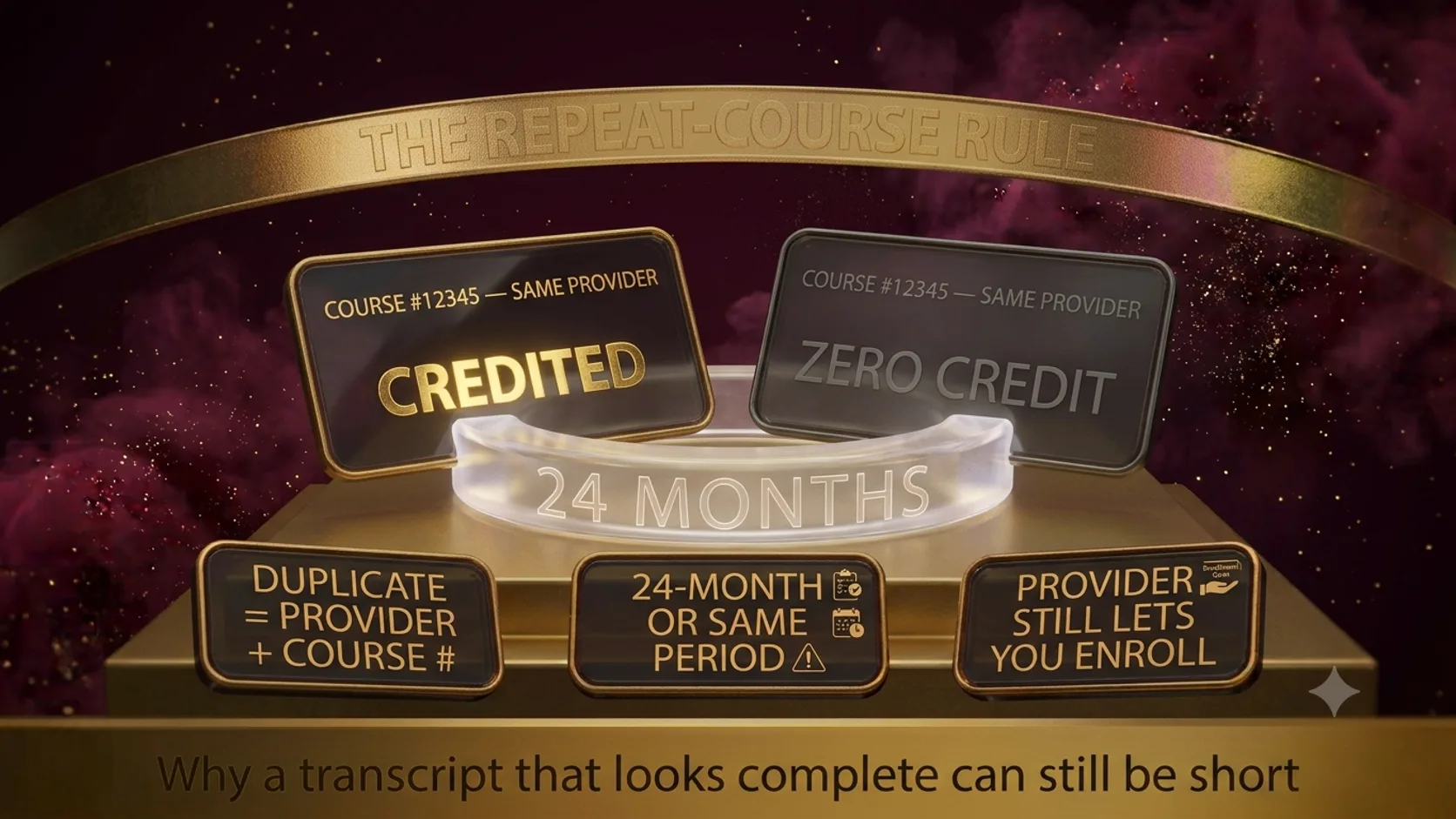
States generally define a duplicate by the combination of provider and course number, not by topic. Two different providers can offer courses on the same subject and a producer can take both for credit. The same provider's same course number, taken twice inside the restricted window, is what triggers the block.
This matters because providers reuse and lightly revise courses. A producer who takes 'Ethics for Producers, Course #12345' in one cycle and sees a similarly named course the next cycle should check the course number — if it is the same number, credit may be denied even though the material was refreshed.
The window: 24 months or the same renewal period
Florida does not allow CE credit for the same course completed within 24 months, even if the completion shows on the transcript. Oklahoma applies the same 24-month restriction. North Carolina frames it as no repeat for credit within the same renewal period.
The practical difference is small but real. A 24-month rule is a rolling window measured from the prior completion date; a same-period rule resets cleanly at the renewal boundary. A producer near a renewal date who retakes a course completed early in the previous cycle may be fine under a same-period rule and blocked under a rolling 24-month rule.
How a repeat quietly costs you hours
The danger is that a provider's system will often let a producer enroll in and complete a course they already took, and the completion posts to the transcript. The state's compliance engine, not the provider, is what strips the duplicate when it evaluates the renewal.
So a producer can look at a transcript showing 24 hours, feel compliant, and be short because 3 of those hours were a disallowed repeat. The gap only surfaces when the state processes the renewal or during a CE audit — often too late to fix comfortably before the deadline.
Where repeats are allowed
Retaking a course across different, non-adjacent compliance periods is generally fine once any time-based restriction has passed. A course completed two cycles ago can usually be taken again now for credit.
Some course types are also structurally exempt from the concern because they are designed to be repeated — a state's annual law update, for example, changes content each year and carries a new course number each time, so taking 'the update course' every cycle is not a duplicate.
Worked example: catching a repeat before renewal
A producer in a 24-month-rule state pulls his CE transcript six weeks before renewal. It shows 24 hours. Checking course numbers against the prior cycle, he finds a 4-hour course with the same provider and course number he completed 20 months earlier — inside the 24-month window.
He treats himself as having 20 creditable hours, not 24, and enrolls in a different 4-hour course from another provider to close the gap. Because he checked early, the fix is routine rather than a scramble.
A course-approval checklist
- Confirm the course carries an approval number for your state and your license type before enrolling
- Record the provider name and course number for every CE course you complete
- Before retaking anything, check whether the same provider/course number falls inside your state's window
- Know whether your state uses a rolling 24-month rule or a same-renewal-period rule
- Pull your transcript well before renewal and compare course numbers against the prior cycle
- Treat recurring law-update courses as non-duplicates — they carry new course numbers each year
The bottom line
CE credit depends on approved course plus approved provider, and most states will not pay you twice for the same provider-and-course-number inside a 24-month or same-period window. Because the provider's system usually lets you complete a repeat anyway, the shortfall hides on a transcript that looks complete. Checking course numbers against the prior cycle is a five-minute habit that prevents it.
Primary and official sources used for this guide
NAIC — Continuing Education Reciprocity (reciprocal course approval)Explains reciprocal course approval and why a course must be approved for the state and line where credit is claimed.↗Washington Office of the Insurance Commissioner — Continuing Education RequirementsOfficial source on approved-course and approved-provider requirements and how credit is evaluated.↗OLTraining — How Florida Insurance Professionals Avoid Taking the Same CE Course TwiceDescribes how Florida defines a duplicate by provider and course number and the 24-month restriction.↗Florida Department of Financial Services — Continuing EducationPrimary source for Florida's rule denying credit for the same course within 24 months.↗Oklahoma Insurance Department — License CE RequirementsPrimary source for Oklahoma's 24-month no-repeat restriction.↗Source pages can change. Check the current text and effective date before relying on an hour requirement, a reporting deadline, or a course approval.
Written for licensed agents, not issued by a regulator. Insurance License CE Desk has no connection to any state department of insurance or CE provider. Hour requirements, ethics credits, and compliance deadlines are set state by state and do change, so your department of insurance, or the CE tracking vendor it uses, has the final word on what your transcript needs.