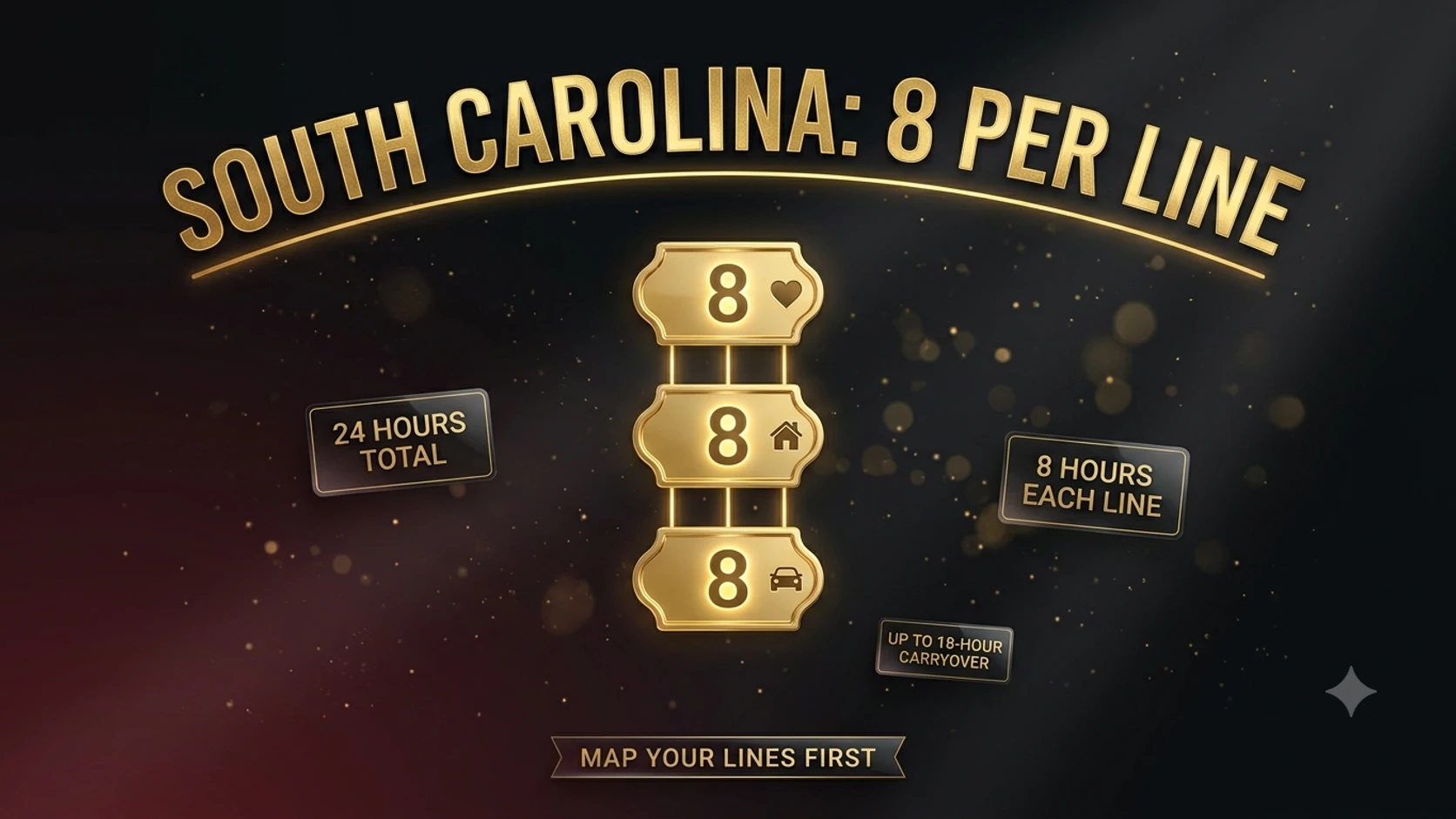
24 hours baseline, then an 8-hour-per-line add-on for multi-licensed producers
South Carolina requires producers to complete 24 hours of continuing education every two years, including 3 hours of ethics — matching the common baseline structure. For resident producers holding multiple lines of authority specifically, South Carolina adds a structural requirement on top: a minimum of 8 hours in each line of authority held, in addition to the required 3 hours of ethics, to be considered compliant.
This is conceptually similar to Maryland's 6-hours-per-line rule and Virginia's 8-hours-per-line rule for multi-licensed producers, though the specific hour figure (8, matching Virginia's number rather than Maryland's 6) needs to be confirmed against South Carolina's own rule directly rather than assumed from a neighboring state's structure.
Ethics hours don't carry over
South Carolina's 3-hour ethics requirement must be completed fresh every two-year renewal; ethics credits do not carry over to satisfy a future term's ethics obligation. A maximum of 18 credit hours can be carried over into the next license term for general purposes — a notably generous carryover cap, higher than the 12-hour caps common in many neighboring states.
This carryover generosity somewhat offsets the added per-line requirement for multi-licensed producers, since a producer who completes extra hours in one line during a lighter term can bank a meaningful cushion (up to 18 hours) toward a future term's general requirement.
Renewal timing tied to birth-year parity
South Carolina's license term ends on the last day of the licensee's birth month, based on birth-year parity: producers born in an even-numbered year must comply by the end of their birth month in even-numbered years, and producers born in an odd-numbered year comply in odd-numbered years — the same birth-year-parity structure used by North Carolina and Michigan.
As with most states covered on this site, all CE credit hours must be completed BEFORE the license renewal application is actually submitted.
Worked example: a producer with three lines of authority
A South Carolina producer holds life, health, and property & casualty authority — three separate lines. Beyond her standard 3-hour ethics requirement, she must complete at least 8 hours specific to each of those three lines, meaning at minimum 24 hours (8 × 3) just from the per-line requirement, before even counting her ethics hours separately.
In practice, her per-line minimums alone (24 hours) essentially consume her entire general 21-hour allotment (24 total minus 3 ethics), leaving her with little room for general or miscellaneous coursework outside her three specific lines — she plans her CE almost entirely around line-specific courses rather than general topics.
Checklist for multi-licensed South Carolina producers
Count your active lines of authority first, then multiply by 8 to find your per-line hour floor, and add the fixed 3-hour ethics requirement — this combined total, not the flat 24-hour headline figure, is your real target if you hold more than one line.
- 24 total CE hours per two-year term (single-line baseline)
- 3 hours ethics, fresh every term
- 8 hours minimum per line of authority for multi-licensed producers
- Up to 18 excess general hours may carry forward
- Complete all hours before submitting the renewal application
How the per-line minimum compares across neighboring states
South Carolina's 8-hours-per-line minimum for multi-licensed producers sits at the stricter end of the per-line-requirement spectrum among the states covered on this site — matching Virginia's 8-hour figure but exceeding Maryland's 6-hour figure — meaning a South Carolina producer holding several lines faces a comparatively larger structural constraint on how their 24-hour total can be allocated.
For a producer holding exactly two lines of authority, the 8-hours-per-line minimum (16 hours total across both lines) still leaves meaningful room within the 24-hour total for general or flexible coursework after accounting for the fixed 3-hour ethics requirement — a comfortable margin that shrinks quickly once a third or fourth line enters the picture.
South Carolina's Department of Insurance course-search tool allows filtering by line of authority, which is the most direct way for a multi-licensed producer to confirm they're tracking toward each line's 8-hour minimum separately rather than assuming a broad mix of general coursework will automatically satisfy the per-line allocation requirement.
Non-resident producers: reciprocity, plus a $15 record-keeping fee
A non-resident South Carolina producer generally doesn't need to separately satisfy the 8-hours-per-line structure described above — meeting a home state's CE requirement, including reciprocal treatment for Suitability and Best Interest annuity training completed elsewhere, generally satisfies South Carolina's requirement instead. That reciprocity comes with a modest administrative cost: non-resident producers pay a $15 record-keeping fee to South Carolina alongside confirming their home-state compliance, rather than a fee-free pass-through.
Producers should also note that South Carolina's own renewal fee for residents is a comparatively low $25, and licenses can be renewed any time within a 90-day window before expiration — a wider early-renewal window than the tighter pre-deadline buffers required in states like Michigan or Minnesota.
The separate annuity training requirement layered on top
South Carolina adds one more product-specific obligation beyond the 8-hours-per-line structure described above: producers must complete a one-time 4-hour Annuity Suitability and Best Interest course before selling any annuity product, followed by a 4-hour refresher every 24 months from that initial completion. Producers who completed an equivalent Suitability or Best Interest course in another state — even a shorter 1-hour version under an older standard — are generally considered reciprocal in South Carolina, provided that other state's training is substantially similar to South Carolina's own standard.
The bottom line
South Carolina's 8-hours-per-line minimum for multi-licensed producers becomes a meaningfully larger constraint the more lines a producer holds, and mapping out the per-line math before selecting courses prevents the kind of late scramble that can happen when a producer discovers, close to their deadline, that their coursework wasn't distributed the way the rule requires.
South Carolina producers should also double-check how the state treats a course that reasonably covers content relevant to more than one line simultaneously, since it isn't always obvious whether such a course can count toward more than one line's 8-hour minimum at once or must be allocated to only one.
Primary and official sources used for this guide
South Carolina Department of Insurance — Continuing EducationPrimary/official source for South Carolina's per-line CE requirement for multi-licensed producers.↗NIPR — South Carolina Resident Renewal (Individual)Secondary source for South Carolina's renewal fee, 90-day renewal window, and non-resident reciprocity fee.↗South Carolina Department of Insurance — Providers Offering Annuity Suitability Training CoursesPrimary/official source for South Carolina's 4-hour annuity Suitability and Best Interest training requirement.↗Source pages can change. Check the current text and effective date before relying on an hour requirement, a reporting deadline, or a course approval.
Written for licensed agents, not issued by a regulator. Insurance License CE Desk has no connection to any state department of insurance or CE provider. Hour requirements, ethics credits, and compliance deadlines are set state by state and do change, so your department of insurance, or the CE tracking vendor it uses, has the final word on what your transcript needs.