Carryover is a state-by-state privilege, not a default
Carryover — sometimes called banking — lets a producer apply hours earned beyond a cycle's requirement to the next cycle's total. It exists to reward producers who overshoot and to smooth out an uneven course schedule, but many states do not offer it.
When a state does allow it, the carried hours almost always land as general credit only. They reduce the number of flexible hours owed next cycle; they do not pre-satisfy ethics, state-law, or other mandatory carve-outs.
The states that allow it — and their caps
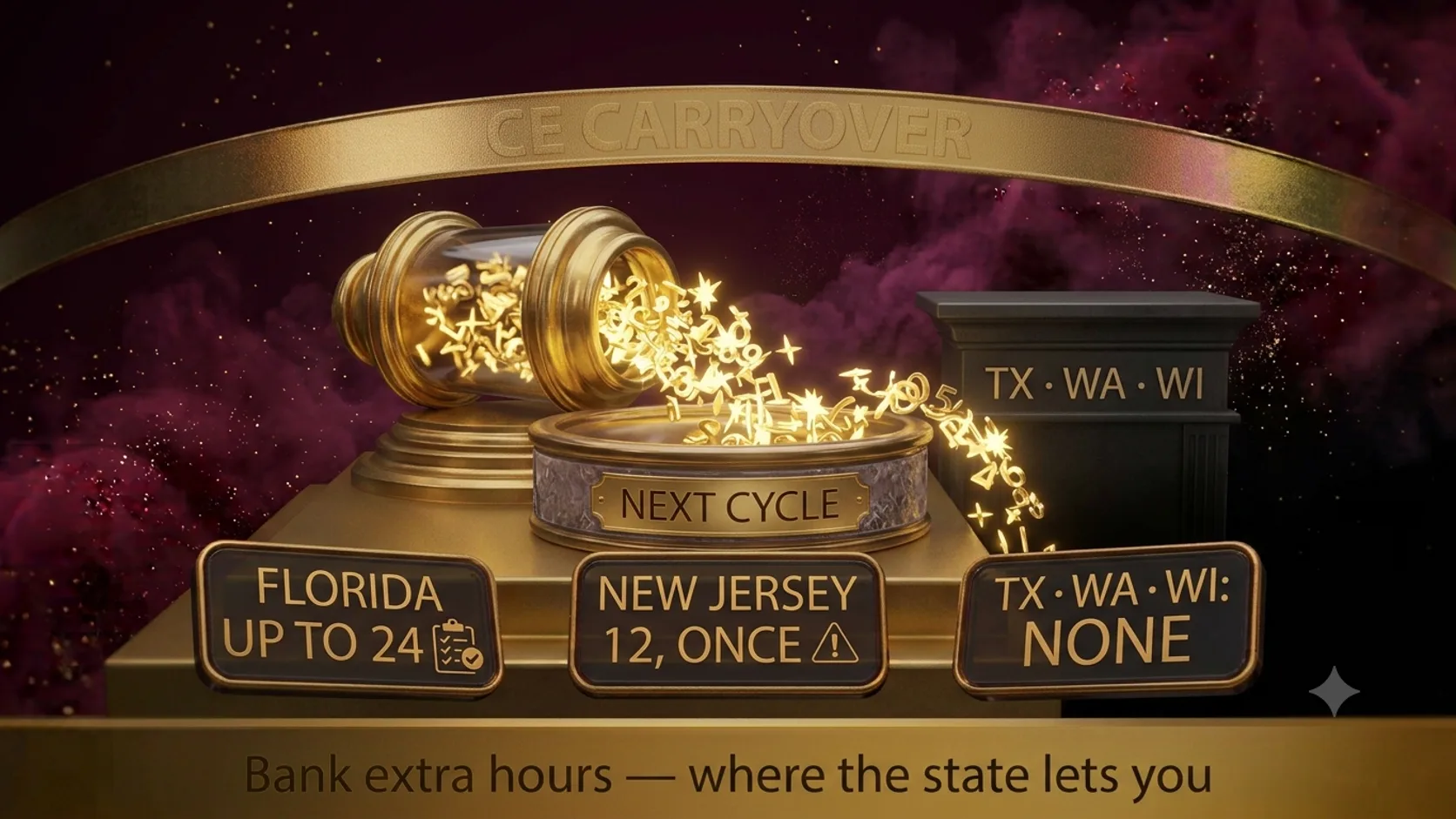
Florida permits up to 24 excess hours to carry into the next reporting period. New Jersey, effective June 19, 2023, allows up to 12 excess hours to carry forward — but only once, so they cannot be re-banked indefinitely, and ethics hours are excluded. Michigan's carryover authority came from Public Act 67 of 2017 and lets additional hours move from the current review period to the next. California and Illinois also allow excess hours to be banked.
Several state guides on this site note smaller caps: Kentucky allows up to 12 carried as general credit, and Oklahoma allows up to 6. The pattern is that the cap is usually a fraction of the total requirement, and the carried hours are general only.
The states that allow none
Texas does not permit carryover — excess hours completed in one reporting period cannot move to the next. Washington also does not allow carryover of excess credit. Wisconsin requires all 24 credits to be completed within the current two-year reporting period, with no banking.
In a no-carryover state, there is no downside to finishing early but no benefit to finishing heavy. A producer who completes 30 hours in a cycle has met the requirement and lost 6 hours of effort as far as the next cycle is concerned.
Why ethics hours almost never carry
States treat the ethics requirement as a recurring obligation to revisit current standards, not a quantity to stockpile. So even in generous carryover states, an ethics course completed in excess of the requirement does not reduce next cycle's ethics obligation — the producer still takes a fresh ethics course.
The same logic usually applies to state-law update courses and to specialty training tied to a product line. Carryover is a general-hours mechanism; the carve-outs stand on their own each cycle.
The one-time limit and other fine print
New Jersey's rule that carried hours can only move forward once is worth generalizing: even where carryover exists, states guard against a producer building a permanent buffer. Hours carried from cycle one into cycle two generally cannot then be carried from cycle two into cycle three.
Some states also require the excess hours to have been genuinely completed within the earlier cycle's dates — hours completed after a cycle closed but before the transcript was evaluated may count toward the new cycle rather than carrying back. A producer relying on carryover should confirm the completion dates fall where they think they do.
Worked example: a producer licensed in a carryover state and a non-carryover state
A producer holds a resident license in Florida and a non-resident license in Texas. In one cycle she completes 40 hours of CE because a good conference happened to line up. Florida lets her carry 16 of the 24 excess hours (capped at 24, but she only has 16 above the amount she needs) into the next Florida cycle as general credit.
Texas gives her nothing for the overage — its no-carryover rule means her next Texas cycle starts at zero. She plans accordingly: the heavy year helps her Florida planning but changes nothing about what she owes Texas next time.
A carryover checklist
- Confirm whether your state allows carryover at all before counting on it
- Note the cap — commonly a fraction of the total requirement (Florida 24, New Jersey 12, Oklahoma 6)
- Assume carried hours are general credit only — plan to retake ethics and state-law courses each cycle
- Check whether your state limits carryover to one move forward
- In a no-carryover state (Texas, Washington, Wisconsin), do not over-complete expecting a benefit
- Verify the excess hours' completion dates fall inside the cycle you are carrying from
The bottom line
Carryover is real but narrow: a capped number of general-only hours, often movable just once, and unavailable entirely in states like Texas, Washington, and Wisconsin. It is a nice cushion where it exists, but never a substitute for taking a fresh ethics course and any state-law course every single cycle.
Primary and official sources used for this guide
Michigan DIFS — Insurance Licensee Continuing Education (CE) Carryover FAQOfficial explanation of Michigan's carryover authority under Public Act 67 of 2017.↗New Jersey — Insurance Continuing Education State Requirements (AOI)Describes New Jersey's 12-hour, one-time, no-ethics carryover effective June 19, 2023.↗AD Banker — Florida Insurance CE Requirements & RenewalStates Florida's allowance of up to 24 excess hours carried into the next reporting period.↗Success CE — Washington Insurance CE RequirementsConfirms Washington does not allow carryover of excess CE credit hours.↗CE Wisconsin — Wisconsin Insurance CE Rules & RequirementsConfirms Wisconsin does not permit carryover; all 24 credits must fall in the current period.↗Source pages can change. Check the current text and effective date before relying on an hour requirement, a reporting deadline, or a course approval.
Written for licensed agents, not issued by a regulator. Insurance License CE Desk has no connection to any state department of insurance or CE provider. Hour requirements, ethics credits, and compliance deadlines are set state by state and do change, so your department of insurance, or the CE tracking vendor it uses, has the final word on what your transcript needs.