24 and 3 for producers, a lighter track for Service Representatives
Alabama licensed producers are required to take 24 hours of continuing education, including 3 hours of ethics, every two-year license term. Alabama also maintains a distinct, lighter license category — Service Representatives — who face a reduced requirement of 12 hours, including 2 hours of ethics, for the same two-year term. This is a genuinely separate license type with its own CE track, not simply a discount for a subset of producers.
A producer confirming their Alabama CE obligation should first verify which specific license category applies to them, since the Service Representative track's numbers (12 hours, 2 ethics) are meaningfully different from the standard Producer track (24 hours, 3 ethics).
A first-year exemption most new producers don't know exists
Producers who have been licensed for less than 12 months at the time of their first renewal are exempt from Alabama's CE requirement for that renewal. This gives genuinely new producers a real grace period on their very first renewal cycle, rather than requiring a full 24-hour (or 12-hour, for Service Representatives) completion within their first partial year of practice.
This exemption applies specifically to the first renewal only — a producer shouldn't assume any ongoing 'new producer' leniency extends beyond that initial cycle.
The 15-years-and-60 senior exemption
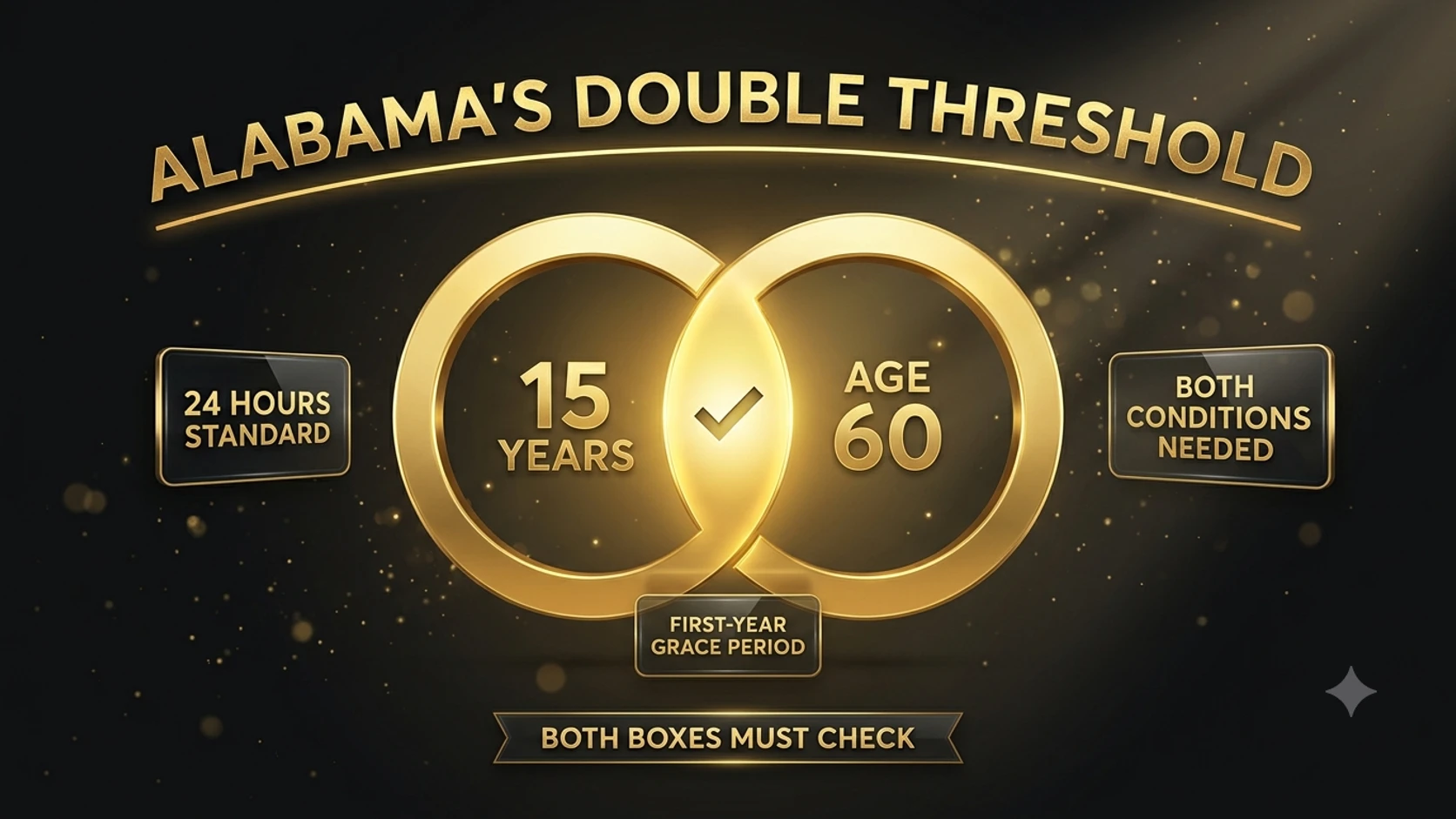
Producers licensed in Alabama for 15 years and who are at least 60 years of age are exempt from the CE requirement entirely. This combines a tenure threshold (15 years) with an age threshold (60), distinct from Georgia's pure 20-year tenure-based reduction, Maryland's pure 25-year tenure-based reduction, or Missouri's pure age-70 exemption — Alabama requires both conditions to be met simultaneously, not either one alone.
A producer who reaches 15 years of Alabama licensure at age 55, for example, would not yet qualify for this exemption until also reaching age 60 — the two conditions need to be satisfied together, not on an either/or basis.
Non-resident reciprocity exemption, no carryover, no repeats
Non-residents of reciprocal states who have met their home state's CE requirements are also exempt from Alabama's separate CE requirement — a straightforward reciprocity provision consistent with the general resident-vs-non-resident CE pattern described broadly across states on this site. Alabama does not allow excess credits to carry forward into the next licensing period, and producers cannot take a course more than once within a two-year license term for credit.
Worked example: checking exemption eligibility before assuming a requirement
An Alabama producer licensed for exactly 16 years, now turning 61, checks the exemption criteria and confirms she meets both the 15-year tenure threshold and the age-60 threshold simultaneously — making her fully exempt from the 24-hour, 3-ethics requirement for her upcoming renewal and every renewal after, as long as she continues to meet both conditions.
A younger colleague at the same agency, licensed only 8 years, does not qualify for any exemption and completes the standard 24-hour, 3-ethics requirement in full, with no carryover credit available from any prior term regardless of how far ahead of the minimum he finished in the past.
The combined-threshold structure and how it differs from single-factor exemptions
Alabama's requirement that a producer meet both the 15-year tenure threshold and the age-60 threshold simultaneously — rather than qualifying based on either factor alone — sets it apart from states like Missouri (age-only) and Maryland or Georgia (tenure-only). This combined structure means a producer's exemption eligibility can't be determined from a single data point; both their license-issue date and their birthdate need to be checked together against the current renewal date.
A producer who reaches the 15-year tenure mark well before turning 60 — for example, someone licensed at age 30 who hits 15 years of tenure at age 45 — continues owing the full 24-hour, 3-ethics requirement for another 15 years until reaching age 60, even though they've long since cleared the tenure half of Alabama's combined test. This is a meaningfully different outcome than a pure tenure-based system would produce.
The Alabama Department of Insurance's licensing lookup tool can confirm a producer's current continuous-licensure start date, which combined with their known birthdate lets them calculate precisely when (if ever) they'll cross both thresholds simultaneously and qualify for the full CE exemption.
A note on Service Representative producers approaching the exemption thresholds
Producers licensed under Alabama's lighter Service Representative track (12 hours, 2 ethics) should confirm directly whether the same 15-years-and-60 combined exemption applies equally to that license category, since Alabama's published exemption language should be checked against the specific license type held rather than assumed to apply uniformly across both the standard Producer and the Service Representative tracks.
What happens if an Alabama renewal deadline is missed
Producers who don't qualify for any of the exemptions above and miss their renewal deadline entirely face a specific cost structure: Alabama provides a 30-day grace period after expiration during which a producer can still renew by paying a $50 late fee on top of the standard $70 renewal fee.
Beyond that 30-day window, reinstatement is still possible for up to one year past expiration, but the cost roughly doubles — a producer must complete all outstanding CE hours and pay double the standard renewal fee ($140) to reinstate, with no exam retake required. Past the one-year mark, however, the license is gone for good, and the producer must reapply entirely as a new applicant, including retesting and fingerprinting.
The bottom line
Alabama's combined 15-year-and-age-60 exemption threshold, its distinct Service Representative track, and its genuine first-year grace period together make Alabama's CE structure more nuanced than a single flat figure — confirming which specific rule applies to a given producer's tenure, age, and license type is worth doing directly with the Department of Insurance rather than assuming.
Alabama producers should also confirm the exact definition of '15 years licensed' the department uses, since some states count total years across any license type held, while others count only years under the specific current license category — a distinction worth clarifying directly rather than assuming.
Primary and official sources used for this guide
Alabama Department of Insurance — Continuing Education FAQsPrimary/official source for Alabama's CE hours, Service Representative track, and exemption categories.↗StateRequirement — Alabama Insurance License RenewalSecondary source for Alabama's grace period, late fee, and reinstatement fee structure.↗Source pages can change. Check the current text and effective date before relying on an hour requirement, a reporting deadline, or a course approval.
Written for licensed agents, not issued by a regulator. Insurance License CE Desk has no connection to any state department of insurance or CE provider. Hour requirements, ethics credits, and compliance deadlines are set state by state and do change, so your department of insurance, or the CE tracking vendor it uses, has the final word on what your transcript needs.