24 hours, due by your birth month, every two years
Connecticut requires producers to complete 24 hours of continuing education every 2-year license term, due by the last day of the producer's birth month. Within that total, at least 6 hours must relate specifically to each line of authority the producer holds — a producer holding both property/casualty and life/health authority needs at least 6 hours tied to each line, not simply 24 hours of unspecified general content.
The ethics carve-out that can be satisfied two different ways
Connecticut requires at least 3 hours of continuing education in Connecticut insurance law and regulation, or ethics — and unlike states that require both categories separately, Connecticut treats these as interchangeable: a producer can satisfy this specific 3-hour minimum with either Connecticut-specific law/regulation content or general ethics content, not necessarily both.
This is a meaningfully different structure from a state like Oregon, covered elsewhere on this site, which requires a separate 3-hour ethics course AND a separate 3-hour state-law course. A producer moving between Connecticut and a dual-carve-out state should not assume the same course selection strategy works identically in both places.
New in 2026: a one-time flood insurance training requirement
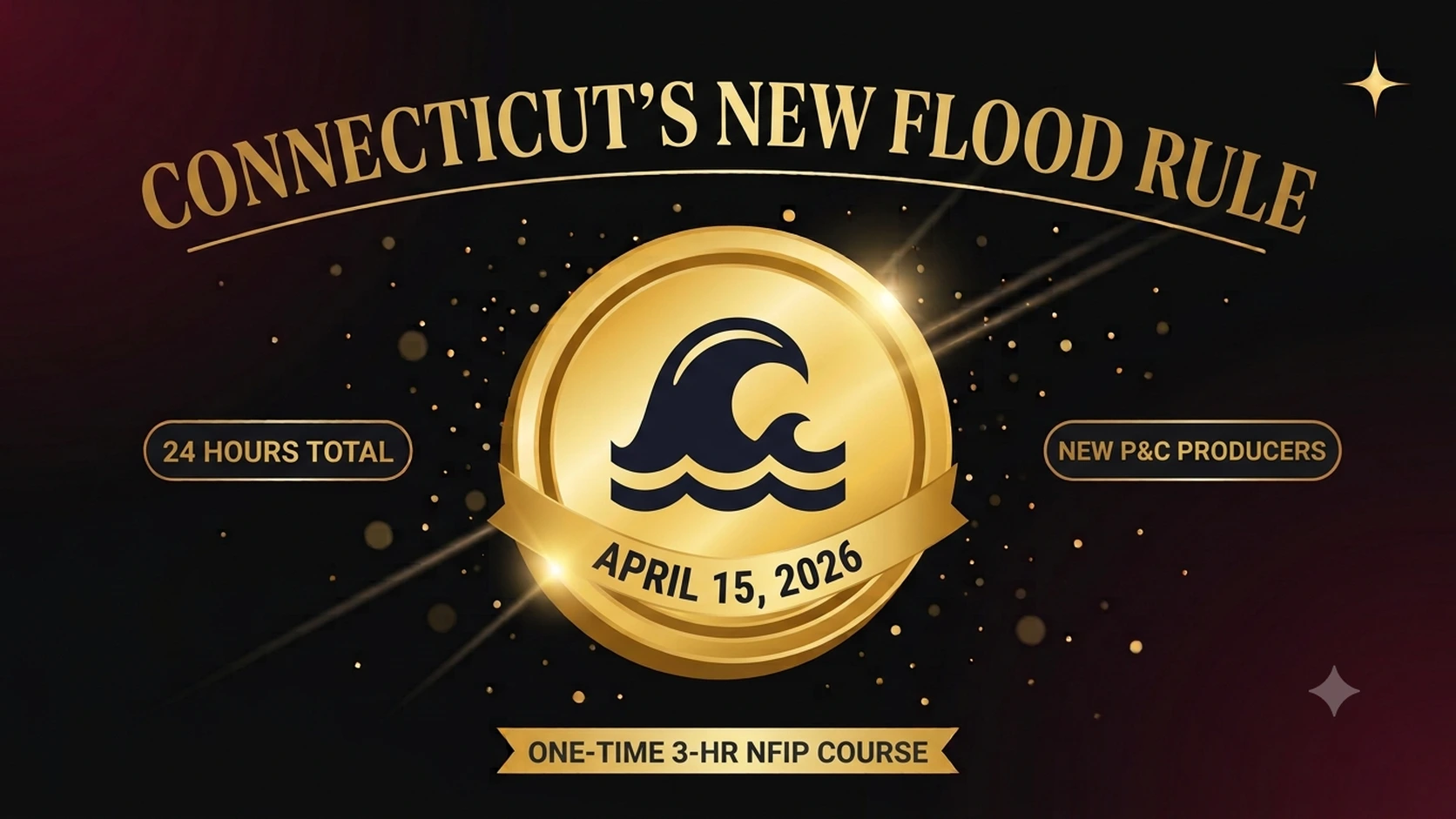
Effective April 15, 2026, newly licensed Connecticut resident producers holding property/casualty or personal lines authority must complete a one-time, 3-credit NFIP (National Flood Insurance Program) flood insurance course approved by the Connecticut Insurance Department, in addition to their standard 24-hour biennial requirement. This applies specifically to producers newly licensed on or after that date — it is not a retroactive requirement added to every existing P&C or personal-lines producer's next renewal.
A producer who was already licensed before April 15, 2026 should confirm directly with the Insurance Department whether this requirement applies to them specifically, since a rule that targets newly licensed producers by definition draws a line based on licensing date rather than applying uniformly to the entire existing producer population.
A separate, smaller track for life settlement brokers
Resident individuals holding only a Life Settlement Broker license — a narrower license type distinct from a standard producer license — follow a different requirement: 15 hours of continuing education every 2 years, specifically in the Life, Accident & Health, or Sickness category, rather than Connecticut's standard 24-hour producer structure. A producer who holds both a life settlement broker license and a standard producer license should confirm which set of hours applies to which license rather than assuming one CE total covers both.
Worked example: a newly licensed property & casualty producer in 2026
A producer newly licensed with property/casualty authority in Connecticut in May 2026 needs to plan for both the standard 24-hour biennial requirement (including at least 6 hours in P&C specifically and at least 3 hours of Connecticut law/regulation or ethics) and, separately, the new one-time 3-credit NFIP flood course, since her license date falls after the April 15, 2026 effective date.
A colleague licensed in property/casualty back in 2019 renewing in 2026 is not automatically subject to the new flood-training requirement, because it targets newly licensed producers rather than every P&C-authorized producer regardless of licensing date — she should still confirm this distinction directly with the Department rather than assuming either way.
How Connecticut's single ethics-or-law carve-out compares to Massachusetts
Massachusetts, covered elsewhere on this site, runs on its own three-year cycle structure rather than Connecticut's two-year birth-month cycle — a producer holding both licenses is tracking genuinely different cycle lengths side by side, on top of Connecticut's newer flood-training rule that has no Massachusetts equivalent. Treat each state's timeline independently rather than assuming a shared renewal rhythm.
The annuity training requirement, and where to verify approved courses
Producers selling annuity products in Connecticut must complete a one-time, 4-credit annuity training course approved by the Insurance Department, similar in structure to the one-time annuity training requirements seen in states like Oklahoma covered elsewhere on this site. Confirm any course's Connecticut-specific approval status through the State Based Systems (SBS) Course Lookup or the Pearson VUE Provider and Course Lookup before enrolling — only courses approved specifically for Connecticut's program count toward the state's requirement, regardless of a provider's general multi-state marketing claims.
What happens if you miss the deadline
Connecticut does not offer a standard grace period, but it does allow a narrow 10-day late-renewal window with no penalty fee at all, provided the required CE was actually completed on or before the original expiration date — the leniency covers a short administrative delay in filing, not a delay in finishing the coursework itself.
Beyond that 10-day window, a producer has up to one year from expiration to reinstate by completing outstanding CE and paying a $160 late fee plus the standard $160 renewal fee. After a full year without reinstating, the path shifts to a new-license process entirely: pre-licensing education, the exam, and a $130 reinstatement fee on top of standard licensing costs.
Checklist before your next Connecticut renewal
- 24 total hours, at least 6 per held line of authority
- At least 3 hours of Connecticut law/regulation OR ethics (either satisfies this carve-out)
- If newly licensed P&C or personal lines on/after April 15, 2026: one-time 3-hour NFIP flood course
- If selling annuities: one-time 4-hour annuity training course
- Life Settlement Broker-only license: 15 hours in Life/Accident & Health/Sickness instead of the standard 24
The bottom line
Connecticut's core 24-hour structure is manageable, but the new flood-training requirement is exactly the kind of narrow, licensing-date-triggered rule that's easy to miss if a producer only checks general 'Connecticut CE requirements' summaries rather than confirming their own license date against the April 15, 2026 effective date directly with the Department.
Primary and official sources used for this guide
Connecticut Insurance Department — Continuing EducationPrimary/official source for Connecticut's 24-hour requirement, ethics/law carve-out, and life settlement broker track.↗Connecticut Insurance Department — Regulations Concerning Continuing Education of Insurance ProducersOfficial regulation page, including the new NFIP flood insurance training requirement effective April 15, 2026.↗Source pages can change. Check the current text and effective date before relying on an hour requirement, a reporting deadline, or a course approval.
Written for licensed agents, not issued by a regulator. Insurance License CE Desk has no connection to any state department of insurance or CE provider. Hour requirements, ethics credits, and compliance deadlines are set state by state and do change, so your department of insurance, or the CE tracking vendor it uses, has the final word on what your transcript needs.