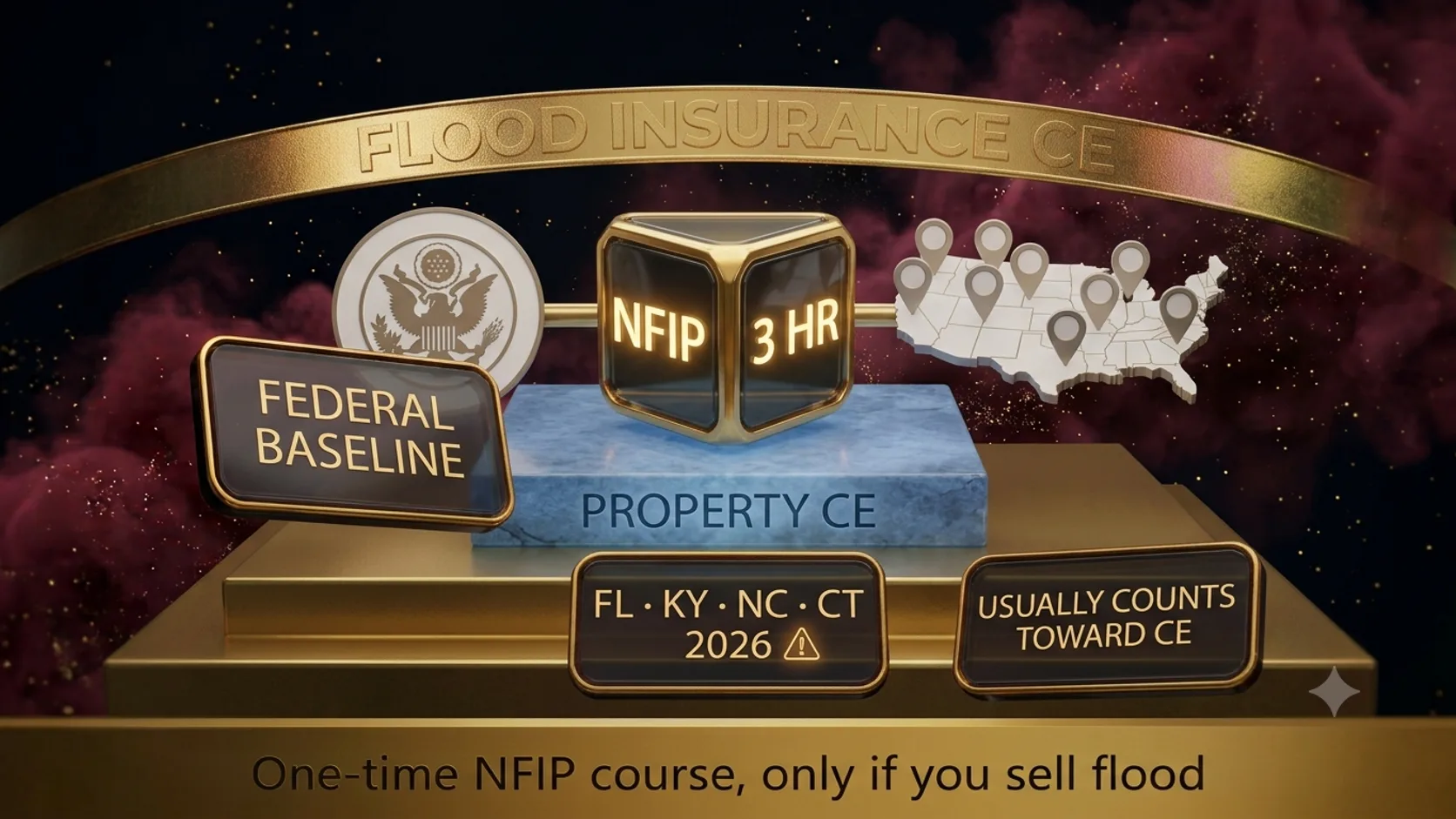
The requirement starts federally, not with your state
Section 207 of the Flood Insurance Reform Act of 2004 directed FEMA, working with the insurance industry and state regulators, to set minimum flood-insurance training and education standards for any producer who sells coverage through the National Flood Insurance Program. The federal expectation is generally described as a one-time course of at least three hours covering the NFIP, the flood insurance product, and the producer's responsibilities.
FEMA did not build a national enforcement system for this. In practice it is enforced through the states — either a state adopts a specific mandatory NFIP course, or it treats the federal expectation as met when a producer completes flood content as part of ordinary property CE.
The states with a specific one-time NFIP course
A number of states have written the federal expectation into a concrete rule. Florida requires property and casualty producers who sell federal flood insurance to complete a one-time NFIP training course. California requires fire and casualty producers who sell federal flood policies to complete a one-time three-hour NFIP course. Kentucky requires property agents who sell NFIP policies to complete a one-time course that also carries three hours of CE credit. North Carolina has a one-time three-hour NFIP training requirement. Connecticut added a one-time three-credit NFIP training requirement for resident producers holding property/casualty or personal-lines authority, effective April 15, 2026.
The common shape is: one time, roughly three hours, required only if you actually sell flood coverage through the NFIP, and keyed to property, casualty, fire, or personal-lines authority rather than life or health. A producer who never writes flood business is generally not required to take it.
It usually counts toward your CE — but confirm the category
In most of the states that mandate it, the one-time NFIP course also carries CE credit that applies to the producer's renewal hour total, typically categorized as property or general CE. Kentucky is explicit that its NFIP course provides three hours of CE credit.
That means the flood course is usually not pure overhead — it does double duty. The exception a producer should watch for is a state that requires the flood course but does not let it count toward the renewal total, which would make it three hours on top of the normal requirement. Check how your state categorizes it before assuming it reduces your remaining hours.
Optional enhanced flood courses are a different thing
Several states, including New York, have an optional enhanced or advanced flood course that a producer can take for CE credit but is not required to take. These are marketed alongside the mandatory NFIP course and have similar names, which causes confusion.
The distinction that matters: a mandatory one-time NFIP course is a condition of selling flood coverage in that state; an enhanced flood course is just an elective CE topic. A producer should confirm which one their state actually requires rather than assuming any course with 'flood' in the title satisfies a mandate.
Non-resident producers writing flood coverage
A non-resident producer who sells NFIP coverage in a state with a mandatory NFIP course generally has to satisfy that course requirement for that state, the same as a resident. Because it is a one-time course rather than a recurring hour count, reciprocity is less of a factor — but a producer should confirm whether the state accepts an NFIP course completed elsewhere or wants one from a provider it approved.
For a producer licensed in multiple coastal states, the practical outcome is often a single NFIP course completion that several states will accept, plus a check of each state's own rule to be sure.
Worked example: a personal-lines producer adding flood
A personal-lines producer in Connecticut wants to start writing NFIP flood policies in 2026. Because the state's one-time NFIP training requirement takes effect April 15, 2026 and applies to personal-lines authority, she completes a three-credit NFIP course before writing her first flood policy after that date.
The three credits post to her CE transcript and count toward her 24-hour renewal total. She does not have to repeat the course at renewal — it is one-time. If she later adds a non-resident property license in another mandatory-course state, she checks whether that state accepts her Connecticut NFIP completion or wants its own.
A flood-training checklist
- Determine whether you actually sell flood coverage through the NFIP — if not, the mandate generally does not apply
- Check whether your state has a specific mandatory one-time NFIP course (Florida, California, Kentucky, North Carolina, Connecticut, and others)
- Confirm which license types the requirement applies to (usually property, casualty, or personal lines)
- Verify whether the course's hours count toward your renewal CE total or sit on top of it
- Do not substitute an optional enhanced flood course for a required NFIP course
- For non-resident flood sales, confirm each state accepts your NFIP course or requires its own
The bottom line
Flood training is a one-time, roughly three-hour NFIP course that only matters if you sell flood coverage — and in most mandating states it also counts toward your renewal hours, so it rarely adds net workload. The mistakes are taking an optional enhanced course thinking it satisfies a mandate, and overlooking a new state requirement like Connecticut's April 2026 rule that is triggered by license type rather than announced at renewal.
Primary and official sources used for this guide
NFIP for Agents (FloodSmart) — State Training RequirementsOfficial NFIP agent resource on the federal training expectation and state-by-state flood training requirements.↗Federal Register — Flood Insurance Training and Education Requirements for Insurance AgentsThe federal rule implementing Section 207 of the Flood Insurance Reform Act of 2004.↗Kentucky Department of Insurance — Continuing EducationConfirms Kentucky's one-time NFIP course requirement and that it carries three hours of CE credit.↗Source pages can change. Check the current text and effective date before relying on an hour requirement, a reporting deadline, or a course approval.
Written for licensed agents, not issued by a regulator. Insurance License CE Desk has no connection to any state department of insurance or CE provider. Hour requirements, ethics credits, and compliance deadlines are set state by state and do change, so your department of insurance, or the CE tracking vendor it uses, has the final word on what your transcript needs.