A three-year cycle, and a front-loaded first term
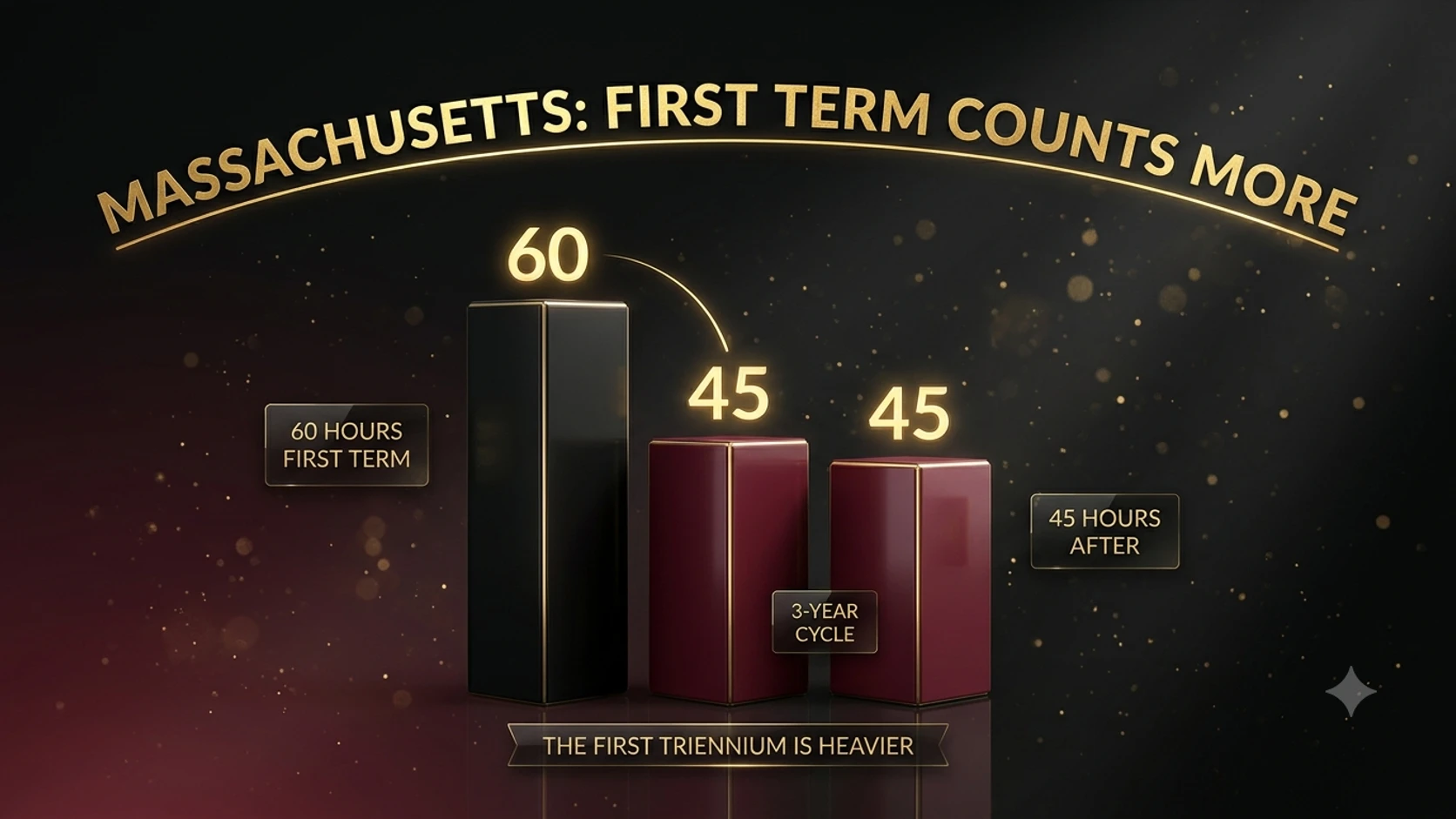
Massachusetts uses a three-year renewal cycle rather than the two-year cycle common in most states, and it structures the hour requirement differently for new producers than for everyone after: the first license term after initial licensure requires 60 hours of continuing education, including 3 hours of ethics, while every term after that first one drops to 45 hours, still including the same 3-hour ethics component.
This front-loaded structure means a newly licensed Massachusetts producer faces a meaningfully heavier CE load in their first three years than they will in every subsequent renewal — a detail easy to miss if a producer only checks a generic 'Massachusetts CE requirement' figure without noting which term that figure describes.
Ethics hours stay fixed at 3 regardless of which term applies
Whether a producer is in their heavier first-term 60-hour requirement or their standard 45-hour requirement in later terms, the ethics component remains 3 hours in both cases — equivalent to 3 classroom hours of instruction, completed through an approved MA Ethics category program or seminar. This requirement does not increase the overall hour total; it's a mandatory subset within whichever total applies.
The ethics requirement resets every three-year triennium the same way general hours are recalculated — a producer cannot rely on an ethics course from a prior triennium to satisfy the current one.
A large carryover allowance, proportional to the longer cycle
Massachusetts allows up to 45 hours of excess CE credit to carry forward into the next license term — a notably large carryover cap compared to the 12-hour caps common in two-year-cycle states, though proportional given Massachusetts's three-year cycle length and higher baseline hour totals.
As with essentially every state covered on this site, courses may not be taken more than once within the same three-year reporting period for credit, regardless of how much carryover flexibility exists for general hours.
Renewal timing
The Massachusetts CE renewal date is tied to the licensee's birthdate, on a three-year cycle — meaning, unlike the two-year birth-month pattern common elsewhere, a Massachusetts producer's renewal only comes around once every three years relative to their birthday.
Worked example: a producer's first vs. second renewal
A producer newly licensed in Massachusetts budgets for 60 hours of CE, including 3 hours of ethics, across her first three-year term — a heavier initial commitment she plans for accordingly, spreading the hours across the full three years rather than assuming the lighter 45-hour figure she may have seen quoted in a general multi-state comparison.
At her second renewal, three years later, her requirement drops to 45 hours including the same 3-hour ethics component — a genuine reduction from her first term, which she can partially ease using carried-forward excess hours from her heavier first term, up to the 45-hour carryover cap.
Why the three-year cycle changes reminder-setting habits
Producers accustomed to a two-year renewal rhythm from other states sometimes misjudge how much time remains in a Massachusetts three-year term, mentally rounding it down to the more familiar two-year figure. A dedicated reminder specific to the actual three-year Massachusetts deadline, checked independently from any other state's renewal calendar, avoids this common miscalculation.
Non-resident reciprocity, and a considerably higher renewal fee
Non-resident Massachusetts producers are exempt from the state's three-year, first-term-vs-standard-term structure described above only if their home state offers reciprocal treatment to Massachusetts producers — a non-resident whose home state doesn't have any CE requirement at all must instead comply with Massachusetts's own CE structure directly, rather than getting an automatic pass.
The Annuity Best Interest training requirement doesn't bend to reciprocity either way: both resident and non-resident producers need the one-time 4-hour course before selling annuities in Massachusetts, regardless of what their home state requires. Massachusetts's non-resident renewal fee is a notably steep $225 — considerably higher than the fees charged by most neighboring states — a real cost to budget for beyond whatever CE a non-resident producer's home state actually requires them to complete.
What happens after a missed deadline, and a waiver option worth knowing
Massachusetts offers no grace period on the renewal deadline itself, but a producer who lets a license lapse can still reinstate — without retaking the licensing exam — within 12 months of the original renewal due date, by paying a penalty equal to double the unpaid renewal fee. Producers unable to meet renewal deadlines due to military service or another genuine extenuating circumstance can request a formal waiver of the renewal procedure, examination requirement, or associated fines — an option worth knowing about for a producer facing a legitimate hardship rather than routine oversight.
What Massachusetts's ethics hours actually cover
Massachusetts's mandatory 3 ethics hours cover field underwriting and policy delivery, fiduciary responsibilities, unfair trade and claims practices, producer errors and omissions exposure, and consumer privacy — with real enforcement-action case studies woven through the material rather than abstract ethics theory alone. Outside of that fixed 3-hour ethics block, Massachusetts places no subject-matter restrictions on the remaining hours in either the 60-hour first term or the 45-hour standard term, giving producers real latitude in choosing which topics fill out the rest of their requirement.
The bottom line
Massachusetts's heavier 60-hour first term followed by a lighter 45-hour standard term, combined with its generous 45-hour carryover cap, gives new producers a real incentive to front-load their early CE effort in exchange for meaningfully easier subsequent renewals.
Massachusetts producers transferring from another state mid-career should also confirm with the Division of Insurance whether their prior out-of-state experience affects which specific triennium (first or subsequent) applies to their initial Massachusetts renewal, since the answer isn't always the same as it would be for a producer newly licensed for the very first time. A producer facing a genuine hardship near a deadline should also remember the waiver option exists rather than assuming a missed renewal automatically means the full lapse-and-penalty path described above.
Primary and official sources used for this guide
Massachusetts Division of Insurance — Continuing Education InformationPrimary/official source for Massachusetts's three-year cycle and first-term vs. subsequent-term hour totals.↗NIPR — Massachusetts Resident Renewal (Individual)Secondary source for Massachusetts's non-resident reciprocity and renewal fee.↗Source pages can change. Check the current text and effective date before relying on an hour requirement, a reporting deadline, or a course approval.
Written for licensed agents, not issued by a regulator. Insurance License CE Desk has no connection to any state department of insurance or CE provider. Hour requirements, ethics credits, and compliance deadlines are set state by state and do change, so your department of insurance, or the CE tracking vendor it uses, has the final word on what your transcript needs.