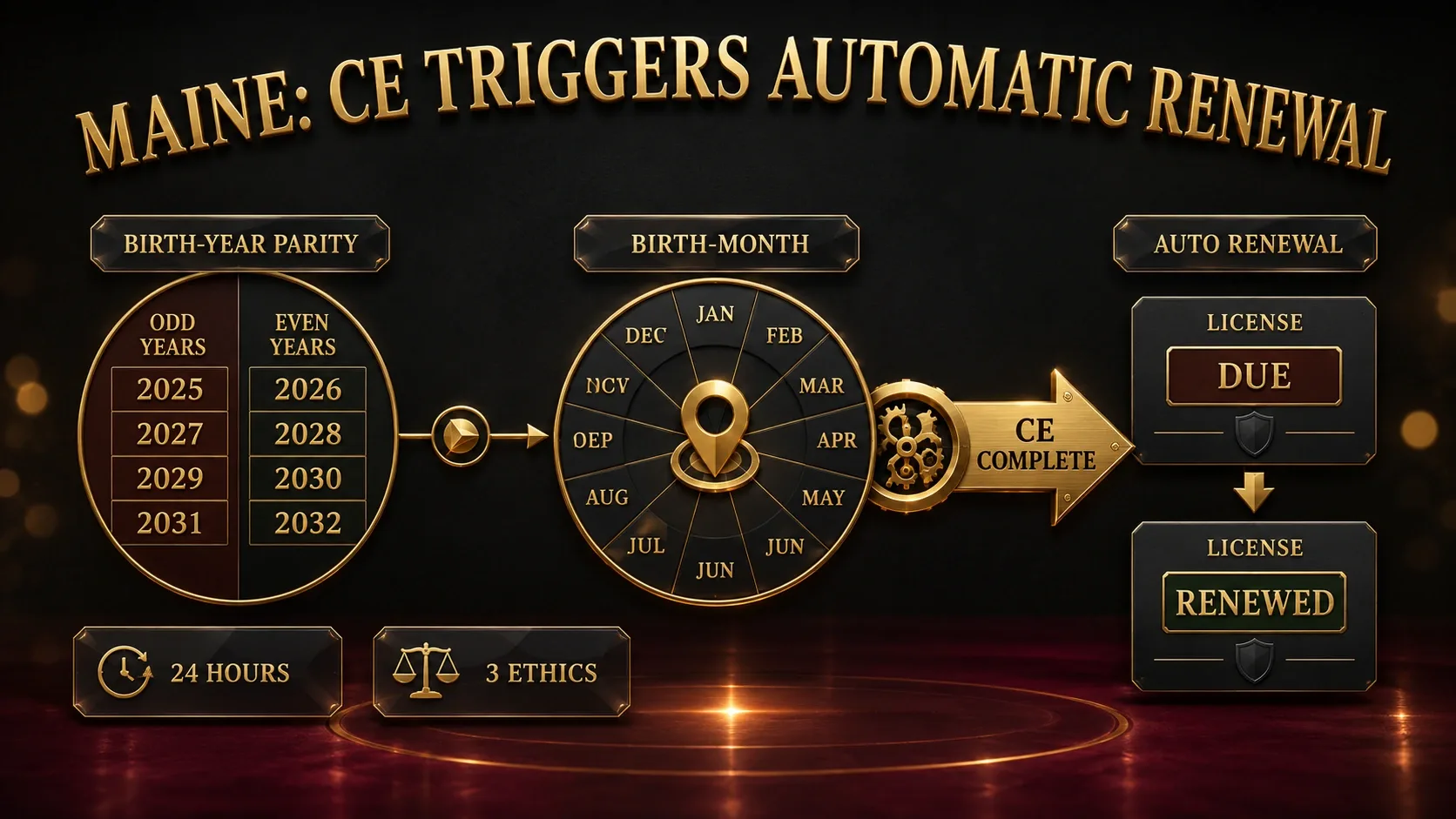
24 hours, 3 ethics, nothing else mandated
Maine requires all resident producers and consultants to complete 24 CE credit hours as a condition of continued licensure, including a minimum of 3 credit hours in ethics. Maine is explicit that, apart from the mandatory ethics hours, there is no subject requirement — the other 21 hours can be any approved insurance content.
That makes Maine one of the simpler states to plan for: no classroom minimum, no company-course cap, no state-specific legislative hour, and no per-line split for dual-line producers. The complexity in Maine is entirely in the renewal timing, not the coursework.
The Rule 542 birth-month-and-year cycle
Maine's Rule 542 sets a biennial compliance date for each licensee based on their month and year of birth. A producer determines their due date by taking their birth month, then whether they were born in an odd or even year: the due date is the end of the birth month, every odd or every even year to match.
So a producer born in March of an even year renews at the end of March in even calendar years, while a producer born in March of an odd year renews in odd years. The exact date is on the Maine Bureau of Insurance license record, and reading it once removes the guesswork.
The 60-day window after the CE due date
Maine keeps a license active for up to 60 days after the CE due date to give a producer time to complete and submit outstanding CE. Finish inside that window and the license stays in good standing — the producer pays a late penalty but does not lose the license, which is a genuine safety margin most states do not offer.
Miss the 60-day window and the path is much harder: the producer has to retake the licensing exam and apply to reinstate. CE credits can still be completed while the license is suspended, and once the requirements are met and the penalty paid, the license reinstates.
Fees and the reinstatement period
The Maine resident renewal fee is $30, and reinstatement adds a $45 fee. A producer who completes CE and the renewal application within 30 days after expiration pays $30 plus the $45 late penalty — $75 total.
If the license is not renewed by the end of the birth month or the 30-day grace period, it expires and enters a 365-day reinstatement period from the last day of the birth month, with a $75 fee. The 60-day CE window and the 30-day renewal grace period run concurrently from slightly different start points, so the safe reading is to treat the CE due date as the real deadline.
How completions are reported, and what to keep
Maine-approved providers report completions to the Bureau of Insurance electronically, and the producer's CE record is what the Bureau checks at renewal. Because the 60-day window is measured from the CE due date, a producer who is relying on it should confirm the record — not just the certificates — before the window closes.
If a provider reports late while the 60-day post-due-date window is closing, the certificate is what the Bureau of Insurance accepts to post the hours in time and keep the license in good standing. File a certificate for every course, and confirm the Bureau's own record — not just the certificates in a drawer — shows compliance before that window runs out.
Non-resident producers
Maine's 24-hour requirement applies to residents. A non-resident producer licensed in Maine satisfies it through their home state's CE rules, assuming the home state has a requirement and the producer keeps that license in good standing.
Training for annuity or long-term care sales runs on its own track, apart from the 24-hour count, and should be checked against a current Maine Bureau of Insurance bulletin before that first sale.
Worked example
A producer born in March of an odd year has a Rule 542 due date at the end of March in odd years. She completes a 3-hour ethics course and 21 general hours by February.
If a provider's reporting lags and her record shows a 2-hour shortfall on April 10, she is still inside the 60-day window — she finishes the 2 hours, pays the late penalty, and the license never leaves good standing. Waiting past late May would have forced her back to the exam.
The bottom line
Maine is a clean 24-hour, 3-ethics state with no other subject requirements. Two Maine details matter: the Rule 542 cycle, which uses both the birth month and the birth-year parity to fix the exact date, and the 60-day post-due-date window — a genuine safety margin, but the last one before reinstatement requires re-passing the exam.
Read the Rule 542 due date off the Bureau of Insurance record, book a 3-hour ethics course plus 21 hours in any approved subject, and finish a month or more ahead. The renewal fee is $30, reinstatement adds $45, and the 60-day window after the due date lets you finish outstanding hours with a penalty rather than losing the license — but only within those 60 days.
Primary and official sources used for this guide
Maine Bureau of Insurance — CE Requirements for Producers and ConsultantsPrimary/official source for Maine's 24-hour requirement, the 3-hour ethics minimum, the Rule 542 birth-month-and-year cycle, and the absence of other subject requirements.↗NIPR — Maine Resident Renewal (Individual)Renewal detail for Maine residents, including the $30 renewal fee, the $45 reinstatement fee, the 60-day completion window, and the re-exam requirement after it closes.↗Source pages can change. Check the current text and effective date before relying on a threshold, waiting period, or required form.