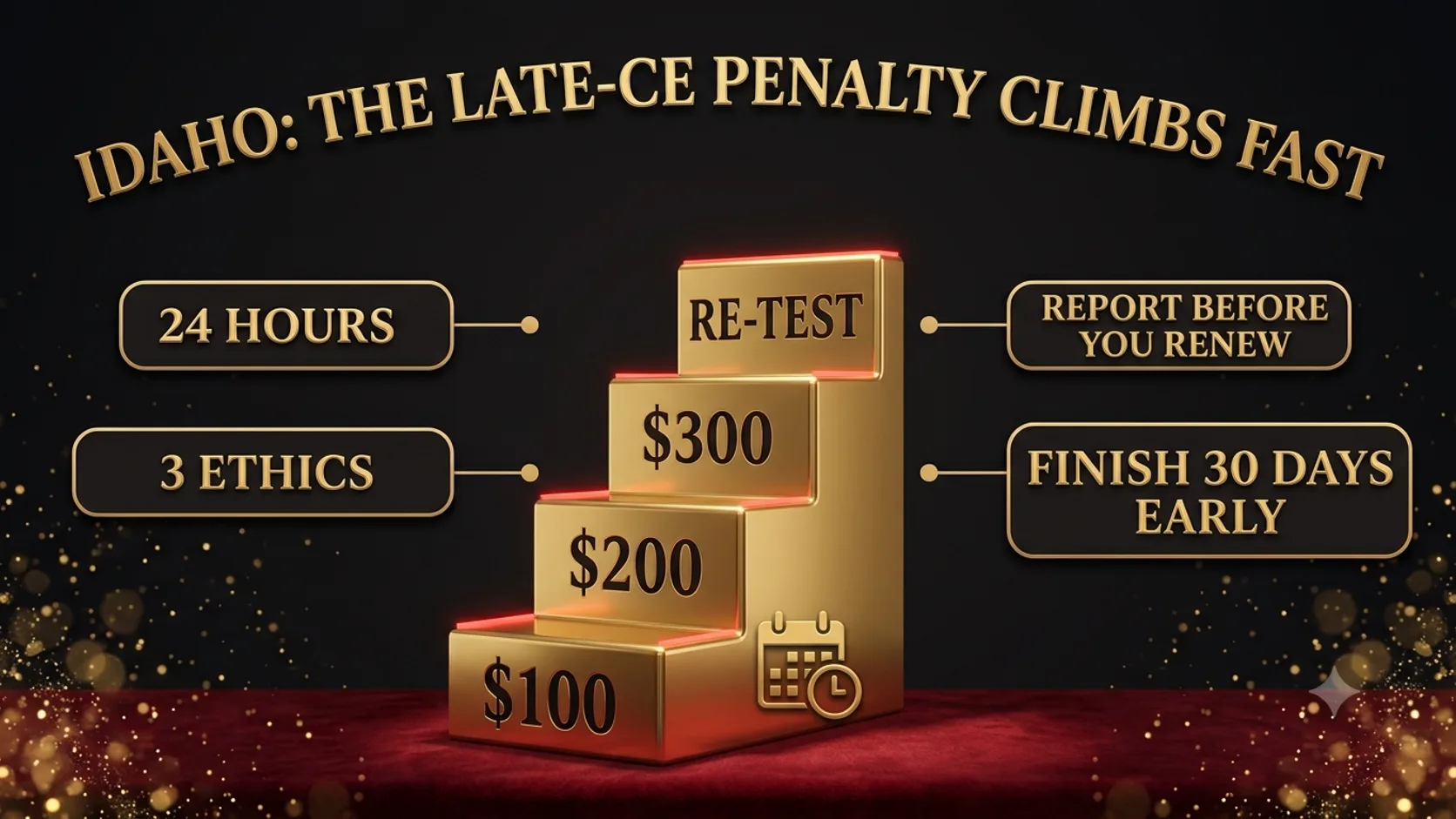
24 hours, 3 of them ethics
Idaho requires 24 hours of approved continuing education for each two-year license term, with a minimum of 3 hours in ethics. Ethics hours completed beyond the required 3 still count toward the overall 24; there is no separate ceiling on ethics credit the way a few states impose, so a producer who enjoys ethics coursework is not penalized for it.
Idaho does not mandate a classroom-format portion. A producer can complete the entire 24 hours through approved self-study, in any line of authority the producer holds, though the department recommends matching courses to the license type so the content is actually relevant to the book of business.
The report-before-renewal constraint
The rule that matters most in Idaho is sequencing: CE must be completed and posted to the producer's record before a renewal application can be submitted and processed. A producer who finishes on the expiration date is relying on the provider to report and the department to post within hours, which does not happen — provider reporting runs on a batch cycle measured in days, sometimes a week or more.
Because of that, the Idaho Department of Insurance recommends completing all CE at least 30 days before the license expiration date. That is not a legal deadline, but it is the realistic one: it gives providers their normal reporting window and the department time to post the credits so the renewal can go through.
Birth-month cycle, no carryover, no first-renewal break
The Idaho license term ends on the last day of the licensee's birth month, every two years. Idaho does not allow excess CE hours to carry forward into the next term, and a course may not be repeated for credit inside the same two-year term.
Idaho also does not exempt a first renewal from CE the way some states do. A resident producer licensed for close to two years still owes the full 24 hours, including the 3 ethics hours, at their first renewal — there is no ramp-up period.
The graduated CE-deficiency penalty
Idaho spells out what a late CE record costs, and the schedule climbs fast. Completing the deficiency within 30 days after expiration is a $100 penalty; within 31 to 60 days, $200; within 61 to 90 days, $300. From 90 days out to one year, it is $80 plus a mandatory re-test for the license — at that point the money is almost beside the point.
Separately, any renewal fee received after the due date carries a penalty equal to double the unpaid renewal fee; the base renewal fee is $60. Late renewals are possible through NIPR up to one year past expiration. After a year, the license can no longer be renewed at all, and the producer starts over as a new applicant.
How completions are reported, and what to keep
Idaho-approved providers report completions to the department electronically, and the producer's CE transcript is what determines both eligibility to renew and which penalty tier applies if the record is short. Because the tier is set by the date the record clears, not the date the producer finished studying, checking the transcript a few weeks before the deadline is the single most useful habit.
Save the certificate from every course for a few years. If a provider misreports or fails to report, the certificate is what the department accepts to correct the record — and, because the deficiency penalty tier is fixed by the date the record clears rather than the date the producer finished, correcting a misreport quickly can be the difference between the $100 tier and the $200 one.
Non-resident producers
A non-resident licensed in Idaho meets the CE requirement by keeping their home-state license current, provided the home state imposes CE of its own. The 24-hour Idaho count does not stack on top of that, and neither does the deficiency schedule.
Product-specific training tied to an Idaho annuity or long-term care sale is a separate question from the general hour requirement and should be confirmed against a current Idaho bulletin before that first sale.
Worked example
A producer born in September renews at the end of September every two years. She targets an August 1 completion date — about eight weeks early — so provider reporting has cleared and the department has posted her credits before she files the renewal.
If a provider is slow and her record still shows a shortfall on October 5, she is already 30-plus days past expiration, which means the $200 penalty tier rather than the $100 one, even though she personally finished the coursework in July. The early target is what keeps a reporting delay from moving her up the schedule.
The bottom line
Idaho's requirement is a clean 24 hours with 3 ethics and no carryover. What makes Idaho unforgiving is the interaction between the report-before-renewal rule and the steep deficiency schedule: because the penalty tier is set by the date your record clears, not the date you finished, the 30-day-early target the department recommends is really the deadline that matters.
Primary and official sources used for this guide
Idaho Department of Insurance — Continuing Education for ProducersPrimary/official source for Idaho's 24-hour requirement, ethics minimum, carryover rule, and the recommendation to finish 30 days early.↗Idaho Department of Insurance — Late Renewal (Individual)Official source for Idaho's graduated CE-deficiency penalties, the double-fee late-renewal penalty, and the one-year reinstatement limit.↗Source pages can change. Check the current text and effective date before relying on a threshold, waiting period, or required form.