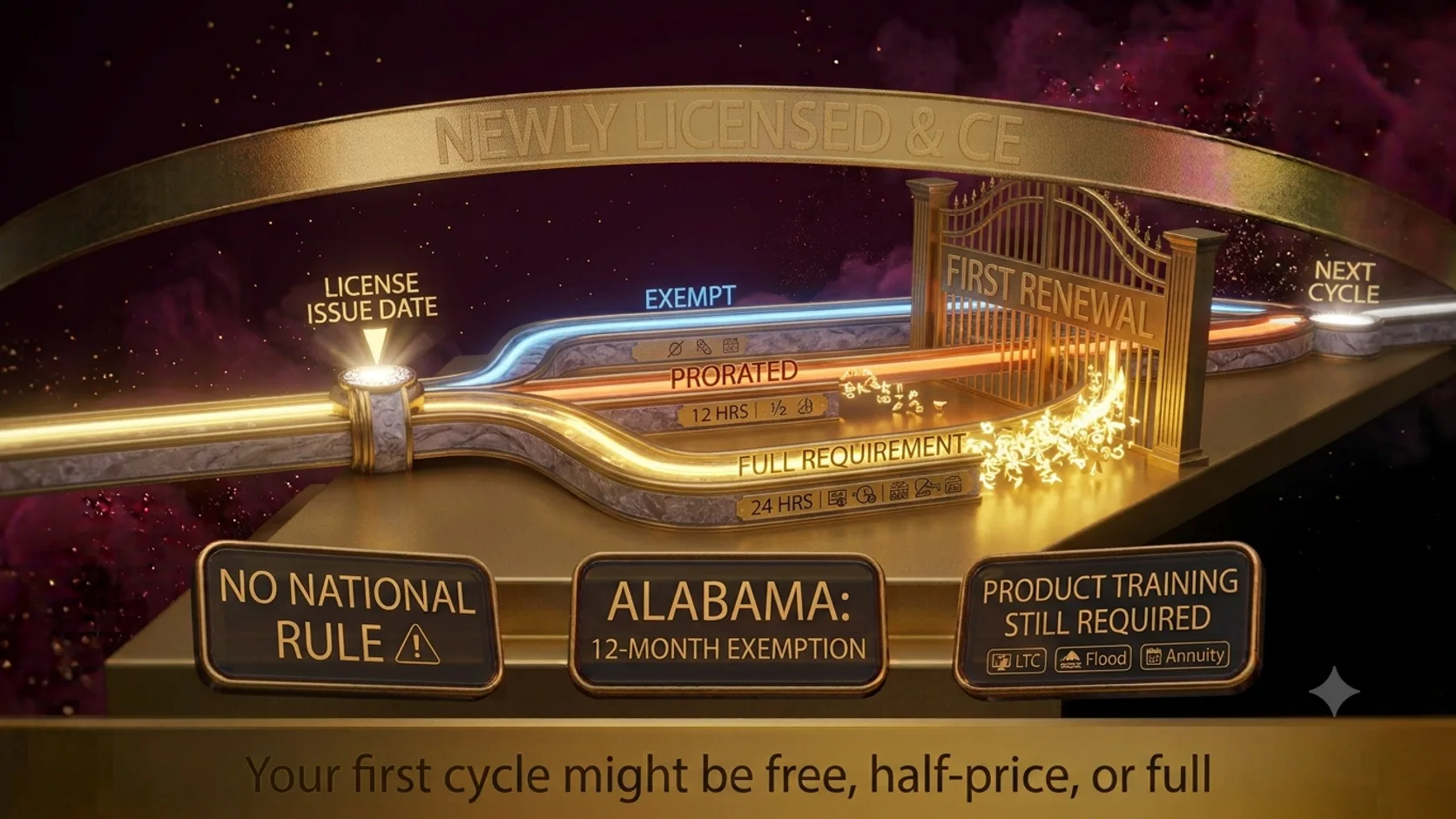
Three models, no default
When a producer is licensed partway through what would be a normal CE cycle, states resolve the first-cycle question in one of three ways. A minority exempt the first renewal entirely if the license was issued close enough to the renewal date. Some prorate — reducing the required hours in proportion to the fraction of the cycle the license existed. The rest simply apply the full hour requirement from the license issue date.
Because the models differ, a new producer cannot reason from what a colleague in another state experienced. The only reliable source is the resident state's own rule for first-term licensees.
The exemption model
Alabama exempts newly licensed producers, service representatives, adjusters, and title agents who are licensed within 12 months of their renewal date from the CE requirement for that first cycle. The exemption is automatic based on the license issue date relative to the renewal date; the producer does not apply for it.
Where this model exists, the practical effect is that a producer licensed late in a cycle gets a near-free first renewal and then owes the full requirement for every cycle after. A producer licensed early in the cycle — more than the threshold before renewal — does not get the exemption and owes full or prorated hours.
The proration model
Other states scale the first-cycle requirement to time licensed. The arithmetic varies — some reduce by whole months, some by the number of full quarters, some round to the nearest common fraction — but the idea is that a producer licensed halfway through a two-year cycle owes roughly half the hours before their first renewal.
Georgia is a useful example of how granular this can get: a producer who completed Georgia's prelicensing education is exempt from CE for the first renewal period, while a producer who was exempt from prelicensing education instead gets a prorated first-period CE requirement. Two producers licensed the same month can owe different first-cycle hours based on how they qualified. The Georgia state guide on this site covers that split in more detail.
Proration is easy to get wrong by estimating. A producer in a proration state should confirm the exact reduced number with the department or in the licensing portal rather than dividing the standard requirement in half and assuming.
The full-requirement model
Many states apply the entire CE requirement from the license issue date regardless of how little of the cycle remains. A producer licensed three months before a renewal in one of these states owes the same hours as a producer licensed at the start of the cycle.
This is the model that most often catches new producers off guard, because it feels unreasonable and because pre-licensing education does not count toward it. A producer entering the business should ask this question specifically during onboarding, not assume a grace period exists.
Product training is a separate question
Even where the first CE cycle is exempt or prorated, pre-sale product training is not waived. A newly licensed producer who wants to sell annuities still completes the one-time four-hour annuity best-interest training first. One who wants to sell long-term care still completes the initial LTC training. California's LTC schedule, which requires eight hours every year for the first four years licensed, is aimed squarely at new licensees.
So a new producer can be genuinely exempt from renewal-cycle CE and still have mandatory coursework to complete before writing certain products. The two obligations do not rise and fall together.
Worked example: two new producers, two states
A producer licensed in Alabama 8 months before her renewal date is exempt from CE for that first cycle. She still completes the four-hour annuity best-interest course before her first annuity sale. Her second cycle onward, she owes Alabama's full 24 hours including 3 ethics.
A producer licensed in a full-requirement state 8 months before renewal owes the entire state requirement before that first renewal, with no reduction for the short cycle. He builds a course plan immediately rather than waiting, because pre-licensing gave him no CE credit and the deadline is closer than it looks.
A first-cycle checklist
- Ask your resident state specifically how the first CE cycle is treated — exempt, prorated, or full
- If exemption depends on the license date relative to renewal, confirm which side of the threshold you fall on
- In a proration state, get the exact reduced hour count from the department, do not estimate
- Assume pre-licensing education earns zero CE credit toward the first renewal
- Complete annuity and LTC pre-sale training regardless of how the CE cycle is treated
- In California, plan for eight hours of LTC training every year for the first four years if you sell LTC
The bottom line
A new producer's first CE cycle might be free, half-price, or full-price depending entirely on the state — there is no safe assumption. And even a genuine first-cycle exemption does not touch the product training required before selling annuities or long-term care. Confirm both, early, during onboarding.
Primary and official sources used for this guide
NIPR — Understand Insurance Continuing Education RequirementsPrimary source on how CE cycles are set from the license issue date and renewal date.↗BetterCE — Alabama Insurance Agent Continuing Education and License Renewal RequirementsDescribes Alabama's exemption for producers licensed within 12 months of the renewal date.↗California Department of Insurance — Continuing Education FAQOfficial source for California's LTC training schedule aimed at newly licensed producers.↗Success CE — Georgia Insurance CE RequirementsDescribes Georgia's first-period rule: prelicensing completers are exempt; prelicensing-exempt licensees get a prorated first-period requirement.↗Source pages can change. Check the current text and effective date before relying on an hour requirement, a reporting deadline, or a course approval.
Written for licensed agents, not issued by a regulator. Insurance License CE Desk has no connection to any state department of insurance or CE provider. Hour requirements, ethics credits, and compliance deadlines are set state by state and do change, so your department of insurance, or the CE tracking vendor it uses, has the final word on what your transcript needs.