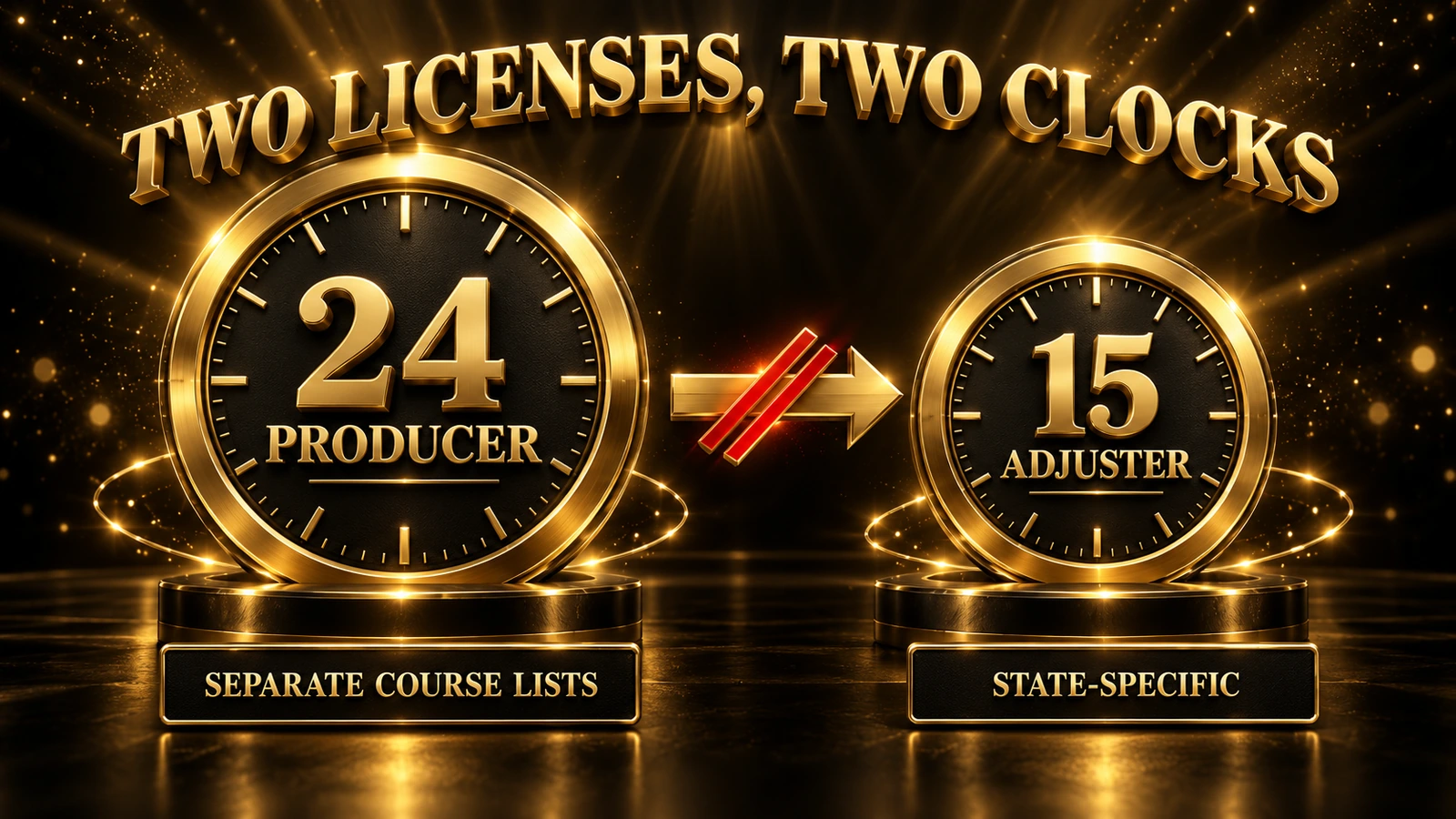
Two different licenses, two different CE tracks
A public adjuster represents a policyholder in negotiating a claim with an insurer, which is a fundamentally different regulated role from a producer who sells or services policies. States generally license the two separately, and because the license itself is separate, many states also set a separate continuing education requirement rather than folding public adjusters into the same CE bucket as producers.
This means a person who happens to hold both a producer license and a public adjuster license in the same state is not managing one CE requirement — they are managing two, tracked and reported separately, each with its own hour count, its own renewal cycle in some states, and its own approved-course list.
The hour counts genuinely differ, and not always in the direction you'd expect
In Massachusetts, public insurance adjusters must complete 15 hours of continuing education, a lower figure than the state's producer requirement. New Jersey follows a similar pattern: public adjusters need 15 CE hours per two-year license term, compared to 24 hours (including 3 ethics hours) for producers in the same state.
Louisiana is a useful counterexample showing this isn't a universal rule: Louisiana adjusters, including public adjusters, are held to 24 hours including 3 hours in ethics — matching the state's producer requirement rather than setting a lower bar. The takeaway is not that public adjuster CE is always lighter; it's that the hour count is a state-specific design choice tied to that state's licensing structure, and has to be checked per state rather than assumed from a pattern seen elsewhere.
Course credit usually doesn't cross over between license types
Massachusetts makes this explicit: a public insurance adjuster does not receive CE credit for taking a producer-licensee CE course, and a producer does not receive credit for taking a public-adjuster CE course, even though both are regulated by the same state insurance division. The two course catalogs are treated as separate content pools tied to the license type they were approved for.
A person holding both license types in a state with this kind of separation cannot double up efficiently by taking one broad course and applying it to both requirements. Each license's CE has to be satisfied with courses specifically approved for that license category, which is worth confirming directly with the state's approved-course search tool before assuming a course qualifies for both.
Adjuster licensing itself varies by category, not just producer vs. adjuster
Beyond the producer/public-adjuster split, states typically distinguish further among staff adjusters, independent adjusters, and public adjusters, and CE obligations can vary again within that breakdown depending on the state. A staff adjuster employed directly by an insurer, an independent adjuster contracted to handle claims for multiple insurers, and a public adjuster representing policyholders are three different regulated roles that don't automatically share one CE rule just because all three involve claims work.
A person moving between these adjuster categories, or adding a public adjuster license to an existing independent adjuster license, should treat it as a genuinely new CE tracking obligation rather than assuming existing adjuster CE experience transfers cleanly.
Why this distinction gets missed
Generic CE hour-count tables that summarize state requirements sometimes report only the producer figure for a state, since producers are the largest licensed population, which can leave a public adjuster assuming the listed number applies to them too. Checking a state's insurance department page for continuing education specifically under the public adjuster license category, rather than a general producer CE summary, is the more reliable way to confirm the correct hour count.
This confusion is compounded when a state's own website groups producer and public adjuster CE information on the same page without clearly separating the two hour counts, which is common enough that reading the fine print on which license type a stated hour figure applies to is worth the extra minute.
Worked example
A person licensed as both a producer and a public adjuster in New Jersey plans their CE separately: 24 hours (including 3 ethics) for the producer license, and a separate 15 hours for the public adjuster license, each tracked against its own renewal date and satisfied with courses specifically approved for that license category.
They confirm through New Jersey's approved-course search that a course they're considering is filed under the correct license category before enrolling, since a course approved only for producers would not count toward the public adjuster requirement even if the subject matter overlaps.
The bottom line
A public adjuster license and a producer license are separate regulatory tracks, and in many states that separation extends to a distinct, sometimes lower, CE hour requirement with its own non-transferable course catalog. Anyone holding a public adjuster license — alone or alongside a producer license — should confirm the public-adjuster-specific hour count and approved-course list directly with the state, rather than relying on a general producer CE figure.
Primary and official sources used for this guide
Mass.gov — Public Insurance Adjuster Continuing Education RequirementsStates Massachusetts's 15-hour public adjuster CE requirement and its separation from producer CE.↗InsuranceStudy — New Jersey Insurance Continuing EducationSource for New Jersey's 15-hour public adjuster requirement versus 24-hour producer requirement.↗Louisiana Department of Insurance — Continuing Education RequirementsSource for Louisiana's matching 24-hour, 3-ethics requirement across producers and adjusters.↗Source pages can change. Check the current text and effective date before relying on a threshold, waiting period, or required form.