Why states distinguish format at all
The concern behind format rules is passive completion — a producer clicking through a self-study PDF and an open-book quiz without meaningfully engaging. To push back, a number of states require a minimum share of CE hours to come from instruction that verifies active participation.
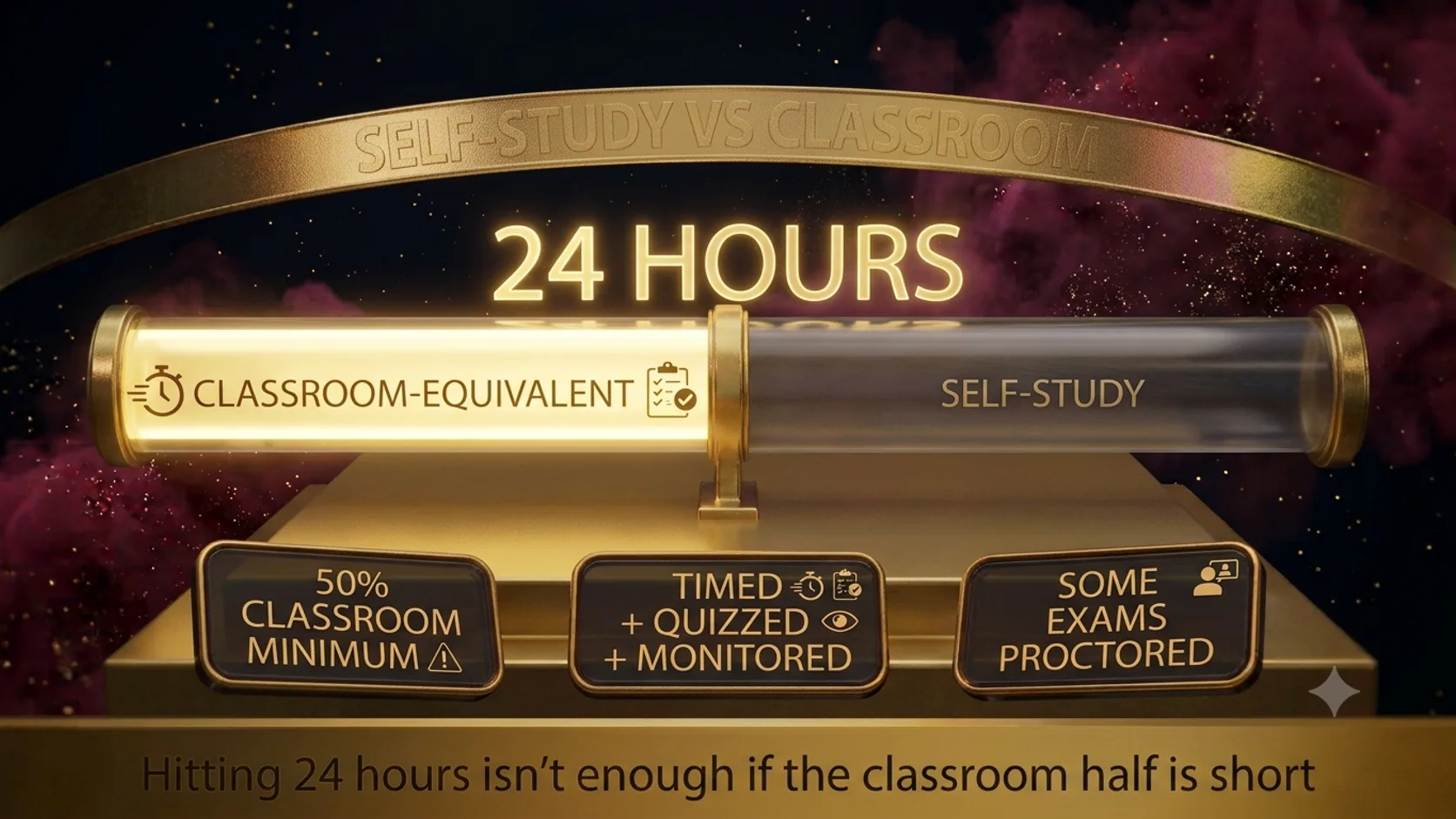
The common structure is a 50/50 split: at least half of the required hours in classroom or classroom-equivalent courses, with the remaining half available as ordinary self-study. Texas and New Jersey are frequently cited examples of this pattern, and several other states apply a similar floor.
What makes an online course 'classroom-equivalent'
Classroom-equivalent does not mean a live webinar. It refers to a self-paced online course engineered to demonstrate engagement: timed progression that prevents skipping ahead, a quiz after each unit that must be passed to continue, and monitored seat time so the reported hours reflect actual time in the material.
A reputable provider labels each course clearly — 'classroom,' 'classroom-equivalent,' or 'self-study' — and reports the hours in the correct category. A producer filling a state's classroom portion has to choose courses tagged classroom or classroom-equivalent specifically; a self-study course does not move into that bucket just because it was thorough.
When a monitored or proctored exam is required
Most self-study CE exams are open-book and unproctored. The exceptions are specific. California, for example, requires the final exam to be monitored by a disinterested third party for courses approved to meet its 24-hour Coverage requirement, while ordinary self-study exams in California do not need a monitor.
A producer taking a course to satisfy a special mandatory requirement — a state's own long-form ethics or coverage course, certain LTC or annuity training — should check whether that specific course carries a proctoring condition, because the rule often attaches to the course type rather than to self-study generally.
How the cap interacts with mandatory carve-outs
Ethics hours, flood training, and annuity training all still have to fit inside the format rules. In a 50/50 state, an ethics course taken as self-study counts toward the self-study half, not the classroom half. A producer who front-loads all their classroom hours with product courses and then takes ethics as self-study can accidentally breach the classroom minimum.
The cleaner approach in a format-capped state is to satisfy the classroom minimum first — often with the ethics course and one or two substantive classroom-equivalent courses — and use self-study only for the remaining flexible hours.
States without a format cap
Many states have no classroom minimum at all and allow the entire requirement to be completed through self-study, as long as the courses and provider are approved. Kentucky, for instance, permits all hours through classroom, correspondence, or self-study.
A producer licensed in both a capped state and an uncapped state should plan around the stricter rule if they want a single course plan to work everywhere — completing the capped state's classroom minimum automatically satisfies the uncapped state, but not the other way around.
Worked example: building a compliant plan in a 50/50 state
A producer in a state that requires at least 12 of 24 hours in classroom or classroom-equivalent format plans her cycle as: a 3-hour classroom-equivalent ethics course, a 6-hour classroom-equivalent course on a product line she writes, and a 3-hour classroom-equivalent update course — 12 classroom hours exactly.
She then completes the remaining 12 hours as ordinary self-study on flexible topics. When she checks her transcript before renewal, she confirms the provider reported the first 12 hours in the classroom-equivalent category, not as self-study, since a miscategorized report would leave her short on the classroom minimum despite having 24 total hours.
A format checklist
- Check whether your state caps self-study — commonly at 50% of required hours
- To fill the classroom portion, choose courses tagged 'classroom' or 'classroom-equivalent,' not self-study
- Confirm classroom-equivalent courses use timed progression, unit quizzes, and monitored seat time
- Check whether any mandatory course you are taking requires a proctored final exam
- Satisfy the classroom minimum first, then use self-study for the remaining flexible hours
- Verify your transcript reports each course in the correct format category before renewing
The bottom line
In a format-capped state, hitting 24 total hours is not enough — at least half usually have to be classroom or classroom-equivalent, meaning timed, quizzed, engagement-verified courses. The avoidable error is taking the ethics or update courses as self-study and discovering at renewal that the classroom half is short. Fill the classroom minimum first.
Primary and official sources used for this guide
New Jersey — Insurance Continuing Education State Requirements (AOI)Describes the requirement that at least 12 of 24 hours be classroom or classroom-equivalent.↗Texas Department of Insurance — Agent Continuing EducationPrimary source for Texas's requirement that at least half of the 24 hours be classroom or classroom-equivalent.↗California Department of Insurance — Continuing Education FAQOfficial source on when a self-study final exam must be monitored by a disinterested third party.↗Source pages can change. Check the current text and effective date before relying on an hour requirement, a reporting deadline, or a course approval.
Written for licensed agents, not issued by a regulator. Insurance License CE Desk has no connection to any state department of insurance or CE provider. Hour requirements, ethics credits, and compliance deadlines are set state by state and do change, so your department of insurance, or the CE tracking vendor it uses, has the final word on what your transcript needs.