24 hours, and the license applies across all lines held
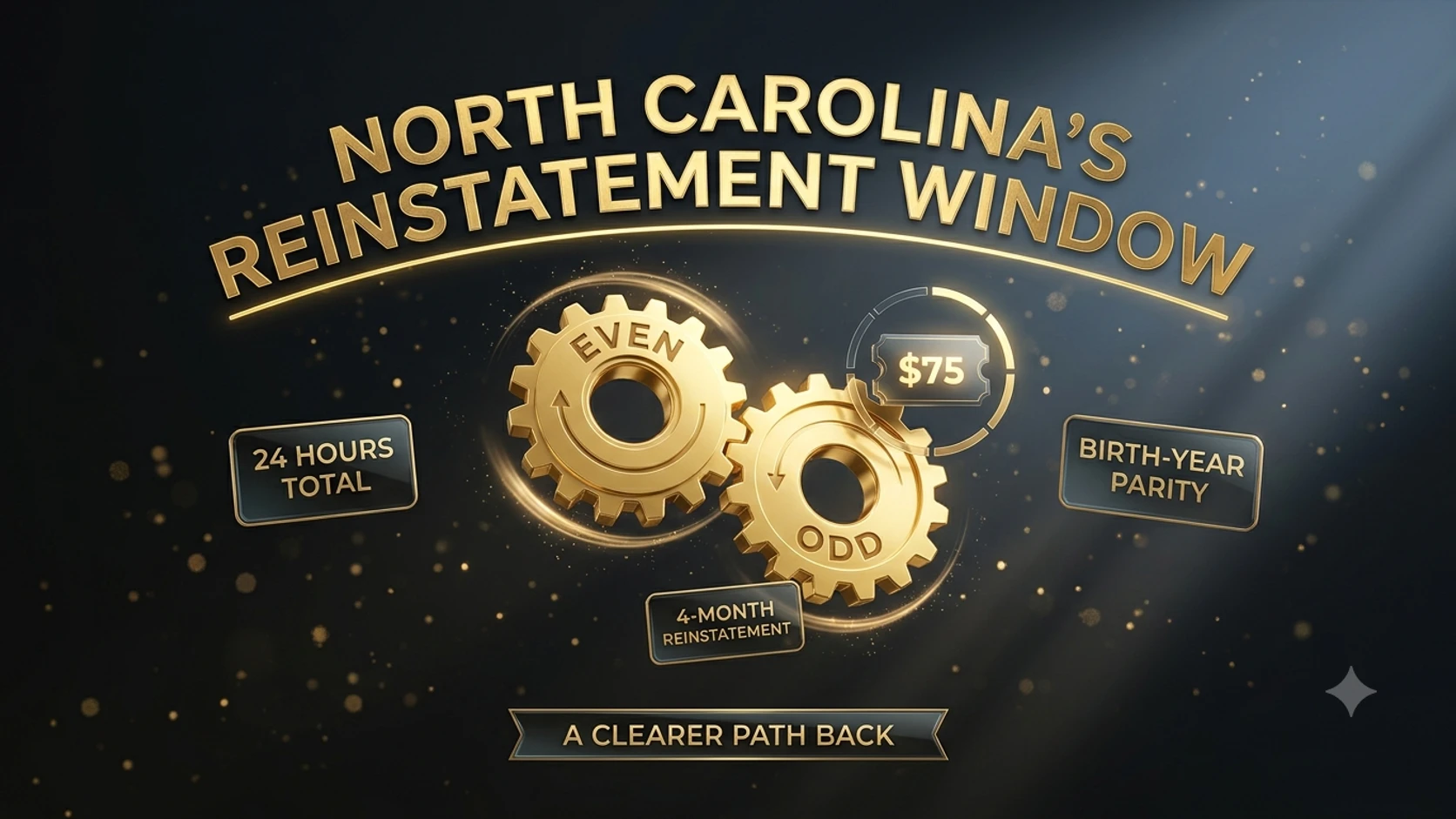
North Carolina resident insurance producers and adjusters must complete 24 hours of approved continuing education every two years, with at least 3 of those hours specifically in ethics. Unlike states that require separate hour minimums per line of authority, North Carolina's remaining 21 hours can be taken in any approved line of authority regardless of which specific lines the producer holds — a multi-licensed producer does not need to double up hours per line.
This makes North Carolina's structure notably simpler for producers holding several lines compared to states like New York (which doubles hours per major line) or South Carolina (which requires 8 hours minimum per line for multi-licensed producers).
Ethics and flood credits: fresh every period
North Carolina's 3-hour ethics requirement must be completed every compliance period — excess ethics hours from a prior period do not count as ethics credit toward the current period, though they may carry forward as general credit. The state applies the same logic to flood-specific credits for producers who hold that authority: both categories reset each cycle even though the general 21-hour pool has more flexibility.
What actually happens if you miss the deadline
North Carolina publishes an unusually specific consequence structure for missed CE compliance: agents who fail to meet the minimum hours, or fail to complete the mandatory ethics and flood hours, by their CE compliance date will have their license expire. However, the state then gives licensees 4 months from that compliance date to complete the outstanding requirement and submit a $75 reinstatement fee to Prometric to have the license restored.
This 4-month reinstatement window is more generous and more clearly documented than in many states, but it is not indefinite — a producer who lets the full 4 months pass without completing the hours and paying the fee faces a considerably harder path back to an active license, likely requiring a fresh application.
Renewal and compliance-date structure
The renewal date falls every two years on the last day of the producer's birth month, aligned to whether the producer was born in an odd or even year (odd-year-born producers renew in odd years, even-year-born producers renew in even years) — the same general birth-month/birth-year alignment pattern used in several other states covered on this site.
Worked example: a producer who catches a near-miss
A producer realizes one week before her North Carolina compliance date that she's 4 hours short of her 24-hour total, having completed her 3-hour ethics requirement earlier in the cycle but underestimated her general-hour progress. Rather than panicking, she checks North Carolina's structure and confirms that even if she misses the compliance date entirely, she has 4 months to complete the outstanding hours and pay the $75 Prometric reinstatement fee.
She still prioritizes finishing before the actual deadline to avoid the fee and any gap in active-license status, but understanding the reinstatement structure in advance changes a near-miss from a crisis into a manageable, bounded problem.
Flood-specific CE for producers with coastal or inland exposure
Producers who do sell flood insurance in North Carolina — a state with substantial coastal and inland flood exposure — should confirm whether any flood-specific CE add-on applies to their specific product mix, since several states in this region (including neighboring Pennsylvania and South Carolina) have recently added flood-specific training requirements as private flood insurance markets have grown.
Why North Carolina's birth-year parity system sometimes confuses producers
The birth-year parity structure — even birth years renewing in even years, odd in odd — means two producers born just one year apart can have renewal deadlines a full year apart from each other, which sometimes leads producers who compare notes with colleagues to mistakenly assume their own deadline matches a colleague's simply because their birth months are close. Always confirm the actual renewal date on file with the North Carolina Department of Insurance rather than assuming based on a colleague's schedule.
How North Carolina actually verifies CE compliance
North Carolina contracts with Prometric as its CE administrator, handling course-provider approval, course-roster processing, and compliance calculations for every licensee rather than the Department of Insurance tracking hours directly in-house. Course providers must agree to let North Carolina Department of Insurance staff, or Prometric acting as its designee, audit classroom instruction, course materials, instructor presentations, and attendance records at any time, and providers are required to retain those records for a minimum of three years.
For an individual producer, this means compliance status isn't something to track manually — a producer can view their own CE transcript and current compliance status directly through Prometric's Sircon-based portal at any point in a renewal cycle, rather than waiting until close to the compliance date to find out whether reported hours have actually posted.
This third-party administration model is distinct from states that run CE tracking entirely in-house through the Department of Insurance's own systems — a structure that shifts the practical point of contact for a North Carolina producer's compliance questions toward Prometric and Sircon rather than the Department directly, though the Department retains ultimate regulatory authority and can still act on any audit findings Prometric forwards to it.
The bottom line
North Carolina's combined-lines flexibility and its clearly defined 4-month reinstatement window make it one of the more producer-friendly states structurally, though producers selling flood insurance specifically should still confirm whether any flood-related add-on applies to their current license and product mix.
Producers relocating to North Carolina from another state should also confirm how any CE already completed elsewhere factors into their first North Carolina renewal, since reciprocity and transfer rules for newly resident producers can differ from the ongoing rules that apply to producers who've been licensed in North Carolina from the start.
Primary and official sources used for this guide
North Carolina Department of Insurance — Continuing EducationPrimary/official source for North Carolina CE hours and the post-lapse reinstatement structure.↗NC DOI — Continuing Education for Insurance Producers and AdjustersPrimary/official source for Prometric's role as CE administrator and the provider audit process.↗Source pages can change. Check the current text and effective date before relying on an hour requirement, a reporting deadline, or a course approval.
Written for licensed agents, not issued by a regulator. Insurance License CE Desk has no connection to any state department of insurance or CE provider. Hour requirements, ethics credits, and compliance deadlines are set state by state and do change, so your department of insurance, or the CE tracking vendor it uses, has the final word on what your transcript needs.