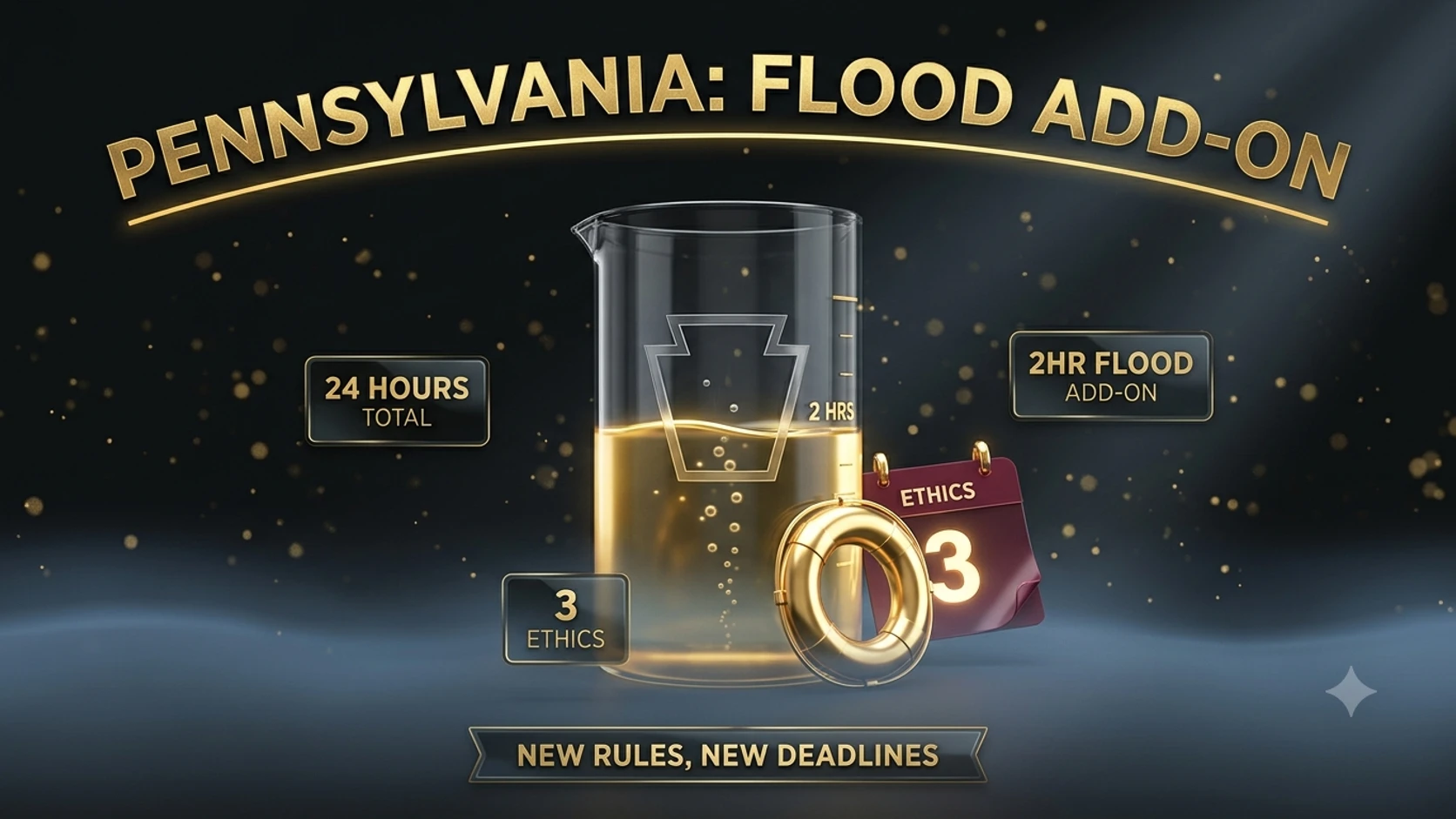
24 hours is the baseline, but two 2025 rule changes matter more
Pennsylvania's standard continuing education requirement is 24 hours per two-year licensing cycle, a figure that matches the most common pattern across states. What makes Pennsylvania worth checking carefully right now isn't the baseline number — it's two rule changes that took effect in 2025 and specifically affect producers who were already licensed before those dates.
Both changes create a real risk of a producer relying on an outdated understanding of Pennsylvania's requirements, either because they were licensed before the changes or because a course provider's page hasn't been updated to reflect them.
The new mandatory 3-hour ethics requirement has a specific compliance deadline
Pennsylvania added a mandatory 3-hour state-approved Ethics course requirement as part of the 24-hour total. For producers who were licensed before April 29, 2025, the state set a specific compliance deadline: complete the 3-hour ethics course by April 29, 2026, or by the end of the producer's current license period — whichever date is later.
This transition structure means two Pennsylvania producers with different license-renewal dates could have genuinely different effective deadlines for the same new ethics requirement. Check your specific license period end date against April 29, 2026 to determine which deadline actually applies to you, rather than assuming one universal date applies to every Pennsylvania producer.
Flood CE is a new, separate line item for property & casualty producers
Effective April 30, 2025, Pennsylvania requires Property/Casualty/Personal Lines producers to complete at least 2 credits of flood-specific continuing education during every renewal period. This is a distinct requirement from the general 24-hour total and the 3-hour ethics course — a third separate line item that only applies to producers holding property & casualty or personal lines authority, not to life or health-only producers.
Because this requirement is new, older CE planning checklists or course catalogs written before mid-2025 are unlikely to mention it at all. A P&C producer relying on a checklist written even a year earlier could complete their full 24 hours plus ethics and still be missing the flood-specific 2 hours.
Reporting timeline and what counts
Pennsylvania allows course providers 15 days, including the exam completion date, to report a completed CE credit to the state. Producers renewing close to their deadline should account for this reporting window rather than assuming a course finished the same week as the deadline will show up in time.
As with most states, only courses currently approved by the Pennsylvania Insurance Department count toward any of the three requirements — the general 24 hours, the 3-hour ethics course, and (for P&C/personal lines producers) the 2-hour flood requirement.
Worked example: a P&C producer navigating both 2025 changes at once
A property & casualty producer licensed in Pennsylvania since 2018 checks her current license period and finds it ends in late 2026 — later than the April 29, 2026 ethics deadline, so her effective ethics-course deadline is the end of her current license period, not the earlier date. She still needs to plan for it well before her actual renewal.
Because she holds P&C authority, she also builds in the new 2-hour flood-specific CE requirement as a separate item alongside her general 24 hours and the new 3-hour ethics course — three distinct boxes to check, not one combined total.
Checklist for Pennsylvania producers in this transition period
Confirm your specific license period end date against the April 29, 2026 ethics deadline to know which date actually governs your compliance. Confirm whether your lines of authority include property & casualty or personal lines, which trigger the separate 2-hour flood requirement.
- 24 total CE hours per two-year cycle (baseline)
- 3 hours state-approved Ethics — deadline is April 29, 2026 OR end of current license period, whichever is later
- 2 hours flood-specific CE for P&C/personal lines producers, effective April 30, 2025
- Allow 15 days for provider reporting before assuming a course posted
- Verify course approval status directly with the Pennsylvania Insurance Department, not an older provider catalog
Why Pennsylvania added a flood-specific CE requirement
Pennsylvania's new 2-hour flood insurance CE requirement reflects a broader national trend of state insurance regulators responding to increased flood risk and the corresponding growth of the private flood insurance market outside the federal National Flood Insurance Program. Producers selling flood coverage need current knowledge of both NFIP rules and the newer private-market flood products, which differ in coverage terms and underwriting.
The Pennsylvania Insurance Department's producer resource pages are the most reliable place to confirm the current complete requirement set for a specific license type, since a checklist built before mid-2025 is unlikely to mention either the flood add-on or the revised ethics deadline.
Non-resident reciprocity, with one line that never gets a pass
Non-resident Pennsylvania producers are generally exempt from the 24-hour structure (and the 2025 ethics and flood add-ons) described above, as long as they remain compliant with their home state's CE requirements. Title insurance is the one exception that doesn't bend to reciprocity at all: both resident and non-resident title agents must complete Pennsylvania's full 24-hour CE requirement every renewal period regardless of what their home state requires, since Pennsylvania treats title-specific compliance as a standalone obligation tied to the license itself.
Pennsylvania's non-resident renewal fee is $110 — double the $55 resident renewal fee — filed through the same NIPR or Sircon system used for the resident renewal process.
What reinstatement actually costs after a lapse
A Pennsylvania producer who lets a license lapse has up to one year from the original renewal date to request reinstatement, which requires a $165 lapsed-license renewal fee plus verification that all outstanding CE has been completed — the fee alone doesn't substitute for the coursework. Timing affects the outcome meaningfully: reinstating within 60 days of the lapse is retroactive to the lapse date with no gap in licensing history, while reinstating between 61 days and 12 months takes effect only going forward, meaning the producer was genuinely unlicensed and could not lawfully transact business during that gap.
Primary and official sources used for this guide
Pennsylvania Insurance Department — Continuing Education RequirementsPrimary/official source for Pennsylvania's 2025 ethics deadline and flood CE requirement.↗AgentSync — Pennsylvania Insurance Licensing & Regulatory ComplianceSecondary source for Pennsylvania's non-resident reciprocity, the title-agent exception, and renewal fees.↗Source pages can change. Check the current text and effective date before relying on an hour requirement, a reporting deadline, or a course approval.
Written for licensed agents, not issued by a regulator. Insurance License CE Desk has no connection to any state department of insurance or CE provider. Hour requirements, ethics credits, and compliance deadlines are set state by state and do change, so your department of insurance, or the CE tracking vendor it uses, has the final word on what your transcript needs.