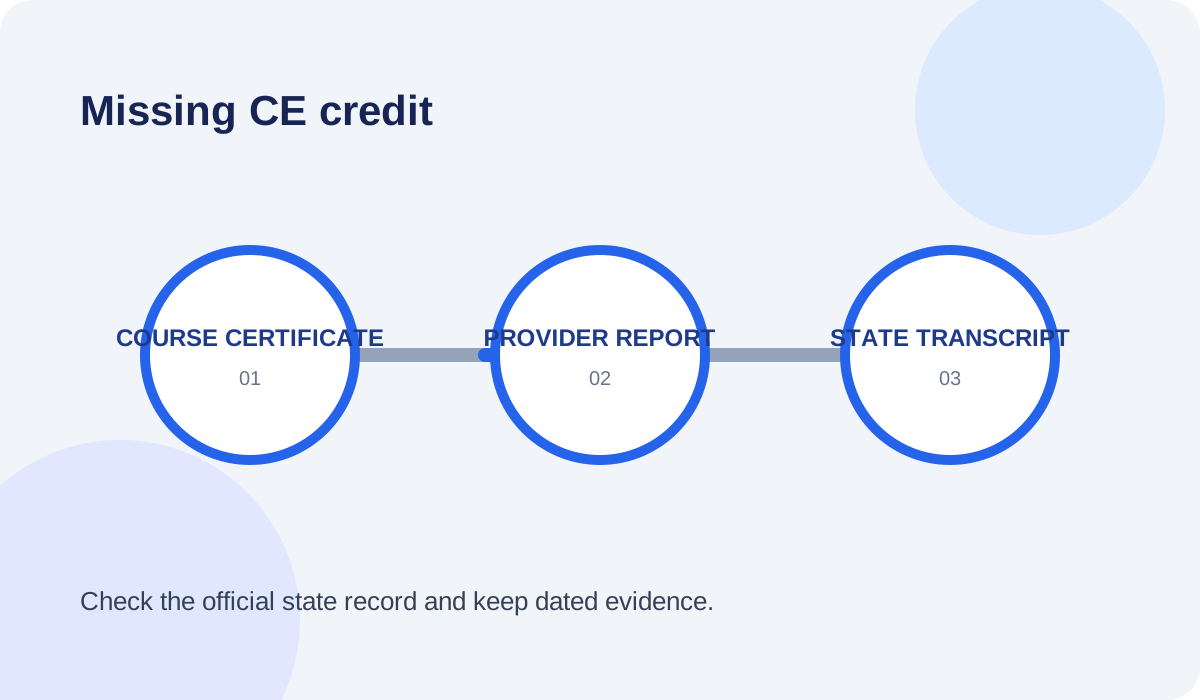
First confirm what is actually missing
A course can be completed without appearing immediately on the state transcript. The certificate records what the learner and provider say happened; the transcript records what the state system has received and accepted. Those records answer different questions. A blank line does not automatically mean the course was invalid, and a certificate alone does not prove that the state has credited the hours toward the correct requirement.
Open the CE transcript for the state and license you are trying to renew. NIPR directs producers to choose their state or territory to locate the corresponding transcript, while individual departments may use a state portal or a vendor such as Sircon or SBS. Check the transcript’s last-updated date and whether the page is showing the correct person, resident status, license class, and renewal period. Save a copy or screenshot with the date so you have a clear starting point if you need to ask for help.
Before reporting a missing entry, compare the course certificate against the transcript and the state’s current CE requirement. A course may appear under a different title than the marketing name, may be assigned a state course number, or may have been submitted under another license or state. If a credit is present but the total still shows incomplete, the problem may be a category or cycle allocation rather than a missing report.
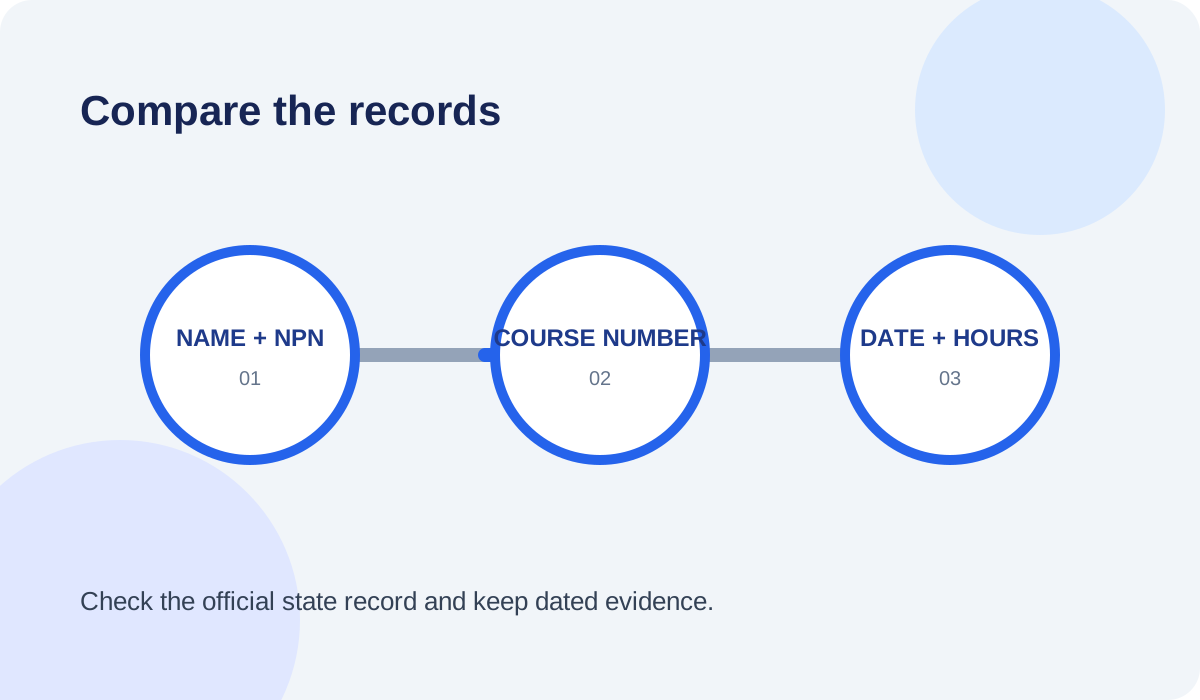
| Record field | What to compare |
|---|---|
| Identity | Name, NPN, license number, and state |
| Course | Course title and state approval or course number |
| Completion | Completion date and certificate status |
| Credit | Hours, category, renewal period, and posting status |
Check the reporting window without assuming one national deadline
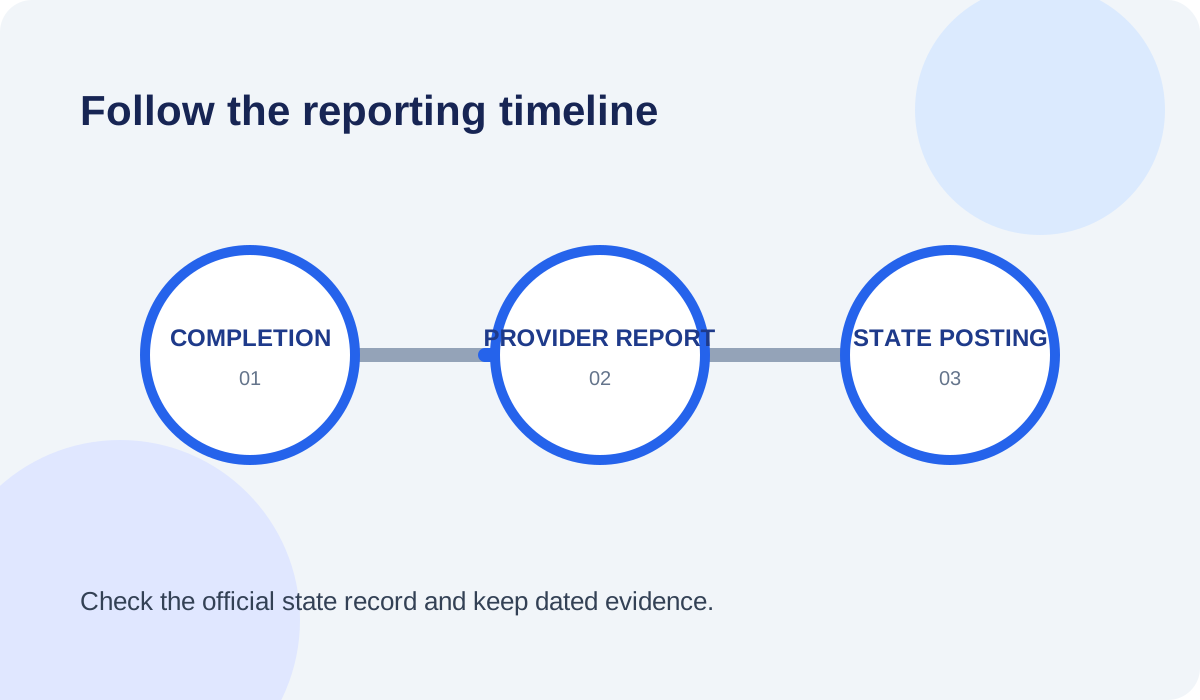
Course reporting is not instantaneous, and the timeline is not identical in every jurisdiction. NIPR’s renewal help page says that CE results can take three to five business days to be reported to the state and NIPR. NIPR’s broader producer guidance describes provider reporting periods that may run from 14 to 30 days. Those are general operational descriptions, not a replacement for the rule that applies to a particular state, course, and renewal period.
Read the course confirmation and the state’s CE instructions for the applicable reporting deadline. A provider may submit completions in batches, and a state system may need additional time to receive, match, or allocate a report. If the state’s stated window has not passed and the transcript otherwise looks correct, note the date and check again after the relevant processing interval. Avoid taking a duplicate course simply because a record has not appeared; duplicate-credit restrictions are state-specific, and repeating a course may not resolve a transmission or identity mismatch.
The renewal date changes how much patience is reasonable. When a deadline is near, contact the provider as soon as you have verified your details, even if the ordinary reporting period is still open. Ask for the expected submission date and whether the state has accepted the roster. At the same time, confirm the regulator’s instructions for a pending discrepancy, extension, or other relief; do not assume that a provider’s promise to report pauses the legal deadline.
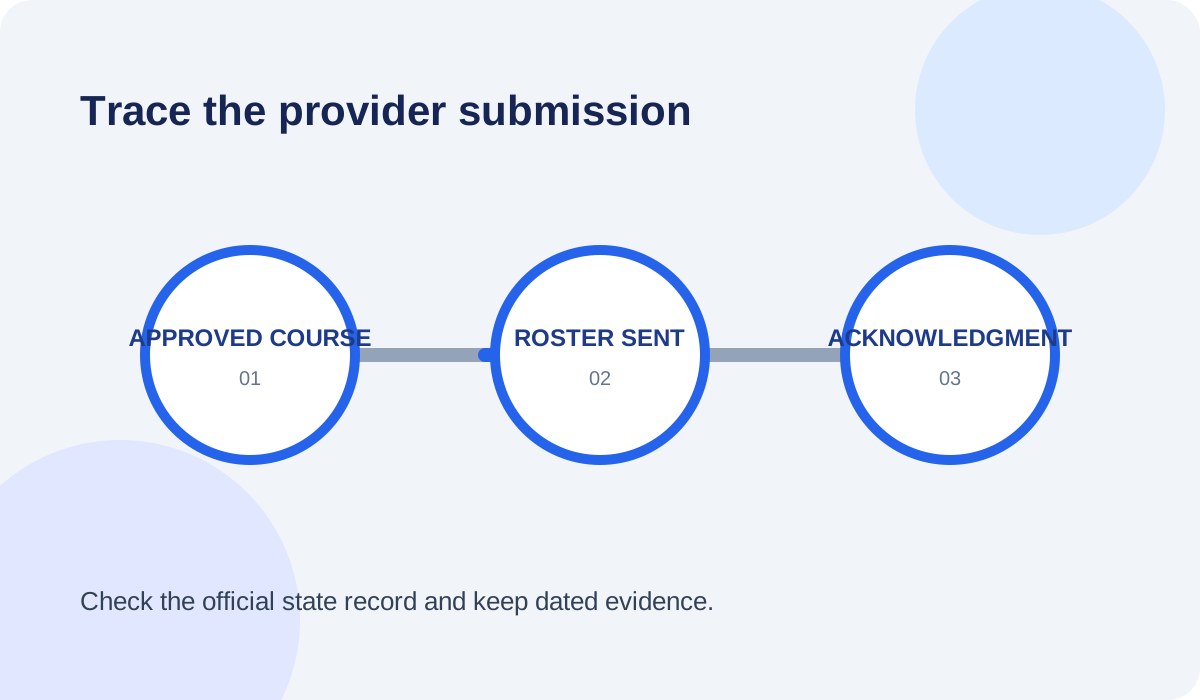
Ask the approved provider to trace its submission
Use the provider’s support channel for the exact course and state, not only a general account help form. Give the provider your name as registered, NPN or license number through its secure support process, state, course number, completion date, and certificate. Ask whether the course was approved for that state on the date you took it, whether your completion met the course rules, when the roster was submitted, and whether the submission received an acknowledgment or rejection.
A useful response distinguishes among three possibilities: the provider has not transmitted the completion yet; it transmitted it but the state rejected or could not match the record; or the state accepted it and the transcript is waiting to update. Ask the provider to correct a typographical error or resubmit a rejected record, and request a case number or written confirmation. Avoid sending a full Social Security number in ordinary email. Use the provider’s secure portal and provide only the information it needs to identify the completion.
If the provider says the completion was reported, ask for the report date, state destination, course number used, and any available confirmation identifier. A provider may not be able to share internal roster details, but these fields make the next conversation with the state more specific. Keep the reply and certificate together so you can show both the underlying completion and the attempted reporting path.
Escalate with a compact evidence packet
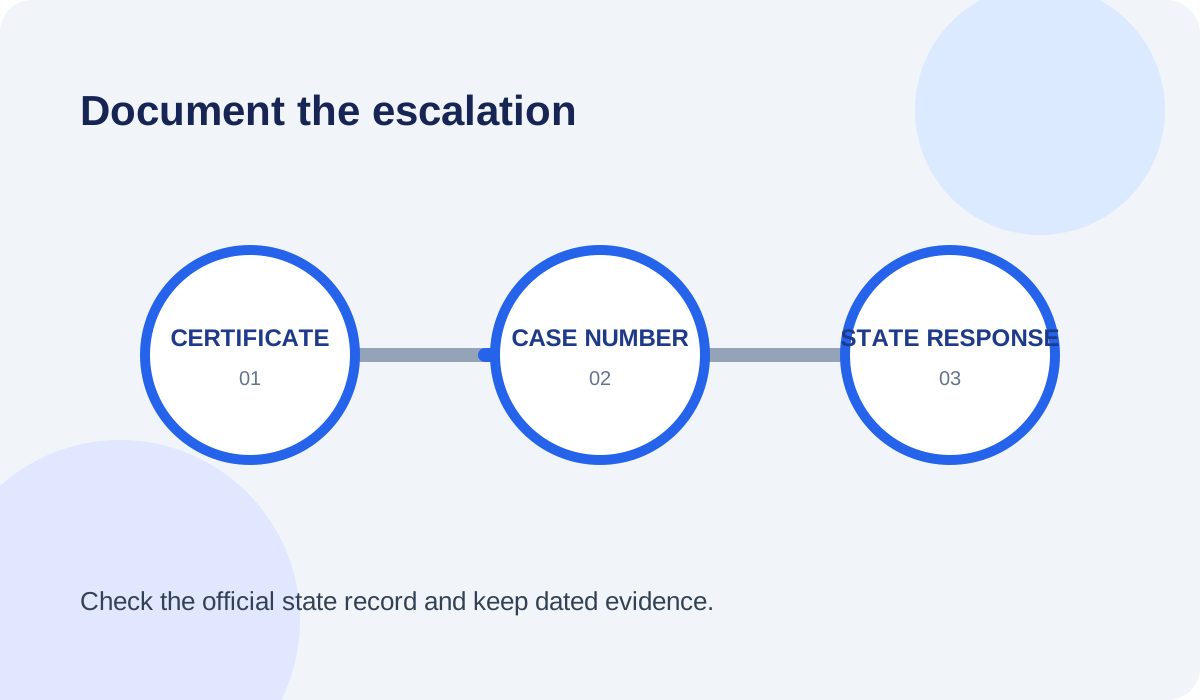
If the provider confirms a successful submission but the transcript remains unchanged beyond the state’s normal posting period, contact the state CE administrator or insurance department using the official channel listed for producers. Include a concise chronology: course completion date, certificate, provider case number, report or resubmission date, transcript check date, and the state renewal deadline. State clearly whether the credit is absent, assigned to the wrong period, or present in the wrong category; those are different issues and may be routed to different staff.
Ask which office owns the next action. Some states direct producers back to the provider for roster corrections, while others can investigate a received record or explain how the transcript allocates it. If the state asks for a certificate, send the requested document through its approved channel. Do not submit a second renewal application, pay a fee, or purchase a replacement course solely to force a transcript update unless the regulator’s instructions support that step.
When an expiration date is close, ask the department what it considers acceptable evidence and what options exist for a disputed or delayed posting. Keep the answer in writing. A certificate can help document your position, but it does not itself guarantee that you are compliant, that an extension was granted, or that you may continue transacting after a license status changes. Check the official license status and follow the regulator’s instructions while the discrepancy is unresolved.
Check category, cycle, and course-approval issues
A course may be visible and still not satisfy the shortfall you care about. The transcript could show the hours as general credit when the state requires a specific ethics, law, flood, or product-related category. It might be allocated to a prior or future period under the jurisdiction’s rules. A course could also have a valid completion certificate but lack approval for that state, license type, or completion date. Ask the state or provider to identify the precise reason rather than relying on the displayed total alone.
Review the state’s course lookup or approval instructions using the course number printed on the certificate. Confirm the credit value and category, the license type to which it applies, and whether any state-specific completion condition was required. If the course was taken for multiple state licenses, do not assume the same course is reportable in the same way everywhere. Reciprocity and course approval rules determine what each state accepts.
Also check whether the reported course was a repeat. A number of states limit duplicate credit, but the lookback period and what counts as the same course differ. Compare the course identifier and previous completion dates against the state rule. If a repeat restriction explains the missing hours, ask whether another eligible course is needed and how the state treats the first completion; do not infer the rule from another state’s transcript.
Keep a record that is easy to audit later
Save the certificate, enrollment confirmation, payment receipt, course number, provider approval information, and any transcript snapshot. Keep the provider and regulator correspondence with dates and case numbers. Name files so the state, course, and completion date are easy to identify, and retain them for the period stated by the regulator or your employer’s record policy. A simple folder per renewal period is often enough; the purpose is to locate proof quickly if an audit or renewal review occurs.
The NAIC’s sample producer FAQ recommends retaining certificates even where online renewal does not require sending them, because a certificate may be needed to resolve a discrepancy or respond to an audit. That FAQ is an illustrative model resource, not a binding rule for every state. Follow the retention period and documentation requirements published by the state that issued your license, and use the regulator’s current instructions when they differ from a generic checklist.
For a multi-state producer, keep the transcript and supporting documents separated by jurisdiction. One state’s record may be complete while another has a reporting delay or category mismatch. A spreadsheet can track completion date, state, course number, credits, category, and posting status, but do not treat a personal spreadsheet as an official transcript or as a substitute for the state’s compliance determination.
| Date | Action | Evidence to retain |
|---|---|---|
| Course day | Finish the approved course | Certificate and course number |
| After submission | Check the state record | Dated transcript snapshot |
| Provider follow-up | Request a roster trace | Support case and reply |
| State escalation | Ask for discrepancy instructions | Official response and next step |
Prevent a last-minute scramble next cycle
Check the transcript early enough to correct an error while the provider and state have time to investigate. NIPR recommends regularly reviewing CE records and checking results against state requirements before renewing. That is a planning practice, not a universal legal buffer. Set reminders based on the state’s official deadline and processing guidance, then verify that every required category—not just the headline total—shows compliant.
Before enrolling, verify the course and provider approval for the exact state. Enter your identifying information consistently with the license record, especially after a legal name change or when using an older account. At completion, download the certificate and note the course identifier immediately. Later, compare the state transcript to your own course log rather than relying only on a provider dashboard, which may show course completion without confirming state acceptance.
If the transcript shows a discrepancy, follow the same sequence each time: identify the state and period, compare the certificate, ask the provider to trace the report, then escalate to the regulator with a dated evidence packet. This creates a documented trail and avoids unnecessary duplicate enrollment. Requirements, reporting timelines, and remedies vary; the licensing state’s current instructions control the specific compliance decision.
Primary and official sources used for this guide
NIPR — Continuing Education TranscriptsOfficial transcript access page directing producers to choose the state or territory whose CE record they need to review.↗NIPR Help — Renew a LicenseNIPR renewal guidance notes that CE results can take three to five business days to be reported to the state and NIPR; state instructions still control.↗NIPR — Stay on Track with Continuing Education for LicensingNIPR general guidance on provider reporting windows and transcript checks; not a substitute for a jurisdiction-specific deadline.↗Sircon — Mississippi Producer PortalState portal example directing licensees with unrecorded CE to contact the education provider; procedures vary by state.↗NAIC — Producer Licensing Handbook, Sample CE QuestionsIllustrative model FAQ recommends keeping course certificates and explains that proof may be requested when a discrepancy or audit occurs; not binding state law.↗Source pages can change. Check the current text and effective date before relying on an hour requirement, a reporting deadline, or a course approval.
Written for licensed agents, not issued by a regulator. Insurance License CE Desk has no connection to any state department of insurance or CE provider. Hour requirements, ethics credits, and compliance deadlines are set state by state and do change, so your department of insurance, or the CE tracking vendor it uses, has the final word on what your transcript needs.