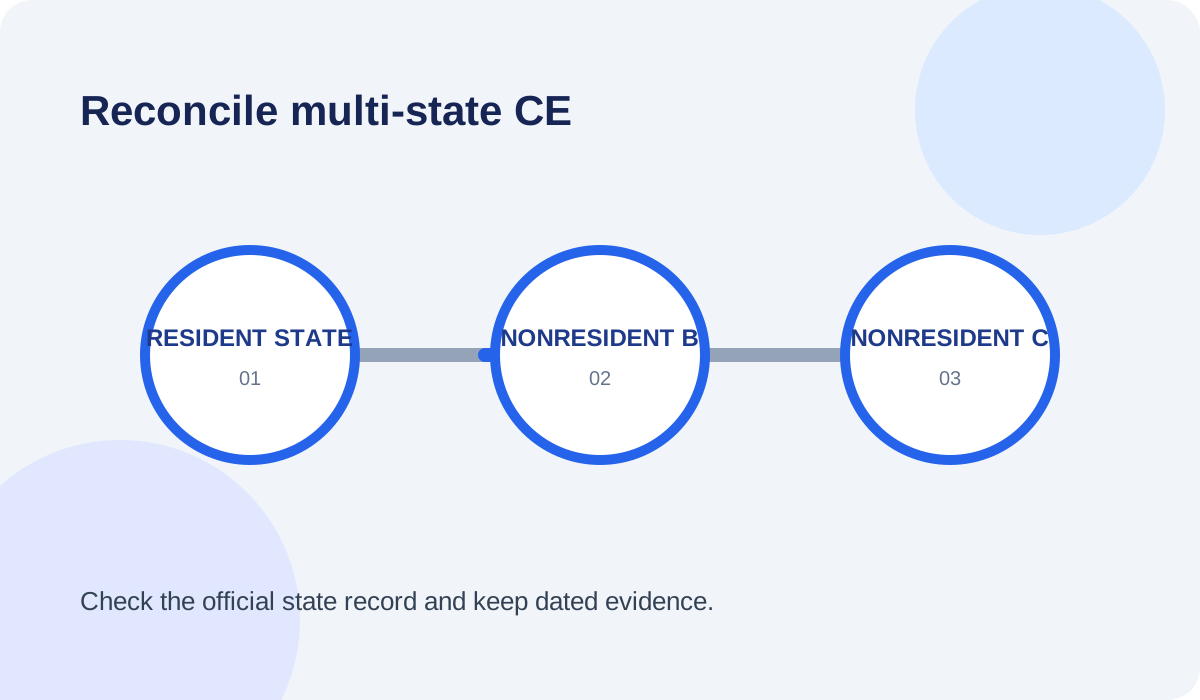
Build the license list before comparing hours
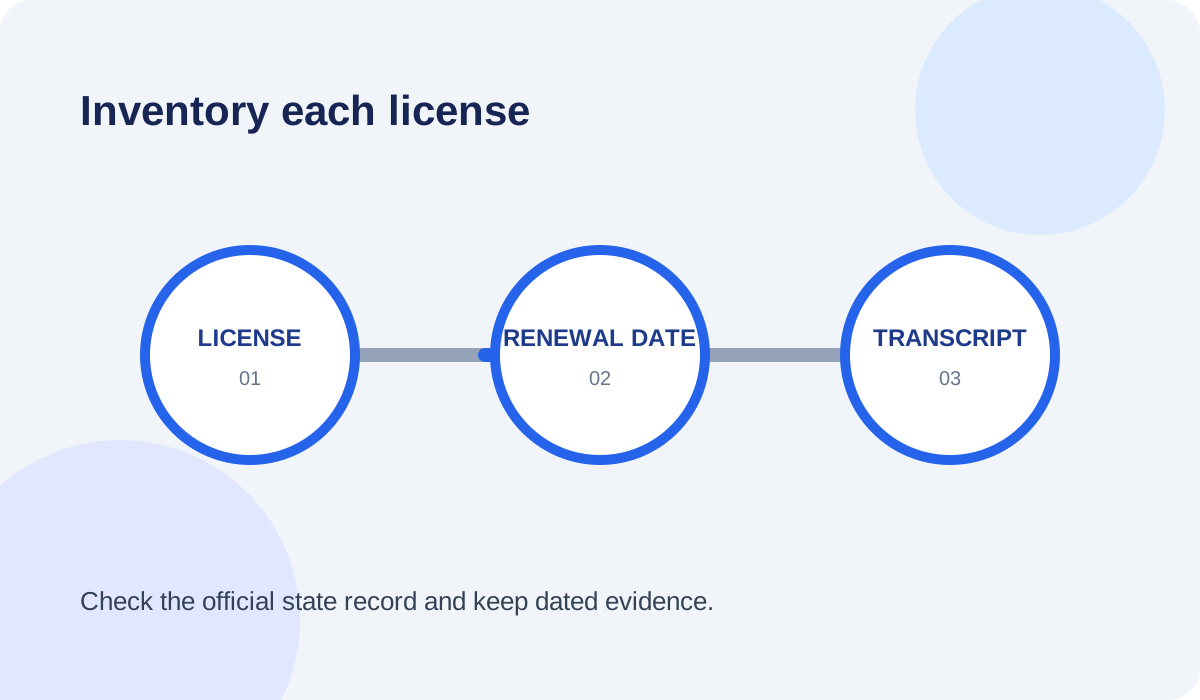
A producer who holds licenses in several states should begin with an inventory of active individual licenses, resident status, lines of authority, renewal dates, and the official CE system for each jurisdiction. Do not begin with one national hours total: the license list determines which states’ rules and records need review. Use each department’s license lookup or the official licensing portal to confirm that the license is active and that the lines on the record match the work you perform.
Record the resident state separately from every nonresident state. The home-state record is often central to reciprocity, but nonresident rules are determined by each state’s current statute and implementation. A nonresident state may accept the producer’s home-state CE, may ask the resident state to confirm compliance, or may publish a limited exception. Do not infer an exemption from a general reciprocity summary or from another producer’s experience.
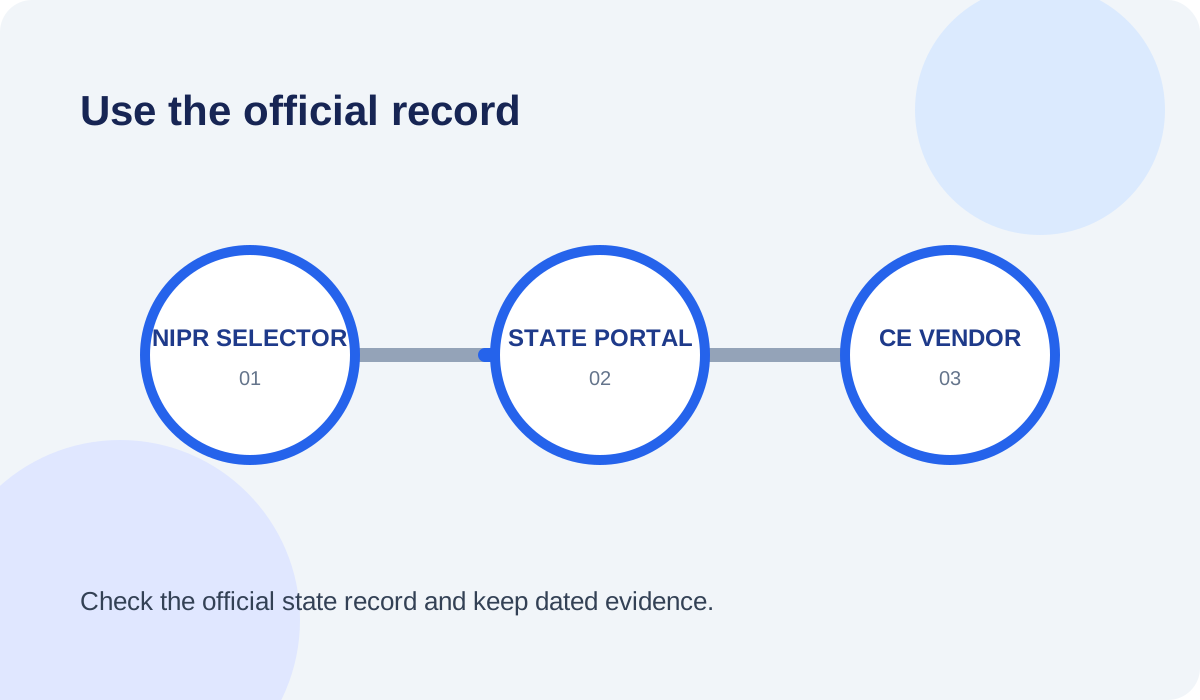
For each license, note the next renewal or continuation date, the cycle being measured, the CE administrator, and where to obtain the transcript. NIPR provides a state and territory transcript selector, and some state pages direct licensees to Sircon, SBS, or another portal. The portal is a route to evidence; the licensing state remains the authority on whether the record satisfies that license’s requirement.
| Field | What to record |
|---|---|
| Jurisdiction | State and resident or nonresident status |
| License | License type, active lines, and renewal date |
| Rule | Current CE requirement and reciprocity condition |
| Record | Official transcript portal and latest status |
Use the resident state as the starting point, not as a shortcut
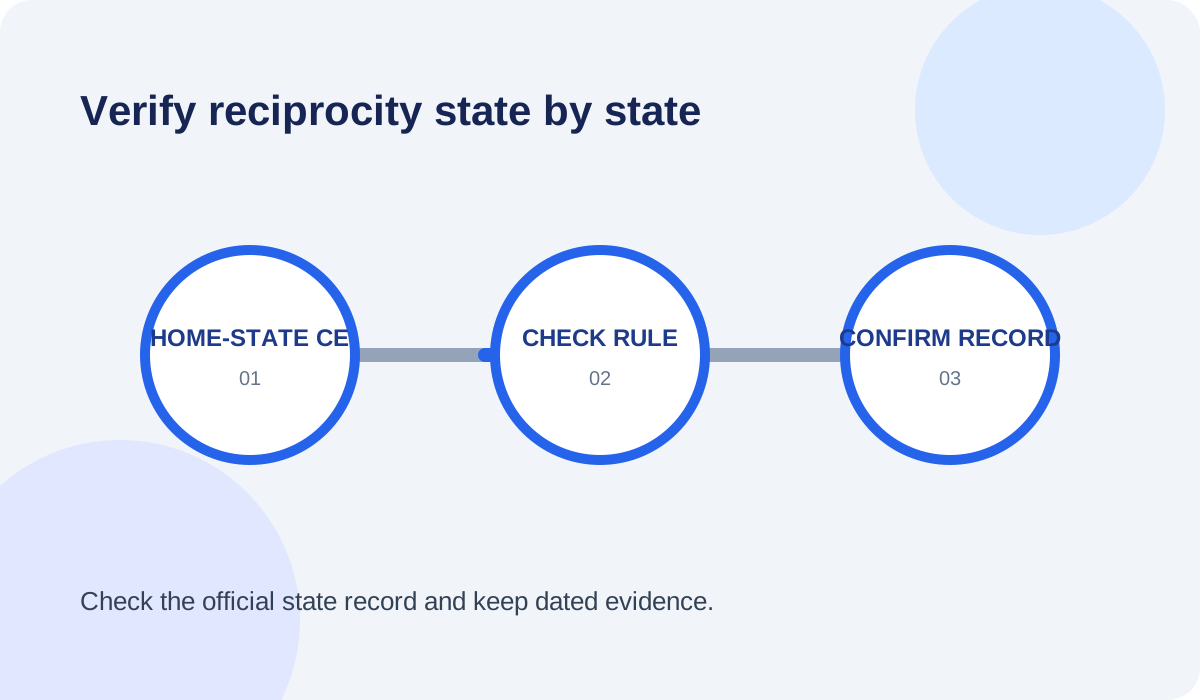
NIPR notes that meeting a producer’s home-state CE requirement often satisfies other states’ requirements because of reciprocity, while advising licensees to verify. That wording matters: reciprocity is common but it is not permission to stop checking. Begin by confirming the resident state’s required total, categories, course approval, cycle, and compliance status. Then review each nonresident state’s current instructions to see how it recognizes resident compliance and whether it lists an exception for your license type or course.
Do not treat an NAIC model, a reciprocal filing framework, or an industry summary as proof that every state adopted identical text. A model may guide state laws, but the enacted rule and official state instructions define the actual obligation. When instructions are unclear, ask the nonresident department how it verifies the home-state record, whether a separate transcript is maintained, and whether any product-specific training sits outside the general CE requirement.
A producer can therefore be compliant in the resident state and still need to correct a nonresident record, provide evidence of an exception, or complete a separate obligation. Keep the distinction visible in the tracker: resident-state CE status; nonresident reciprocity confirmation; and any state-specific add-on. That structure prevents the common mistake of treating a single green status from one portal as proof for every jurisdiction.
Check what each transcript actually covers
Do not assume every portal displays the same data or the same level of detail. NIPR’s CE transcript page offers state-specific access, and NIPR reported that transcript data in its renewal workflow is available for a defined group of states using SBS’s service. Other jurisdictions may direct producers to an external state or vendor portal. If a state’s record is not in the portal you normally use, follow that state’s official link rather than concluding that no record exists.
Compare course date, provider, course number, hours, category, license period, and compliance status where those fields are available. One state may display individual course entries; another may show only a total or a compliant/not-compliant flag. A difference in display does not necessarily mean a difference in legal treatment, but it does determine what evidence you may need to retain and what question to ask if the result is unclear.
Save the date each transcript was checked. Records can change after provider reporting or a state update, so note when you reviewed them and whether the status was final. If the portal permits a PDF download, keep it with your course certificates. If it does not, save a dated screenshot or record the portal and status shown, subject to the department’s own evidence instructions.
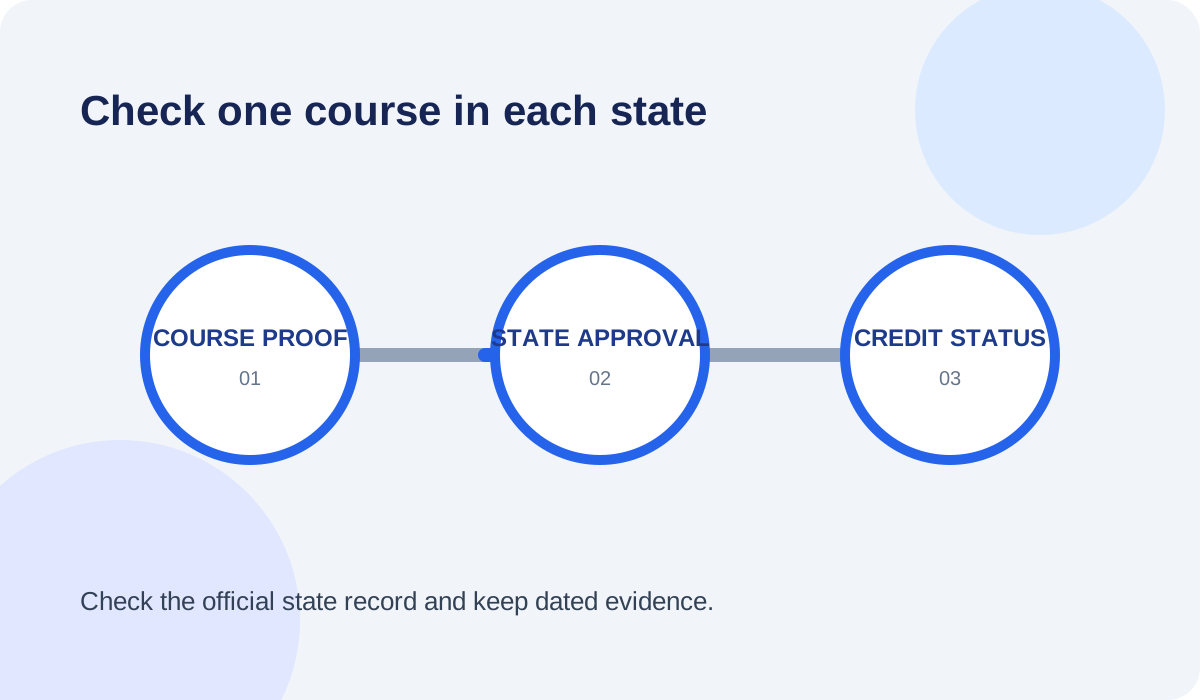
Reconcile one course against every state separately
A course completion is one event, but its credit treatment can differ across jurisdictions. The course may be approved for one state but not another, assigned to different categories, reported on different schedules, or excluded from a particular period under a repeat-course rule. Keep a course ledger with the completion date, state approval number, hours, topic, and each state where you expect it to count. Mark the expected credit as pending until the relevant official record confirms it.
Compare the ledger to every state transcript, not only the total hours on your provider’s dashboard. If one record is missing, use the process in that state: first check the certificate and identity fields; next ask the approved provider whether the roster was submitted and accepted; then contact the state CE administrator if the state’s normal reporting window has passed. Use the state’s own deadline rather than applying a national estimate to every record.
Where credit appears in a different category or period, ask the regulator or provider how the state allocated it. Do not manually reassign it in your own tracker and then treat that as official compliance. A spreadsheet helps you detect differences and follow up, but the state transcript and applicable rule determine what the credit satisfies.
| Course detail | Why it matters |
|---|---|
| Completion date | Places the course in each state's applicable period |
| Approval number | Helps verify state and license eligibility |
| Hours and category | Shows whether required categories are covered |
| Transcript status | Separates completion from accepted state credit |
Separate general CE from product training and exceptions
A transcript reconciliation should include a separate column for obligations that are not simply general renewal hours. Depending on the state and product, annuity, long-term care, flood, or other training may have a one-time or recurring requirement, a state-specific course, or a separate evidence process. The exact rule depends on the license and the state where the producer acts. Confirm whether the obligation is reported as CE credit, tracked separately, or documented through a certificate or another portal.
The same care applies to extensions, waivers, military provisions, and other exceptions. An exception may apply only to certain licensees, time periods, or circumstances, and may require a request before a deadline. Do not mark a state complete because a waiver seems likely or because another jurisdiction granted one. Record the applicable official rule, the filing date, the decision, and any conditions the state imposed.
This separation also prevents double counting. A product course may count toward a state’s general CE total and still be subject to a distinct sales-training requirement, or it may satisfy only one of those needs. Ask the regulator or insurer which record proves each obligation. A course provider’s marketing description is not enough to establish that it meets every licensing and product standard.
Use a deadline review that leaves room for corrections
A multi-state renewal calendar should show the earliest upcoming deadline and the state-specific reporting instructions for that license. NIPR advises producers to review CE requirements and records before renewal; its renewal help page also notes that processing and reporting can take time. These are useful planning signals, but they do not create one universal buffer. Use the deadline and processing rules published by each state, and start sooner where several licenses renew close together or a transcript discrepancy is already open.
About a month before a deadline can be a practical checkpoint for a producer who wants time to investigate, but do not label that timing a legal requirement unless the state says so. At the checkpoint, confirm that each transcript reflects the expected hours and categories, each nonresident state shows the appropriate reciprocity status, and any separate training has its own proof. If a state requires a different verification date or submission step, follow that instruction instead.
If a record is still incomplete, contact the provider or department with the state-specific evidence packet and ask what action remains. A receipt for a renewal application does not necessarily mean the state approved it or that CE compliance has been met. Check license status after filing and follow the state’s direction if it remains pending or becomes inactive.
A worked example: three states, one course plan
Imagine a producer with a resident license in State A and nonresident licenses in States B and C. She completes an approved ethics course and two general courses. Her resident transcript displays all three, with the ethics category satisfied. State B accepts resident-state CE under its published reciprocity rule, but its portal takes additional time to refresh. State C lists a product-specific course requirement for the authority she holds. A single provider dashboard cannot answer all three questions: State A needs its category total; State B needs confirmation of the reciprocity record; State C needs both general CE recognition and separate proof for the added training.
She saves each certificate, downloads the State A transcript, checks State B’s official license record after its stated processing period, and contacts the provider about the missing roster. For State C, she checks the official product-training guidance and keeps the required certificate in a separate folder. The course plan may ultimately satisfy all three states, but she does not treat that result as established until each state’s record or official instructions support it.
The example is a workflow, not a prediction about any particular state. Real requirements depend on the producer’s license, renewal period, resident status, course approval, and the law in effect. Use the state-specific source list and verify all deadlines and categories before relying on a course for an active license.
A concise pre-renewal reconciliation checklist
Review the license inventory against current state lookup records, then open the official CE transcript or portal for every jurisdiction. Match the course ledger to the transcript line by line, including course identifiers, dates, hours, categories, and renewal periods. Confirm the resident state’s compliance result and separately verify every nonresident reciprocity rule or state-specific exception. Keep product training, waivers, and extensions in their own evidence fields so they do not disappear inside a general-hour total.
For any mismatch, follow the affected state’s sequence and preserve the provider case number, dated transcript, certificate, and regulator response. Do not repeat a course or submit a duplicate renewal just to change a status unless the official state instructions call for it. Once the status is resolved, update your tracker with the outcome and the source that confirmed it. That small record makes the next renewal easier to audit and less dependent on memory.
The safest cross-state habit is simple: one license, one state rule check, one official record check. Common reciprocity can reduce duplicate coursework, but it does not eliminate the need to verify how each state recognizes the resident record. When a summary conflicts with a state department’s current instruction, ask the state before relying on the summary.
Primary and official sources used for this guide
NIPR — Continuing Education TranscriptsState and territory selector for finding the relevant CE transcript.↗NIPR Help — Renew a LicenseRenewal preparation guidance, transcript links, and CE result processing notes.↗NIPR — State RequirementsOfficial starting point for checking individual jurisdiction requirements; state rules and instructions control.↗NIPR — 2023 Year in Review: CE Transcript DataNIPR describes transcript data availability for a defined group of states using SBS; portal coverage should not be assumed universal.↗NAIC — Continuing Education Reciprocity AgreementModel reciprocity framework; each state’s adopted law and current guidance determine the applicable producer obligation.↗Source pages can change. Check the current text and effective date before relying on an hour requirement, a reporting deadline, or a course approval.
Written for licensed agents, not issued by a regulator. Insurance License CE Desk has no connection to any state department of insurance or CE provider. Hour requirements, ethics credits, and compliance deadlines are set state by state and do change, so your department of insurance, or the CE tracking vendor it uses, has the final word on what your transcript needs.