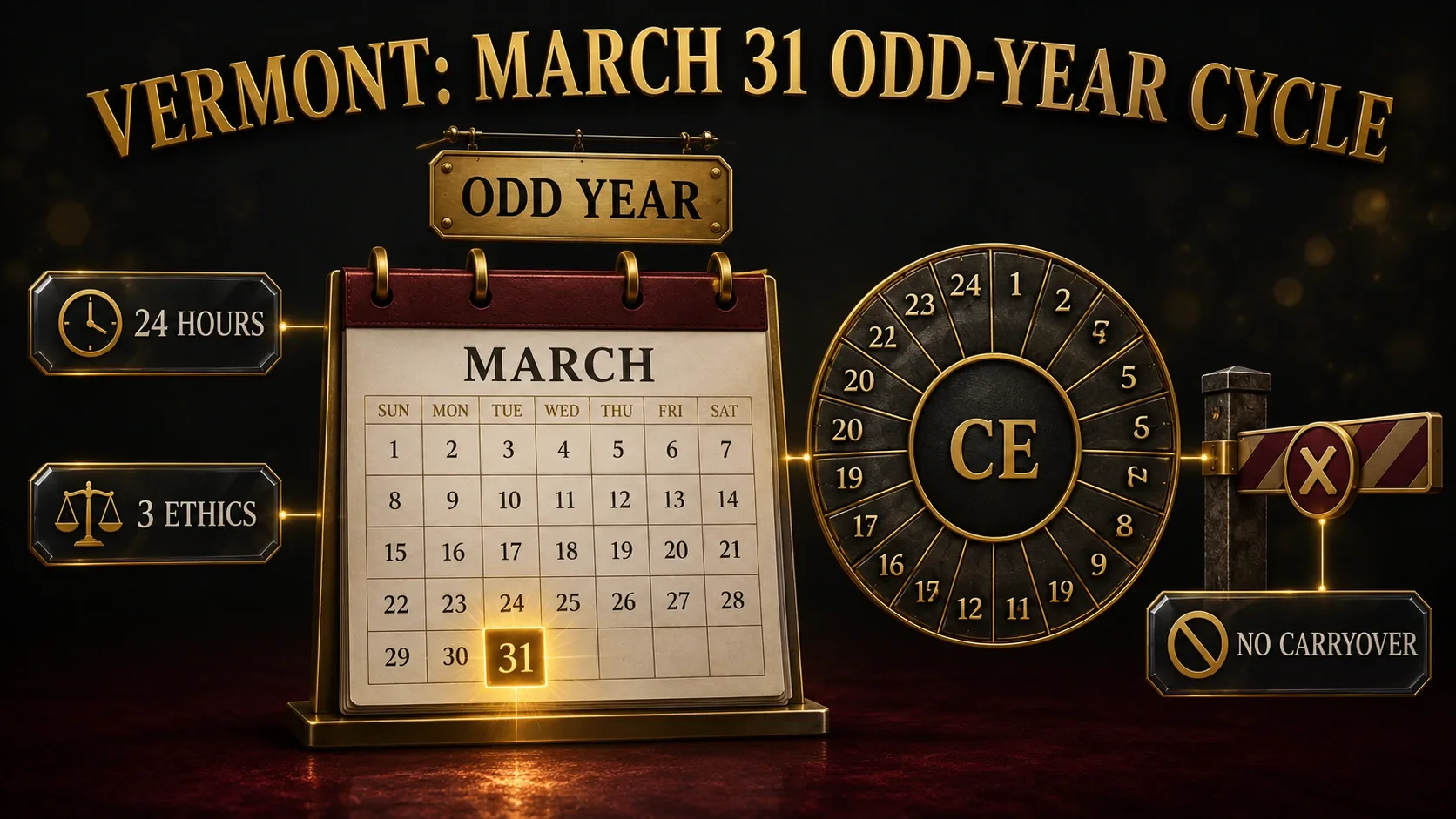
24 hours, 3 ethics, plus a one-time flood course
Vermont requires 24 CE hours per two-year license term for resident producers, with 3 of those hours in ethics. Producers holding a property or casualty license also have a one-time 3-hour Flood Insurance course requirement — a single lifetime course, not a recurring one, and its hours count toward the 24.
No more than 6 hours of the 24 can be in insurance-agency-management courses. A producer building a schedule around business-operations content would find the excess above 6 does not count toward the requirement.
The fixed March 31 odd-year deadline
Vermont's license term runs April 1 to March 31 of odd-numbered years. Like Delaware's February deadline, this is a shared statewide date — every Vermont resident producer's CE and renewal are due March 31 of the same odd year, with no birth-month variation.
A producer who licenses in an even year has a short first term ending that March 31. Because everyone in the state renews together, CE providers see a February and March crunch every odd year — completing in the fall of the even year avoids competing for seats and reporting time.
No carryover, no repeats, and the exemptions
Vermont does not allow excess CE credit to carry forward into the next reporting period, and a course cannot be taken for credit more than once inside the same reporting period.
Vermont exempts producers licensed less than two years at the time of their first renewal, producers holding any limited or restricted license, and producers licensed only in title, travel accident, or travel baggage insurance. Non-residents compliant with their home state's CE requirement are exempt under standard reciprocity.
The 14-day grace period and reinstatement
If CE was completed before the license expiration date, Vermont gives a 14-day grace period after March 31 to submit the renewal application. That grace period covers only the paperwork — it does not extend the CE deadline itself, so a producer who was short on hours at March 31 gets no benefit from it.
If CE is not completed, or an extension is not requested, by March 31, the license is not renewed and lapses. A lapsed license reinstates on payment of the biennial renewal fee plus a late renewal penalty within one year; past one year, the producer retakes the pre-licensing exam and pays the initial application fees.
How completions are reported, and what to keep
Vermont-approved providers report completions to the Department of Financial Regulation electronically, and the producer's CE record is what the Department checks against the March 31 deadline. Because the whole state renews at once, provider reporting queues are slowest in February and March — the same argument for finishing in the fall.
The one-time flood-course certificate is worth holding indefinitely, since a routine transcript may not surface it. For the rest, the point of keeping certificates in Vermont is the 14-day grace window: it only forgives late renewal paperwork when the CE record was already clean at March 31, so a producer needs to be able to prove the hours were done on time, not just eventually.
Non-resident producers
The fixed March 31 deadline and the 24-hour count are resident rules. A non-resident producer licensed in Vermont follows their home state's CE requirement instead, provided the home state imposes CE.
The one-time flood course is tied to the P&C product line and can apply to a Vermont P&C sale regardless of residency — confirm against a current Department of Financial Regulation bulletin.
Worked example
A P&C producer newly licensed in 2026 (an even year) has a first term ending March 31, 2027. She completes the one-time 3-hour flood course, a 3-hour ethics course, and 18 hours of general P&C content — keeping agency-management courses to no more than 6 of those hours.
She finishes by December 2026, three months early, so a provider reporting lag cannot push her past March 31. If her paperwork then slips a week, the 14-day grace period covers her — but only because the CE itself was already done.
The bottom line
The key Vermont facts are the deadline and the flood course: CE and renewal are due March 31 of odd-numbered years for every resident producer, and any P&C producer also owes a one-time 3-hour flood course. Plan completion for the fall of the even year before — the 14-day grace period only forgives late paperwork, not late CE.
Book a 3-hour ethics course, the one-time flood course if you hold property or casualty authority, and general hours to reach 24 with no more than 6 in agency management. Finish by December of the even year so you are not competing with the whole state for course seats and provider reporting in February and March. If CE is genuinely done by March 31, the 14-day window covers a slow renewal filing; if it is not, the license lapses.
Primary and official sources used for this guide
Vermont Department of Financial Regulation — Continuing Education Requirements for Insurance ProducersPrimary/official source for Vermont's 24-hour requirement, the ethics carve-out, the agency-management cap, and the exemptions.↗Vermont Department of Financial Regulation — Apply For and Renew Your LicenseOfficial source for Vermont's April 1–March 31 odd-year term, the one-time flood course, the 14-day grace period, and the one-year reinstatement limit.↗Source pages can change. Check the current text and effective date before relying on a threshold, waiting period, or required form.