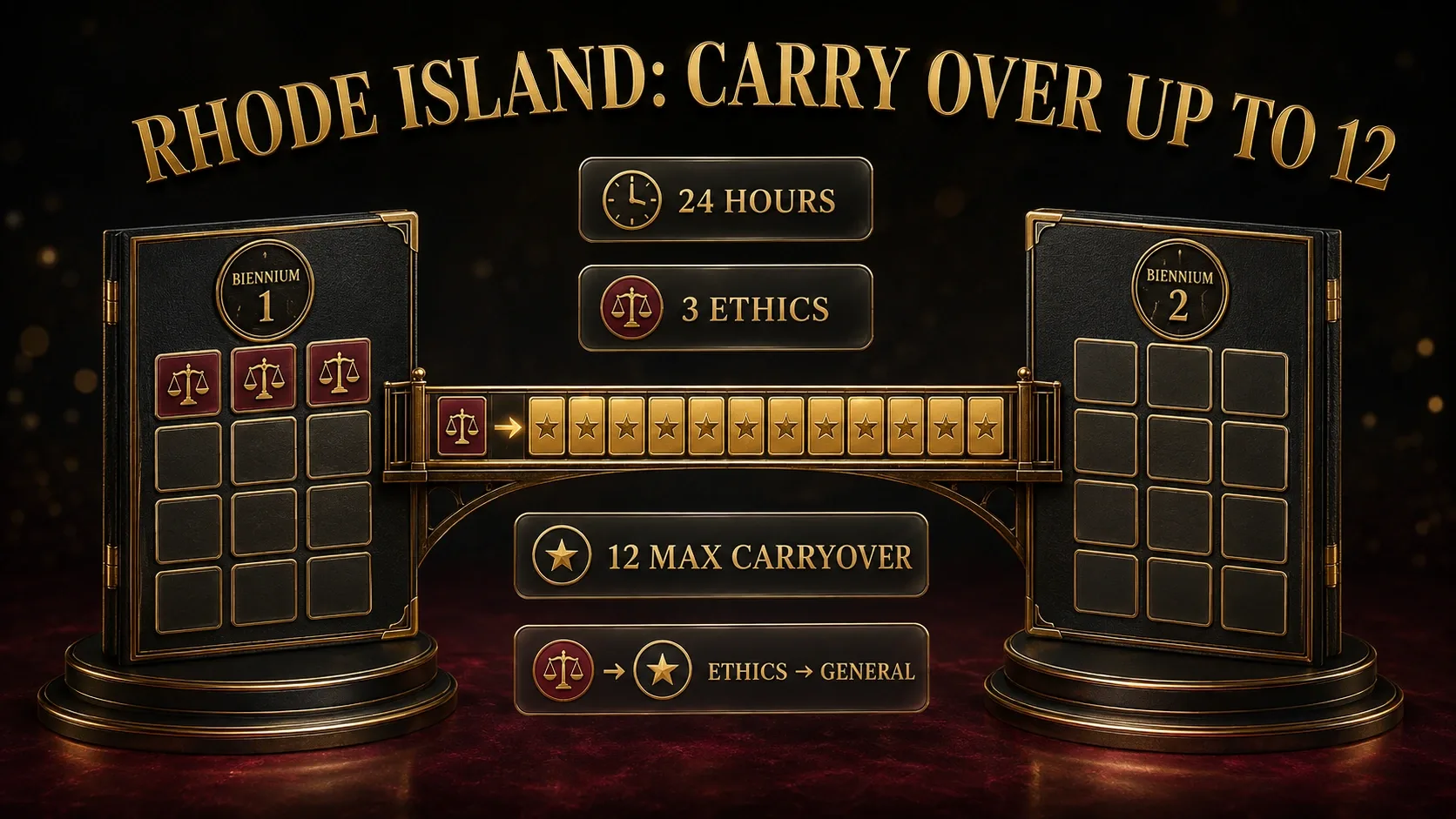
24 hours, 3 ethics, 5 per line
Under Rhode Island regulation 230-RICR-20-50-2, resident producers need 24 CE hours per two-year license term, with 3 of those hours in ethics. Rhode Island also imposes a per-line floor: a minimum of 5 hours in each line of authority the producer holds.
A dual-line producer cannot concentrate all 21 general hours in one line — at least 5 have to be P&C and at least 5 have to be L&H, with the balance flexible. It is a softer version of Hawaii's split, but the same trap: a full 24 hours in one line fails the check.
The one-time FEMA flood course
A Rhode Island property/casualty producer must complete a one-time 3-hour FEMA flood insurance training course. The National Flood Insurance Program course credits count toward the producer's 24-hour CE requirement in the cycle they are completed, so the flood course is not 3 hours on top of the requirement.
It is still a required course tied to the P&C line — a producer cannot skip it by completing 24 general hours, and a producer who added P&C authority after their initial license should confirm whether the flood course is already on their record.
The 12-hour carryover
Rhode Island allows a maximum of 12 excess credit hours to carry forward into the next license term. Excess ethics hours carry forward only as general credit, so a producer relying on carryover still has to complete a fresh 3-hour ethics course each cycle.
A producer who front-loads can use the 12-hour carryover to cut the next cycle's load roughly in half — a meaningful amount, unlike the 5-hour and 6-hour carryovers some neighboring states allow.
Birth-month renewal, the grace period, and reinstatement
The Rhode Island license term ends on the last day of the producer's birth month, every two years. A course may not be repeated for credit inside the same two-year term. There is a 30-day grace period after expiration during which a producer can still renew.
From 31 days to one year past expiration, the producer applies for reinstatement through NIPR — paying both the renewal fee and a reinstatement fee ($170 for residents, $180 for non-residents), with a late penalty equal to double the unpaid renewal fee. A reinstating producer has to complete CE exactly as if the license had been renewed on time.
How completions are reported, and what to keep
Rhode Island-approved providers report completions to the Department of Business Regulation electronically, and the producer's CE record — broken out by line — is what the Department verifies at renewal. A dual-line producer should confirm each line shows its 5-hour minimum, and a P&C producer should confirm the one-time flood course is recorded.
The FEMA flood-course certificate is worth holding indefinitely — it is a one-time requirement that a routine two-year transcript may not surface, so a producer who added property/casualty authority years ago should confirm it is actually on the record. Ordinary course certificates are worth keeping a few years, and the record should show each line's 5-hour minimum, not just the 24-hour total.
Non-resident producers
A non-resident licensed in Rhode Island relies on their home state's CE requirement, provided the home state has one and the producer stays in good standing there. The 24-hour count, the 5-hour-per-line minimum, and the 12-hour carryover are resident rules.
The one-time FEMA flood course is tied to the P&C product line and can apply to a Rhode Island P&C sale regardless of residency — confirm against a current Department of Business Regulation bulletin.
Worked example
A newly P&C-and-life producer completes the one-time FEMA flood course (3 hours, counting toward the 24), a 3-hour ethics course, 5 more hours of P&C content, and 13 hours of life content — 24 total, with each line above its 5-hour floor.
He over-completes by 6 hours the following cycle and carries all 6 forward, though his ethics course still has to be new each time. He finishes a month before his birth-month deadline to stay clear of the 30-day grace period and the double-fee late penalty.
The bottom line
Rhode Island's 24-hour, 3-ethics count comes with two extra structural rules: a 5-hour-per-line minimum and a one-time FEMA flood course for P&C producers. The 12-hour carryover offsets some of that, and the 30-day grace period gives a little slack — but the late penalty past it is double the renewal fee, so early completion is still the cheaper path.
For a P&C producer, the FEMA flood course covers 3 of the 24 hours; add a 3-hour ethics course and enough content to clear at least 5 hours in every line you hold. Finish before the birth-month deadline so you are not relying on the 30-day grace period, and if you over-complete, note the surplus — up to 12 hours carry to the next cycle as general credit.
Primary and official sources used for this guide
Rhode Island Department of State — Regulation 230-RICR-20-50-2: Continuing Education for Insurance ProducersPrimary/official source for Rhode Island's 24-hour requirement, the ethics carve-out, the per-line minimum, the FEMA flood course, and the 12-hour carryover.↗Rhode Island Department of State — Regulation 230-RICR-20-50-5: Licensing and Renewal FeesOfficial source for Rhode Island's renewal and reinstatement fees, the $170/$180 reinstatement fee, and the double-fee late penalty.↗Source pages can change. Check the current text and effective date before relying on a threshold, waiting period, or required form.