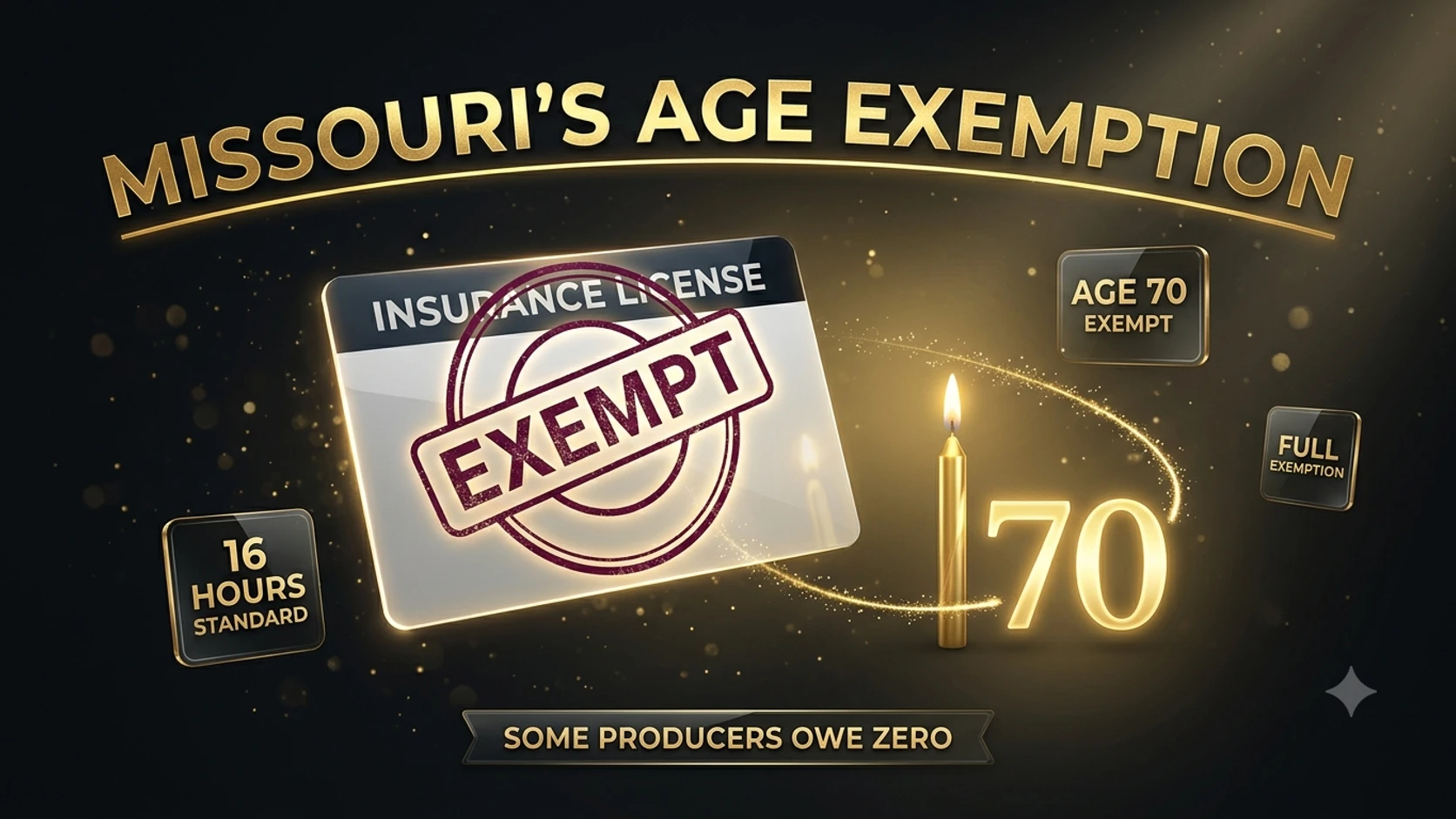
16 hours — genuinely lower than the national norm
Missouri requires producers to complete 16 hours of continuing education every two-year license term, with at least 3 of those hours in insurance ethics — noticeably lower than the 24-hour figure used by a majority of states covered on this site. The ethics courses specifically carry an 'EL' prefix in Missouri course catalogs and must be approved by the Missouri Department of Insurance under that designation.
A producer moving from a 24-hour state to a Missouri license, or comparing states for a multi-state licensing decision, should not assume Missouri's lower total reflects a less serious compliance regime overall — the specific EL-prefix course-approval system still requires genuine verification that a given course is currently Missouri-approved.
An unusually broad set of full exemptions
Missouri exempts several categories of producers from the CE requirement entirely, not merely reducing their hours: producers who have suffered a serious physical injury or illness, producers who reside outside the United States, producers who sell only crop insurance or pre-arranged funeral plan insurance, producers who are at least 70 years old, and producers whose license is restricted to Credit insurance only.
The age-70 exemption in particular is a genuinely distinct feature — few states offer a full CE exemption based purely on age (as opposed to a combination of age and decades of tenure, which is the more common structure in states that offer any age-related reduction at all). A Missouri producer approaching 70 should specifically confirm this exemption applies to their situation before continuing to pay for and complete CE courses they may no longer be required to take.
Carryover and course-repeat rules for non-exempt producers
For producers who don't qualify for a full exemption, all hours earned in excess of the 16-hour requirement may be carried into the next two-year license term — Missouri does not appear to cap this carryover the way many states cap it at a flat 12 hours, making it comparatively generous for producers who complete significantly more than the minimum.
A course may not be repeated for credit more than once within a two-year license term, consistent with the pattern found across nearly every state in this comparison set.
Renewal timing
The Missouri license term runs two years from the license issuance date, and courses must be completed within the specific biennium to which they're being applied — all CE hours must be completed BEFORE submitting the renewal application, the same completion-before-submission pattern found broadly across states.
Worked example: checking exemption eligibility before assuming a requirement
A long-tenured Missouri producer turning 70 this year initially begins researching CE courses for her upcoming renewal out of habit, before checking the current exemption list and confirming that reaching age 70 makes her fully exempt from Missouri's CE requirement going forward, regardless of how many hours she's completed in prior cycles.
She still confirms this exemption status directly with the Missouri Department of Insurance rather than relying solely on a secondary source, given how consequential it would be to either wrongly skip a genuinely required course or wrongly spend time and money on courses she doesn't actually need.
Confirming exemption status the right way
Because several of Missouri's exemption categories — age 70, serious illness or injury, non-U.S. residency — involve personal circumstances rather than simple license-record facts, the Missouri Department of Insurance generally expects a producer to affirmatively confirm or document their exemption status rather than assuming the department will automatically apply it without any producer-side action.
A producer claiming the serious illness or injury exemption in particular should expect to provide some form of documentation supporting the claim, given how significant a full CE exemption is; simply asserting the exemption applies without any supporting basis is unlikely to be sufficient if the claim is ever reviewed.
For the more straightforward age-70 and Credit-only-license exemptions, a producer can typically confirm their status directly through Missouri's online license-management portal, which should reflect exemption status automatically once the department's records show the qualifying birthdate or license type — worth checking directly online before assuming continued CE is or isn't required for an upcoming renewal.
Non-resident producers: PDB verification, not a blanket exemption
Missouri doesn't automatically exempt every non-resident producer from its 16-hour structure described above — the exemption applies specifically to a non-resident who is also licensed and CE-compliant in their home state, verified through the NIPR Producer Database (PDB) rather than a separate paper submission. A non-resident producer who isn't actually licensed in a home state at all must instead comply with Missouri's own CE requirement directly, including the same 3-hour ethics minimum, since there's no home-state compliance for Missouri to recognize in that scenario.
Missouri's renewal fee is $100, and a producer who misses the renewal deadline faces a $25-per-month late fee — a cost that compounds the longer a lapse continues, unlike states that charge one flat late fee regardless of how long the delay runs.
Spotting an approved ethics course, and how reporting actually works
Missouri's approved ethics courses carry a distinct 'EL' course-number prefix in the state's catalog, making them identifiable at a glance separate from general CE offerings — a producer selecting a course should confirm the EL designation directly rather than assuming any course labeled 'ethics' by a provider automatically carries it. Missouri also processes most CE reporting same-day: approved providers electronically submit completions the day the final exam is passed, or the next business day if completed outside normal hours, and producers can independently verify their own hours through the state's SBS Connect portal.
The bottom line
Missouri's comparatively low 16-hour baseline and its unusually broad set of full exemptions mean some producers may owe less CE than they assume — but confirming actual exemption eligibility directly with the Department of Insurance, rather than assuming based on age or license type alone, is the safer approach before skipping any coursework.
Missouri producers relying on the illness-or-injury exemption in particular should also ask the department directly how long that exemption remains valid, since a temporary medical situation that improves over time may not indefinitely exempt a producer from CE the way the permanent age-70 exemption does.
Primary and official sources used for this guide
Missouri Department of Insurance — Producer Licensing RenewalPrimary/official source for Missouri's 16-hour CE requirement and full exemption categories.↗Missouri Department of Insurance — Non-Resident Continuing Education RequirementsPrimary/official source for Missouri's PDB-based non-resident verification and renewal/late fees.↗Source pages can change. Check the current text and effective date before relying on an hour requirement, a reporting deadline, or a course approval.
Written for licensed agents, not issued by a regulator. Insurance License CE Desk has no connection to any state department of insurance or CE provider. Hour requirements, ethics credits, and compliance deadlines are set state by state and do change, so your department of insurance, or the CE tracking vendor it uses, has the final word on what your transcript needs.