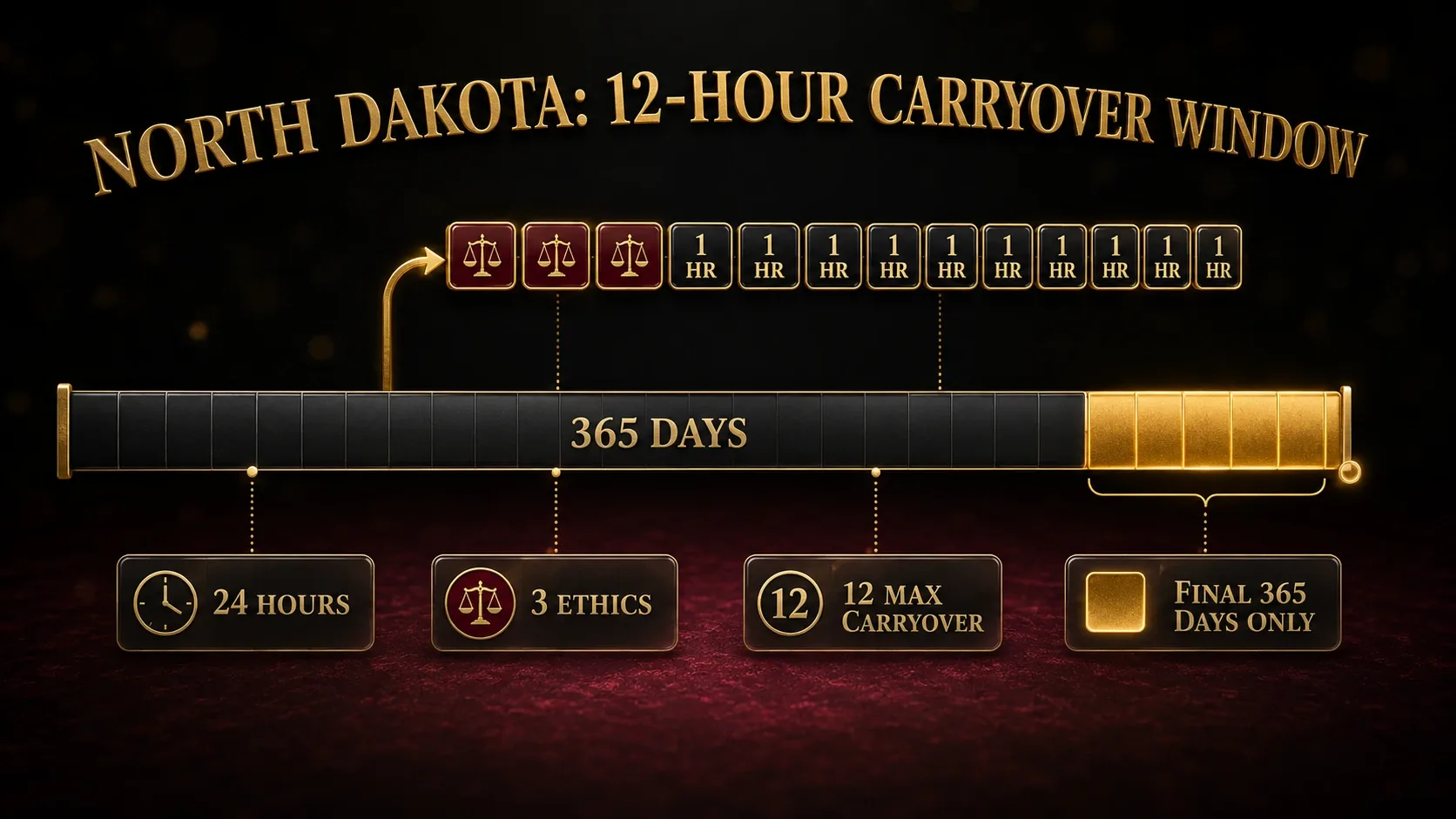
24 hours, 3 ethics, for the major lines
North Dakota requires at least 24 CE credit hours per biennial compliance period for resident producers licensed in life and annuities, accident and health, casualty, property, personal lines, or crop hail — or any combination. Three of the 24 hours must be in ethics.
The compliance period is tied to the license expiration date rather than a statewide calendar, so a producer's period is defined by their own record. Ethics hours over the required 3 count toward the 24-hour total as general hours.
The 12-hour carryover — with a timing condition
North Dakota allows up to 12 hours of course work over the 24-hour minimum to be credited to the next 12-month window — but only if that surplus was earned in the last 12 months of the current reporting period. Hours front-loaded in the first year of a cycle do not carry, which is the opposite of what most producers assume a carryover means.
Ethics hours can be carried forward, but only as regular hours: excess ethics credit does not carry over as ethics credit. A producer cannot bank a large ethics surplus and skip the ethics requirement in the next cycle.
The limited-lines CE exemption
Producers licensed only for credit, surety, travel/baggage, title, bail bonds, legal expense, or any combination of those limited lines are not required to complete CE at all. The license still has to be renewed every two years, but there is no hour requirement attached.
Adding a major line — life, health, property, casualty — removes the exemption and triggers the full 24-hour requirement from that point. A producer who picks up a major line mid-cycle should confirm with the Department when the CE obligation starts.
Birth-month renewal, provider reporting, and the cancel-and-reapply rule
The North Dakota license expiration date is the last day of the producer's birth month, every two years. There is no grace period after the due date, and a record that does not show CE compliance blocks the renewal. CE providers have 15 days from course completion to file the credits, so a course taken within 15 days of expiration may not post in time.
If the license is not renewed by the expiration date, it and all appointments are canceled outright — not suspended, canceled. Getting back in means reapplying with an initial application and a $100 fee, plus a $150 reinstatement fee. The base renewal fee, by contrast, is only $25, so a missed deadline turns a $25 task into a $250 one.
How completions are reported, and what to keep
North Dakota-approved providers report completions to the Insurance Department electronically, within the 15-day filing window. The producer's CE record is what the Department checks, and the 15-day window is exactly why a course finished close to the deadline is risky even though the producer did the work.
Because a missed North Dakota renewal is a cancellation rather than a late fee, the certificate-and-a-phone-call fix for a provider that misses its 15-day filing window only works before the cancellation posts. Keep a certificate for every course for a few years, and check the record against the requirement in the month before the birth-month deadline while there is still time to act.
Non-resident producers
A non-resident licensed in North Dakota relies on their home state's CE requirement, provided the home state has one and the producer stays in good standing there. The 24-hour count and the 12-hour carryover are resident rules.
A non-resident holding only limited-lines authority is in the same position as a resident limited-lines producer — no CE obligation, but the license still renews every two years.
Worked example
A producer in the last year of her compliance period completes 36 hours — 12 over the minimum — all of it in that final 12 months. The 12-hour surplus carries into the next period's first 12 months.
A colleague who completed the same 36 hours but did most of it in the first year of the cycle carries nothing: the surplus only counts if it was earned in the final 12 months. Both then confirm the record shows compliance well before the birth-month deadline, since a cancellation here means a $250 combined fee to return, not a late charge.
The bottom line
North Dakota's 24-hour, 3-ethics count is standard, but two features stand out: a 12-hour carryover that only recognizes surplus earned late in the period, and a full CE exemption for limited-lines-only producers. Check which category a license falls into first — and finish CE well before the birth month, because a missed renewal is a cancellation, not a late fee.
If you hold a major line, book a 3-hour ethics course plus 21 general hours, keep courses at least 15 days ahead of the birth-month deadline so the provider's filing window clears, and check the record before you file. If you want to carry surplus, complete the extra hours in the final 12 months of the period. A limited-lines-only producer still renews every two years but owes no CE.
Primary and official sources used for this guide
North Dakota Insurance Department — Renew Producer LicensePrimary/official source for North Dakota's renewal fee, the no-grace-period rule, the cancel-and-reapply consequence, and the $100 application plus $150 reinstatement fee.↗North Dakota Insurance Department — Continuing Education FAQ (Producer)Official source for the 24-hour requirement, the 3-hour ethics carve-out, the 12-hour late-period carryover, the limited-lines exemption, and the 15-day provider reporting window.↗Source pages can change. Check the current text and effective date before relying on a threshold, waiting period, or required form.