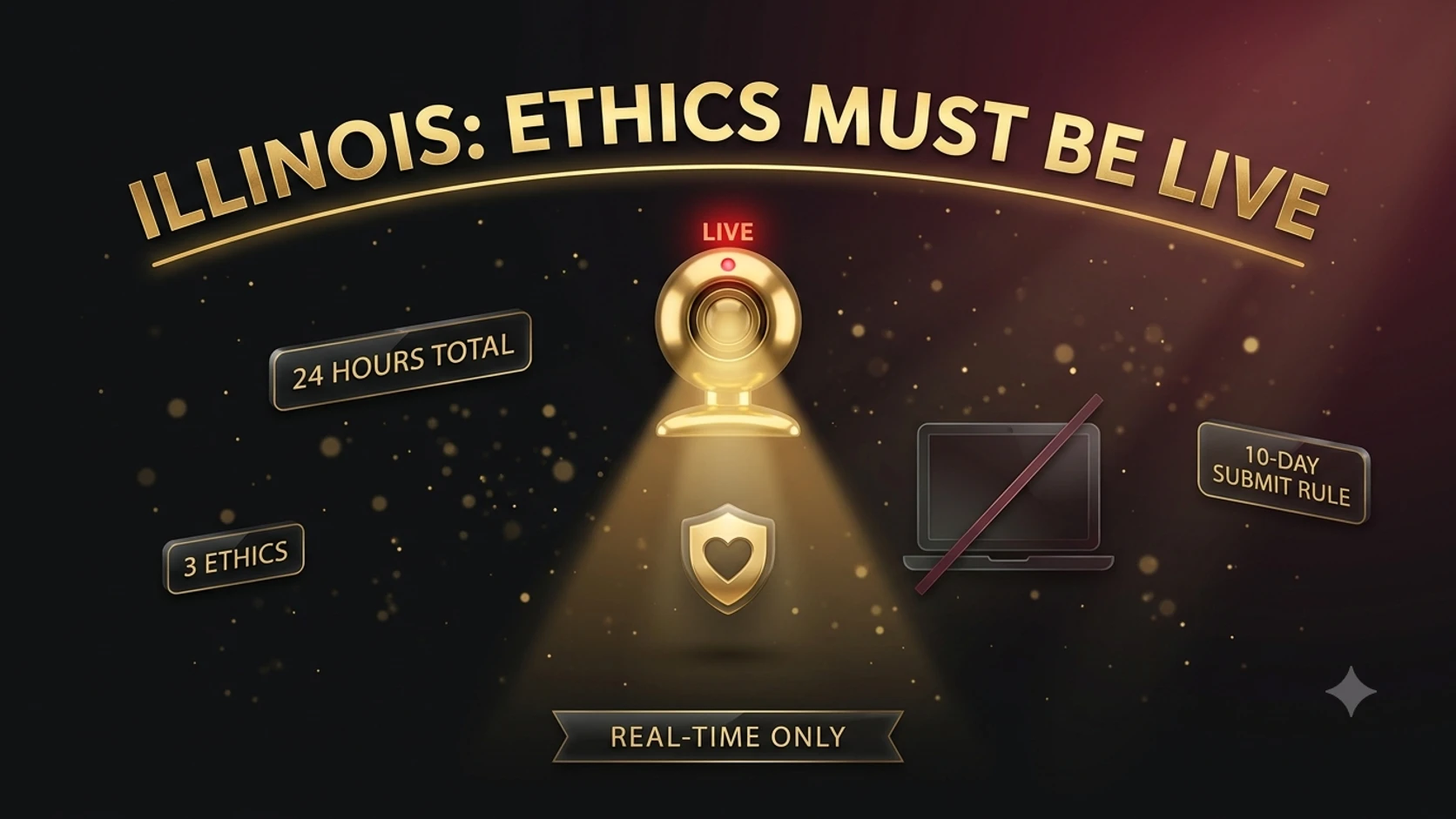
24 hours total, but the ethics hours have a delivery-format rule
Illinois requires 24 hours of continuing education every two-year license term, with 3 of those hours designated as ethics — a familiar structure so far. What makes Illinois distinct is a delivery-format restriction specific to the ethics portion: those 3 hours must be completed in a classroom setting or via a live, real-time online webinar. A self-paced, on-demand online course, even one properly approved for general CE credit, does not satisfy the ethics-specific requirement.
This catches producers who default to the most convenient CE format — self-paced online video, completed whenever it's convenient — without realizing that convenience doesn't extend to the ethics portion specifically. The remaining 21 general hours can be completed through self-paced online coursework without issue; only the ethics 3 hours carry the live-format restriction.
Ten business days, not the renewal date itself
Illinois requires full CE compliance a full ten business days before the actual renewal date — not on the renewal date, and Illinois separately recommends completing coursework no later than one month before expiration to leave a real buffer for processing and reporting.
Because the ethics hours specifically require live-format completion (classroom or real-time webinar), producers should schedule those hours with even more lead time than the general hours — live sessions have fixed dates and limited availability, unlike self-paced content that can be completed at any hour.
Carryover rules split differently for ethics vs. general credit
Illinois allows a maximum of 12 excess continuing education hours to carry over into the next renewal period. Excess ethics hours can technically carry over too, but only as general credit in the next period — they do not satisfy the next period's ethics-specific requirement. A producer who takes 6 hours of ethics in one cycle, thinking they're banking ethics credit for next time, is only banking 3 hours of general credit; the ethics box for the next cycle still needs its own separate 3-hour live-format course.
Treat the ethics requirement the same way every renewal period: as a recurring, non-bankable line item that must be freshly completed in a classroom or live-webinar format each time.
Renewal timing and birth-month cycle
Illinois license renewal falls every two years on the last day of the producer's birth month, the same general pattern used by most states. Combine this birth-month deadline with the ten-business-day full-compliance requirement and the one-month completion recommendation to build a realistic schedule — working backward from the birth-month deadline rather than treating it as the actual completion target.
Worked example: scheduling around the live-ethics constraint
A producer's Illinois license renews at the end of June. Working backward: she wants all CE compliant ten business days before that date, so she targets mid-June as her real deadline, with a personal buffer of finishing by the end of May.
Because her 3 ethics hours require a classroom or live webinar, she registers for a scheduled live ethics webinar in April — well before her self-imposed May deadline — rather than waiting until the last minute and discovering no live sessions are available on short notice. Her remaining 21 hours she completes through self-paced online courses at her own convenience through May.
Why Illinois requires ethics specifically in live format
Illinois's requirement that its mandatory 3 ethics hours be completed through classroom or live-webinar instruction — explicitly excluding self-paced online courses for this specific portion — reflects a judgment that ethics topics benefit meaningfully from real-time discussion and instructor interaction in a way that straightforward product-knowledge topics may not. A producer accustomed to completing their entire CE load through convenient self-paced courses needs to specifically plan around this live-format carve-out.
The requirement to submit CE compliance at least 10 business days before the renewal deadline (rather than allowing completion right up to the deadline itself) gives the Illinois Department of Insurance's system time to process and verify the reported hours before the license technically expires — but it also means a producer's real internal deadline is meaningfully earlier than the calendar renewal date suggests.
Non-resident producers: Illinois reciprocity cuts both ways
A producer licensed in Illinois as a non-resident doesn't need to separately complete the live-format ethics structure described above — completing CE in their home state satisfies Illinois's requirement instead, but only if that home state offers Illinois producers the same reciprocal treatment in return. If a non-resident producer's home state doesn't require CE at all, Illinois can still impose its own requirement on that producer rather than treating the absence of a home-state rule as automatic compliance.
Illinois's one-time 4-hour Annuity Best Interest training, by contrast, applies uniformly to both resident and non-resident producers licensed on or after August 1, 2023, regardless of reciprocity status — an add-on that doesn't bend to the home-state exemption the way the general 24-hour requirement does.
This reciprocal structure is worth double-checking rather than assuming, since 'my home state doesn't require CE from Illinois producers either' isn't automatically true — a producer picking up an Illinois non-resident license for the first time should confirm their specific home state's stance on Illinois reciprocity directly with the Illinois Department of Insurance. States that don't require CE at all from their own residents create the clearest gap in this reciprocity structure, since Illinois has nothing to reciprocate against in that scenario.
The bottom line
Illinois's live-format ethics requirement and its 10-business-day pre-deadline submission rule both compress the effective planning window more than the state's headline 24-hour, 3-ethics figure suggests.
Illinois's insistence on live-format ethics, even as most other CE content has moved toward flexible self-paced delivery, reflects a judgment that some topics are simply better taught with a real instructor present to field questions — a philosophy worth keeping in mind even beyond the state's specific compliance requirement.
Primary and official sources used for this guide
Illinois Department of Insurance — Producer Continuing EducationPrimary/official source for Illinois CE hour totals and the live-format ethics requirement.↗ExamFX — Illinois Insurance Continuing Education RequirementsSecondary source for Illinois's non-resident reciprocity structure and the annuity training carve-out.↗Source pages can change. Check the current text and effective date before relying on an hour requirement, a reporting deadline, or a course approval.
Written for licensed agents, not issued by a regulator. Insurance License CE Desk has no connection to any state department of insurance or CE provider. Hour requirements, ethics credits, and compliance deadlines are set state by state and do change, so your department of insurance, or the CE tracking vendor it uses, has the final word on what your transcript needs.