48 hours sounds like a lot — because the cycle is twice as long
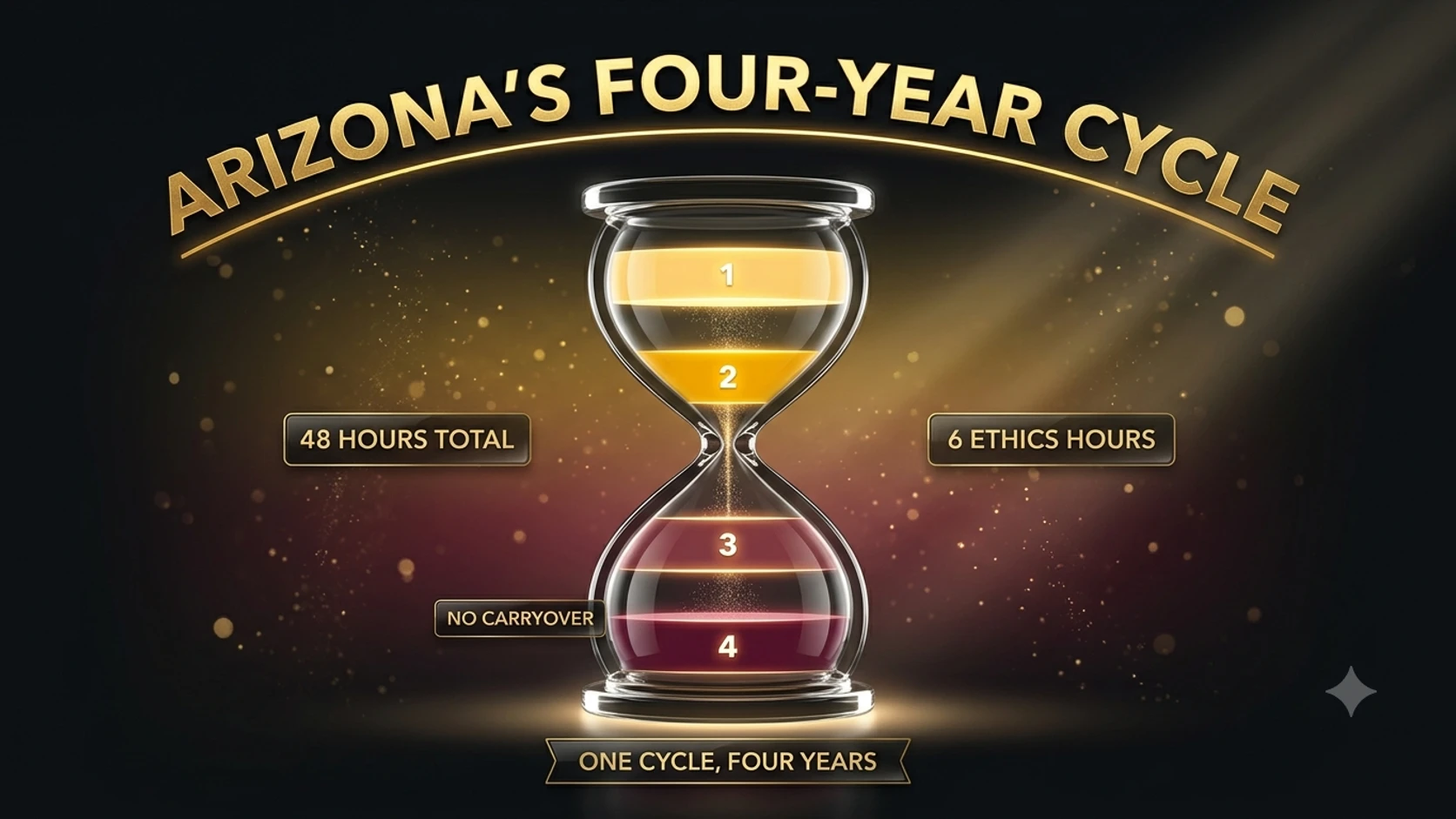
Arizona insurance producers must complete 48 hours of continuing education within each four-year renewal cycle, with six of those hours covering ethics. At first glance, 48 hours looks nearly double the 24-hour figure common in most states — and it is a larger raw number — but the comparison is misleading without accounting for the cycle length: Arizona's renewal cycle is four years, not the two-year cycle used by the majority of states in this comparison set.
On an annualized basis, Arizona's pace works out to roughly 12 hours per year, actually somewhat lower than the 12-hours-per-year pace implied by a 24-hour, two-year state. The real practical difference is that Arizona producers go longer between renewal deadlines, which changes how CE planning and reminders should be structured, not that Arizona is dramatically more demanding overall.
Six ethics hours, not the more common three
Arizona's ethics-specific requirement is 6 hours out of the 48-hour total — again, roughly double the 3-hour figure common in two-year-cycle states, consistent with the doubled cycle length. Those ethics hours must cover professional conduct, regulatory compliance, fiduciary duties, or related topics, matching the general ethics-topic pattern found elsewhere.
Because the ethics requirement spans four years rather than two, a producer might reasonably spread their 6 ethics hours across two separate ethics courses taken a year or two apart within the cycle, rather than needing to find one longer 6-hour ethics course all at once — check with a specific course provider whether shorter modules stack toward the 6-hour total.
No carryover, no repeats — same strict pattern as neighboring states
Arizona does not allow any carryover credits between renewal cycles, and a licensee cannot repeat CE courses for credit within the same cycle — consistent with the stricter end of the spectrum seen in states like Washington and Ohio. All required CE must be completed prior to submitting the renewal application.
Course flexibility is broader than some states: licensees may take an approved course in any line of authority to obtain CE credit, though Arizona recommends (without strictly requiring) that producers choose courses relevant to their actual license type.
Renewal timing on the four-year cycle
Arizona licenses renew every four years, with expiration falling on the last day of the licensee's birth month. Because the gap between renewals is twice as long as in most states, a producer moving to Arizona from a two-year-cycle state should specifically reset their internal CE reminder cadence rather than assuming the same two-year rhythm applies.
Standard annual or biennial reminder habits don't naturally fit this rhythm, so producers licensed in Arizona should set a distinct long-interval reminder — a calendar entry roughly 18 months in — prompting a mid-cycle progress check.
Worked example: pacing 48 hours across four years
A newly Arizona-licensed producer plans to spread his 48-hour requirement across the full four-year cycle rather than rushing to complete it all at once early on, given the strict no-carryover rule would waste any early excess anyway. He plans roughly 12 hours per year, including splitting his 6 ethics hours into two 3-hour ethics courses taken about two years apart within the cycle.
By pacing steadily rather than front-loading, he avoids both the risk of forgetting about CE for years at a time (since the deadline feels distant) and the wasted effort of completing far more than needed early on, given Arizona's strict no-carryover policy.
Non-resident reciprocity, and the cost of missing the deadline
Non-resident Arizona producers are exempt from the 48-hour, four-year structure described above, provided their home state both requires CE from its own residents and recognizes Arizona-earned CE credits in return — a two-way test rather than a one-sided exemption. Non-residents still owe Arizona's own product-specific training where it applies: long-term care and flood insurance training requirements, plus the one-time 4-hour Annuity Best Interest course required of resident and non-resident producers alike before selling annuities.
Arizona's renewal fee is a flat $120 regardless of how many major lines a producer holds, and a producer whose renewal application (including CE evidence) doesn't reach the department before the license expires must stop transacting business and pay a $100 late fee before the department will process the renewal.
How Arizona's annuity training requirement rolled out
Arizona's annuity training requirement traces back to a 2020 update: producers already approved to sell annuities before the change had to complete the new best-interest training by July 1, 2020, while producers new to selling annuities faced an updated 4-hour course starting January 1, 2021. Producers who had completed the original training before that transition period had a choice — a new one-time 4-hour course or a shorter one-time 1-hour update — to bring their training current by July 1, 2021, a staggered rollout that occasionally still causes confusion among long-tenured Arizona producers about which specific version of the training they actually completed.
What Arizona's ethics courses actually cover
Arizona's ethics-course content splits fiduciary obligations into two categories: duties to the company (loyalty, obedience, accounting) and duties to the client (disclosure, suitability, confidentiality, and client advocacy) — a producer-vs-carrier framing that goes beyond a single generic 'be ethical' theme. Courses also work through real enforcement actions and unfair-trade-practice case studies specific to the insurance industry, applicable across every line of authority regardless of which specific lines a given producer holds.
The bottom line
Arizona's 48-hour, four-year structure is not meaningfully more demanding than a typical 24-hour, two-year state on an annualized basis — the real adjustment producers need to make is scheduling and reminder cadence, not overall workload. Producers who sell annuities should treat the Annuity Best Interest training as its own separate checkbox from the start, since it doesn't follow the four-year rhythm the rest of Arizona's requirement runs on.
Primary and official sources used for this guide
Arizona Department of Insurance and Financial Institutions — Continuing Education ProvidersPrimary/official source for Arizona's four-year CE cycle and 48-hour/6-hour ethics requirement.↗ExamFX — Arizona Insurance Continuing Education RequirementsSecondary source for Arizona's non-resident reciprocity, renewal fee, and late-fee structure.↗Source pages can change. Check the current text and effective date before relying on an hour requirement, a reporting deadline, or a course approval.
Written for licensed agents, not issued by a regulator. Insurance License CE Desk has no connection to any state department of insurance or CE provider. Hour requirements, ethics credits, and compliance deadlines are set state by state and do change, so your department of insurance, or the CE tracking vendor it uses, has the final word on what your transcript needs.