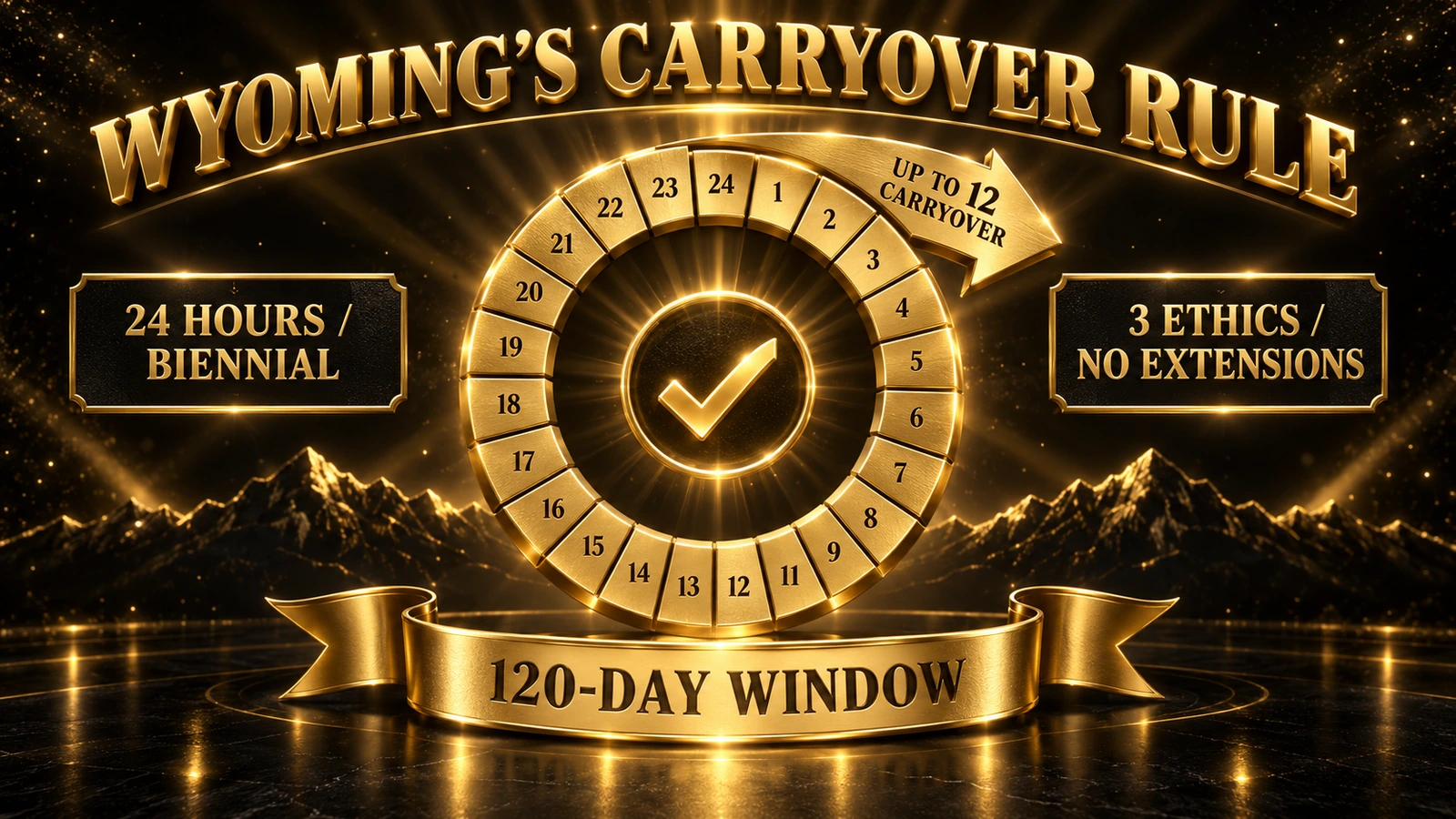
24 hours, 3 ethics, and who the rule actually covers
Wyoming requires resident producers, adjusters, consultants, public adjusters, title agents, and crop agents — along with any adjuster who has designated Wyoming as their home state — to complete 24 hours of continuing education each licensing period, with 3 of those hours specifically in ethics. The rule applies broadly across license types rather than being written narrowly for producers alone, which is worth checking if you hold a less common license type like a crop or title designation.
The licensing period runs two years, and the renewal date is the last day of the licensee's birth month — the same birth-month pattern used by several neighboring states, though the exact hour count and add-on rules differ state by state. Two Wyoming producers born in different months carry different personal deadlines even within the same renewal year.
The 2023 carryover rule: up to 12 excess hours forward
Effective January 2023, Wyoming changed a rule that used to discard anything completed beyond the 24-hour requirement. Credits earned above the required 24 hours in a term can now carry forward to the next renewal term, up to a cap of 12 excess hours, provided those excess hours were completed within 120 days prior to the renewal date they're being applied toward.
That 120-day window is the detail most likely to trip someone up: finishing 30 hours spread evenly across an entire two-year cycle does not automatically bank 6 hours forward the way a flat annual-average assumption might suggest. Only the excess hours completed in the 120 days immediately before the renewal date qualify to roll into the next term, so a producer who wants to bank hours forward should time that extra coursework deliberately, close to the renewal date, rather than early in the cycle.
No extensions, for any reason
The Wyoming Department of Insurance does not approve extensions to comply with the continuing education requirement for any reason. This is a firmer stance than several neighboring states take, some of which grant case-by-case extensions for documented medical or military circumstances. In Wyoming, the practical response to an unexpected disruption — illness, travel, a family emergency — is to finish CE earlier in the cycle with real buffer time, not to plan around requesting relief close to the deadline, because that relief generally is not available.
This makes Wyoming a state where front-loading coursework, rather than finishing right at the wire, meaningfully reduces risk compared to states with a more forgiving extension policy.
If the license lapses
A Wyoming producer who misses the renewal date enters a one-year reinstatement period. During that year the license can be reinstated by completing all outstanding CE and paying a late fee equal to 100% of the standard renewal fee — a producer with a $100 resident renewal fee pays an additional $100 late fee, for $200 total; a non-resident with a $150 renewal fee pays an additional $150, for $300 total.
All CE requirements must be satisfied before reinstatement is processed, and a reinstated license keeps the same expiration date it would have had if renewed on time — the birth-month cycle doesn't reset just because the license lapsed briefly. Once the one-year reinstatement period closes, the option disappears: the producer has to reapply for the license from scratch, as a brand-new applicant, rather than reinstating the old one.
Non-resident producers
Wyoming does not layer its own CE requirement on top of a non-resident producer's home-state compliance. A producer licensed in Wyoming as a non-resident satisfies the state's CE expectation simply by staying current with whatever continuing education their home state requires — there is no additional Wyoming-specific CE requirement for non-residents to track separately.
This is a simpler non-resident posture than some states that carve out specific add-on training (flood, long-term care, or a state-specific ethics module) even for non-residents. A Wyoming non-resident license mainly needs the home-state record to stay clean.
Worked example
A resident producer with an April birth month plans a normal two-year cycle: a 3-hour ethics course early on, and the remaining 21 hours spread across several self-paced and provider courses over the following eighteen months. With about four months left before her April renewal, she realizes she has room to take a few extra courses and decides to bank hours forward.
She completes 6 additional hours in the 120 days immediately before her renewal date rather than earlier in the cycle, which qualifies all 6 as carryover credit into her next two-year term — meaning her following cycle effectively starts 6 hours ahead, as long as she stays under the 12-hour carryover cap.
The bottom line
Wyoming's baseline — 24 hours, 3 ethics, birth-month renewal — is close to the multi-state norm. The two rules that actually change how a Wyoming producer should plan are the strict no-extensions policy, which rewards finishing early rather than relying on a fallback, and the 120-day carryover window, which means banking excess hours forward only works if that extra coursework is timed close to the renewal date rather than scattered earlier in the cycle.
Primary and official sources used for this guide
Wyoming Department of Insurance — Continuing EducationPrimary/official source for Wyoming's 24-hour requirement, 3-hour ethics minimum, and the 2023 carryover rule.↗Wyoming Department of Insurance — Producer License Requirements, Fees & FAQsOfficial source for Wyoming's renewal fees, the one-year reinstatement period, and the 100%-of-renewal-fee late fee.↗Source pages can change. Check the current text and effective date before relying on a threshold, waiting period, or required form.