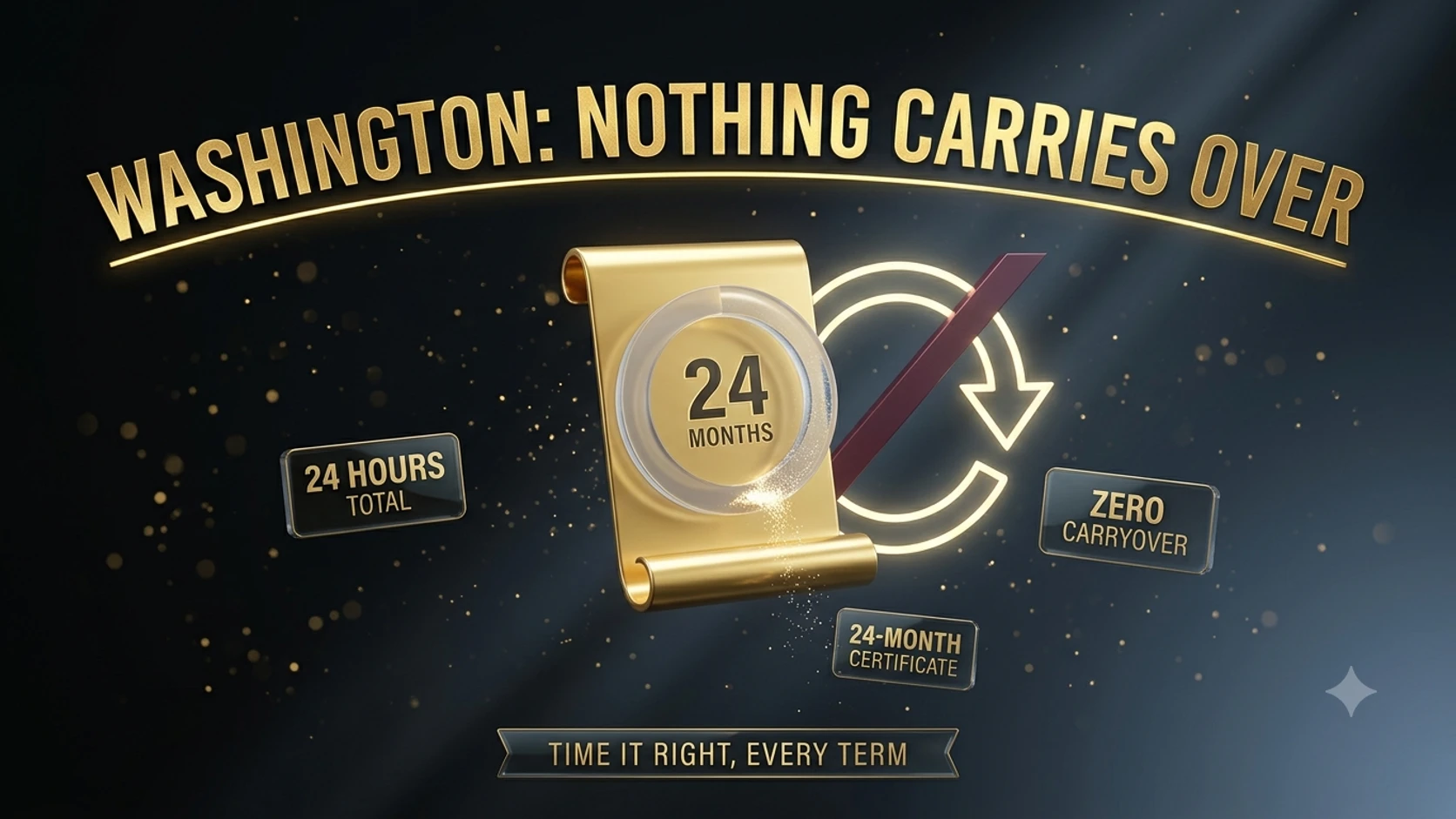
24 and 3, with zero carryover flexibility
Washington requires producers to complete 24 hours of continuing education every two years, including 3 hours specifically covering ethics topics such as professional conduct, fiduciary duties, regulatory compliance, and errors-and-omissions prevention. Unlike many states that allow some portion of excess hours to carry forward into the next term, Washington allows no carryover credits at all — every two-year cycle starts from zero regardless of how far ahead a producer got in a prior term.
This makes Washington one of the stricter states for producers who like to front-load their CE well ahead of schedule: completing 30 hours in one term doesn't reduce the next term's 24-hour requirement by even one hour.
The 24-month certificate validity window is a real trap
Washington's completion certificates are valid for only 24 months from the date the course was actually completed — not from the license issue date or renewal date. Combined with the no-carryover rule, this creates a specific timing hazard: a producer who completes CE very early in their two-year cycle, intending to be safely ahead of schedule, could find that certificate has technically expired by the time the actual renewal date arrives if the timing runs long.
The safer approach in Washington is to complete CE reasonably close to (but still safely before) the renewal deadline, rather than finishing the entire requirement immediately after the prior renewal and assuming it stays valid for the full two years that follow.
No repeated courses, and course topics don't need to match your lines
As with several other states, a Washington producer cannot repeat the identical course for credit within the same renewal period. Washington does offer more flexibility in one respect: any approved insurance CE course may be used regardless of whether its topic matches the producer's specific lines of authority — a life-only producer, for example, isn't restricted to life-specific coursework to fill out their general hours the way some states require.
This flexibility applies to the general hours; the 3-hour ethics requirement still needs to be specifically ethics-designated coursework regardless of line.
Renewal timing
Washington requires all CE credit hours to be completed BEFORE the license renewal application is submitted, with renewal falling on the last day of the licensee's birth month, every two years — the standard birth-month cycle used broadly across states.
Worked example: timing CE to avoid both extremes
A Washington producer's license renews in November. Rather than completing all 24 hours immediately after his prior November renewal (which would risk certificates aging past the 24-month window by the time this November arrives) or waiting until the final weeks before the deadline (risking a reporting delay), he schedules his coursework for the spring and summer of the renewal year — roughly 4 to 8 months before the deadline.
This timing keeps every certificate comfortably within its 24-month validity window while still leaving buffer time before the actual renewal date for any reporting delays.
A tool worth bookmarking
Washington's Office of the Insurance Commissioner maintains an online license-status lookup that shows a producer's currently reported CE hours — useful for confirming completed coursework actually posted to the state record rather than relying solely on a personal certificate, since the reporting obligation sits with the course provider and provider errors are a real, if uncommon, risk.
Non-resident producers skip the 24-hour requirement, with line-specific exceptions
Non-resident Washington producers don't need to satisfy the state's 24-hour, no-carryover structure described above at all — Washington exempts non-residents from its general CE requirement outright, without requiring proof of home-state compliance the way most states do. That exemption has real limits, though: non-residents transacting long-term care insurance, flood insurance, or annuities in Washington still owe the same product-specific training resident producers face for those lines.
Washington's own renewal fee is $55, charged in addition to whatever a CE provider separately bills for reporting hours to the state — a cost worth budgeting for on top of the coursework itself, since the two are billed by different parties.
What a missed deadline costs a resident producer
Washington does allow a late-renewal window despite exempting non-residents from CE entirely: residents can renew up to 60 days after expiration by paying an $82.50-per-line late fee through the state's online system. A resident producer who misses even that 60-day window enters a longer reinstatement period running from day 61 through 12 months past expiration, with a flat $165 reinstatement fee for a full-lines individual producer — beyond 12 months, the producer must apply as an entirely new licensee rather than reinstating.
What Washington's ethics courses actually cover
Washington's ethics courses go beyond a generic overview: approved content covers ethics versus morals, ethical decision-making models, and terminology like tort law and equity, alongside Washington's own Revised Code and Administrative Code provisions specifically relevant to producer ethics and consumer privacy. Courses are also expected to fold in current-year developments — new state and federal laws affecting the industry — rather than teaching from a static, unchanging curriculum year after year.
The bottom line
Washington's no-carryover rule combined with its 24-month certificate validity window rewards producers who time CE completion to the middle of their renewal cycle rather than either extreme — completing everything immediately after a prior renewal, or waiting until the final weeks before the next one.
Producers relocating from a carryover-friendly state should be especially careful not to bring that state's habits with them, since banking extra hours in Washington in anticipation of a future term provides no benefit under its strict no-carryover rule. Non-resident Washington producers, by contrast, sidestep this timing puzzle entirely — their exemption from the state's general CE requirement means the no-carryover rule simply doesn't apply to them in the first place.
Primary and official sources used for this guide
Washington Office of the Insurance Commissioner — Continuing Education RequirementsPrimary/official source for Washington's no-carryover rule and 24-month certificate validity window.↗AgentSync — Washington Insurance Licensing & Regulatory ComplianceSecondary source for Washington's non-resident CE exemption and renewal fee.↗Source pages can change. Check the current text and effective date before relying on an hour requirement, a reporting deadline, or a course approval.
Written for licensed agents, not issued by a regulator. Insurance License CE Desk has no connection to any state department of insurance or CE provider. Hour requirements, ethics credits, and compliance deadlines are set state by state and do change, so your department of insurance, or the CE tracking vendor it uses, has the final word on what your transcript needs.