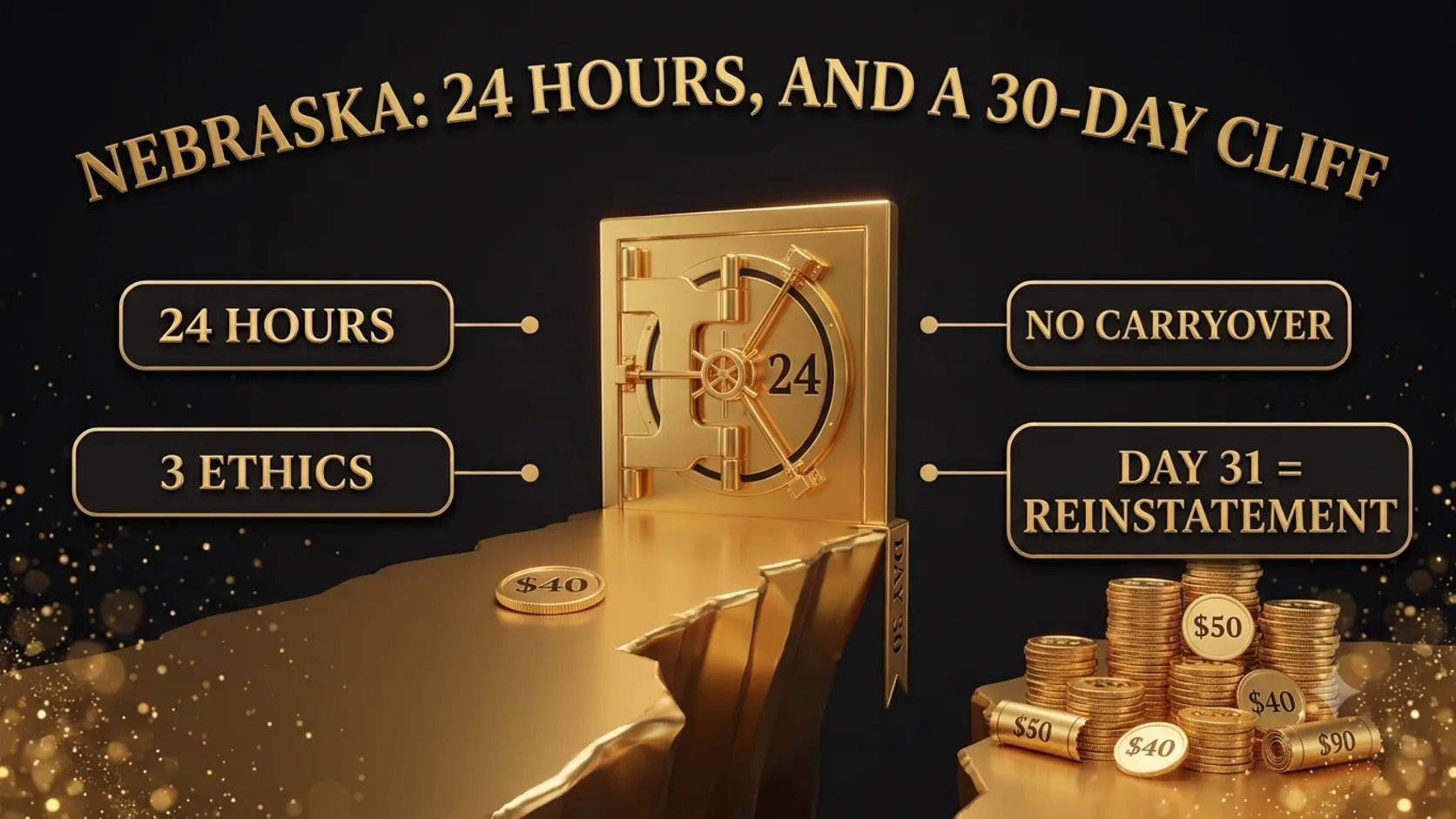
24 hours, 3 ethics
Nebraska requires 24 hours of continuing education per two-year license term for resident producers, with 3 of those hours in ethics. The remaining 21 hours can be in any approved subject within a line of authority the producer holds.
Nebraska does not impose a mandatory classroom portion, a company-course cap, or a state-specific legislative-update hour, which keeps the structure simpler than several neighboring states. What Nebraska does enforce is the line match and the timing.
The birth-month renewal cycle
The Nebraska license term ends on or before the last day of the licensee's birth month, every two years. The calendar year is matched to the birth year: a producer born in an even year renews in even years, and a producer born in an odd year renews in odd years.
The Nebraska Department of Insurance license record shows the exact expiration date, which a producer cannot infer from their original licensing date. Confirming it once removes the most common source of a missed deadline.
No carryover, no repeats, line-of-authority match
Nebraska does not allow excess CE credit to carry forward into the next license term, and a course may not be taken for credit more than once inside the same reporting period.
Courses have to be approved for a line of authority the producer actually holds. A property-and-casualty-only producer cannot count a life course, and vice versa. A producer licensed only in a limited line for which CE is not required renews without a CE obligation at all.
If the license lapses
A producer who allows a Nebraska license to lapse may reinstate the same license within 12 months from the renewal due date without retaking the exam. A late renewal within the first 30 days draws a $40 late fee on top of the renewal fee.
Once the license has been expired more than 30 days but less than a year, reinstatement means submitting a new application with a $50 application fee, the $40 late fee, and a $90 reinstatement fee — and the producer has to be CE compliant to do it. Past one year, the producer restarts the initial licensing process from scratch, exam included.
How completions are reported, and what to keep
Nebraska-approved providers report completions to the Department of Insurance electronically, and the producer's CE record is what the Department verifies before the renewal will process. A record that does not show CE compliance blocks the renewal outright.
A dropped or late-reported course is fixed by sending the Department the certificate, so keep one for every course for a few years past the cycle. Because Nebraska blocks the renewal outright on an incomplete record — with no short window to finish afterward — a producer who spots a shortfall a week before the birth-month deadline needs that certificate in hand, not a promise from the provider to report soon.
Non-resident producers
A non-resident's satisfaction of their home state's CE requirement counts as satisfaction of Nebraska's requirement, provided the home state recognizes Nebraska's CE on the same reciprocal basis.
Product-specific training tied to a Nebraska annuity or long-term care sale is separate from the general 24-hour count and should be confirmed against a current Nebraska Department of Insurance bulletin before the first sale.
Worked example
A producer born in November of an even year renews at the end of November in even years. She holds only a property/casualty license, so she books 21 hours of approved P&C content plus a 3-hour ethics course.
She finishes in September. If a provider's reporting had lagged and her record still showed a shortfall in early December, she would be inside the 30-day window and owe the $40 late fee — but a shortfall discovered in January would push her into the new-application, $50-plus-$40-plus-$90 reinstatement path, which is why the September target has real value.
The bottom line
Nebraska is a straightforward 24-hour, 3-ethics state with no carryover and no unusual add-ons to the general count. The planning points are the birth-year parity that sets the exact renewal year, and the sharp cost step at 30 days past expiration — a $40 late fee becomes a multi-fee reinstatement once that line is crossed.
Read the exact expiration date off the Department of Insurance license record, book a 3-hour ethics course plus 21 hours in your own line of authority, and target completion six to eight weeks early so a provider's reporting lag never pushes you past the 30-day mark. Confirm the record shows 24 hours before filing the renewal, because Nebraska blocks the renewal outright on an incomplete record.
Primary and official sources used for this guide
Nebraska Department of Insurance — Education for LicenseesPrimary/official source for Nebraska's 24-hour requirement, ethics carve-out, carryover rule, and the birth-month renewal cycle.↗NIPR — Nebraska Resident Licensing (Individual)Renewal and reinstatement detail for Nebraska residents, including the $40 late fee, the $90 reinstatement fee, and the 31-day-to-one-year window.↗Source pages can change. Check the current text and effective date before relying on a threshold, waiting period, or required form.