Per-line hours, and no ethics carve-out
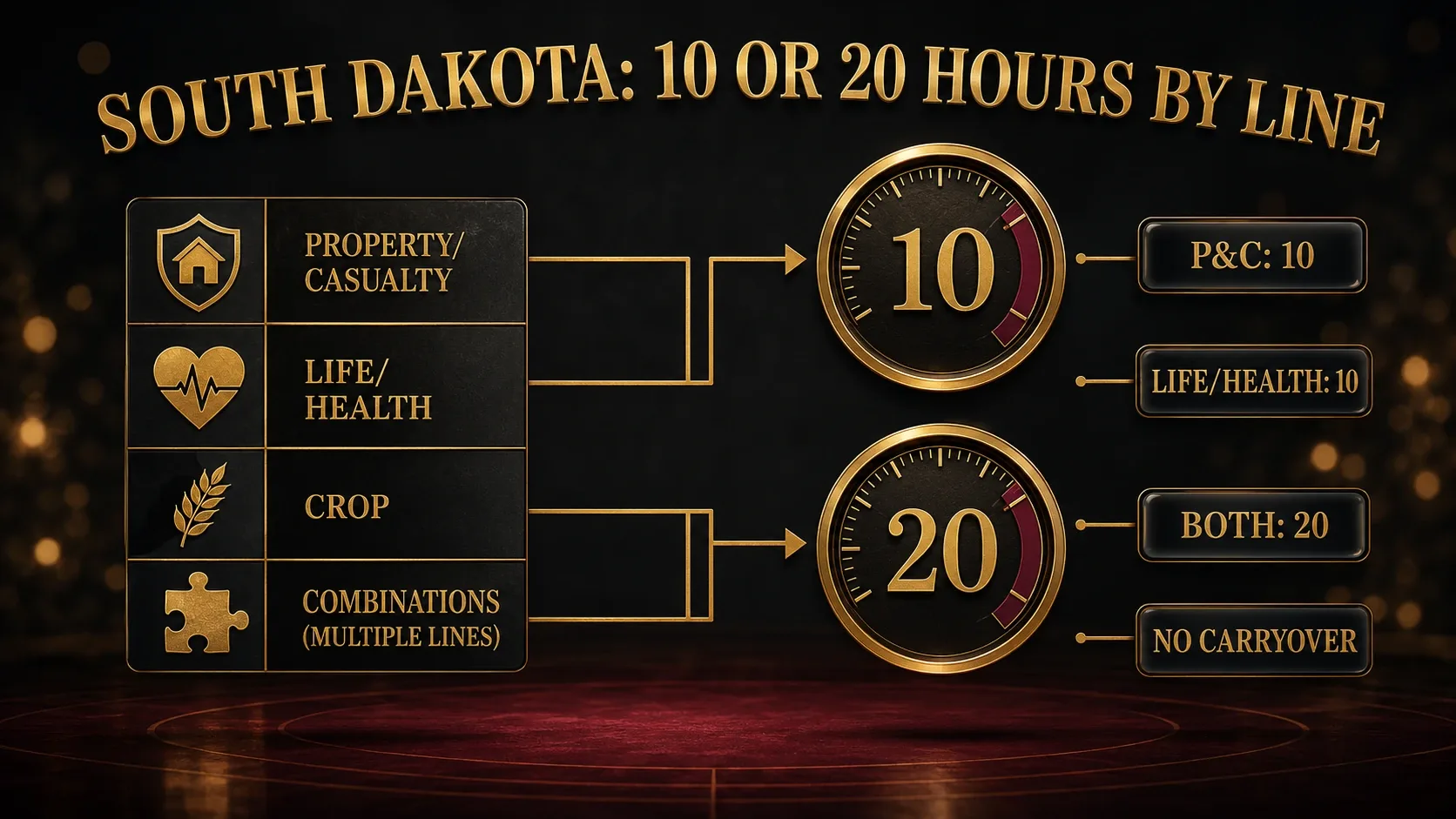
South Dakota structures CE by line of authority rather than as a single pooled requirement. Under Administrative Rule ARSD 20:06:18:03, a producer licensed only in life/health needs 10 hours per two-year term; property/casualty only, 10 hours; crop only, 4 hours. A combined life/health and property/casualty license is 10 hours in each line — 20 total — and a producer holding all three lines owes 2 crop, 8 property/casualty, and 10 life/health.
South Dakota is also one of the few states with no statewide mandatory ethics-hours requirement. A producer can satisfy the full 10 or 20 hours with general product and coverage content. Ethics courses still count as valid CE — they are simply not separately required, which is a real difference from almost every other state.
The one-time annuity best-interest course
A South Dakota producer must complete a one-time annuity best-interest standard training course before selling, soliciting, or negotiating any annuity product. This tracks the NAIC's revised suitability model and is tied to the product, not the hour count, so it does not recur each cycle but must be done before the first annuity sale.
A producer who added annuity activity after initial licensing is the most common miss here, because the course does not appear on a generic total-CE-hours summary — it is checked against the annuity authority specifically.
Long-term care training on a fixed schedule
Before selling or soliciting long-term care insurance, a South Dakota producer must complete an initial 8-hour state-approved LTC training course, followed by an ongoing LTC course on a recurring schedule. LTC courses are also counted at 60 minutes per credit hour, versus the standard 50 minutes for other CE, so an "8-hour" LTC course takes noticeably longer than an 8-hour general course.
The ongoing LTC deadline is a fixed statewide date, not one that moves with the producer's individual term, so an LTC-authorized producer effectively tracks two calendars — their birth-month renewal and the LTC schedule.
Renewal timing, the extension, and reinstatement
The South Dakota license term ends on the last day of the licensee's birth month, every two years. There is no grace period and no carryover. A producer who shows good cause can request a written CE extension — sent to the Division at least 21 days before expiration, and never granted for more than one year — which is a formal safety valve most states do not offer.
The reinstatement window opens the day after expiration and runs one year, with a $40 reinstatement fee. A producer must have completed the CE required for the pre-cancellation period before reinstatement will process; past one year, the producer reapplies as a new licensee.
How completions are reported, and what to keep
South Dakota-approved providers report completions to the Division of Insurance electronically, and the producer's CE record — broken out by line — is what the Division verifies at renewal. Because the requirement is per-line, a producer with two lines should confirm each line shows its own 10 hours rather than a combined 20 sitting under one.
The annuity best-interest and LTC training certificates are worth keeping indefinitely — those are one-time or long-cycle requirements, and a routine two-year transcript may not display them at all. Keep the ordinary course certificates for a few years, and confirm each line of authority shows its own hours rather than a combined total filed under one line.
Non-resident producers
A non-resident licensed in South Dakota relies on their home state's CE requirement, provided the home state has one and the producer stays in good standing there. The per-line hour structure is a resident rule.
The annuity best-interest course and the LTC training are tied to the products themselves and can apply to a South Dakota sale regardless of residency — confirm against a current Division of Insurance bulletin before selling those products in the state.
Worked example
A producer holds both a life/health and a property/casualty license and also sells annuities. Her general requirement is 20 hours — 10 in each line — every two years. Before her first annuity sale she completes the one-time best-interest course; those hours also count toward her life/health total for that cycle.
Because she has no ethics requirement to satisfy, she can fill all 20 hours with product and coverage content — but she still checks the LTC schedule separately, since she added LTC authority last year and the ongoing course runs on its own statewide deadline rather than her birth month.
The bottom line
South Dakota is the state where the standard "24 hours including 3 ethics" model breaks down entirely: it is 10 hours per line (20 combined), with no ethics requirement at all. The real compliance burden for many producers is the separate annuity and LTC training — especially the ongoing LTC course, which runs on a fixed statewide schedule rather than the producer's own renewal date.
Primary and official sources used for this guide
South Dakota Division of Insurance — Continuing EducationPrimary/official source for South Dakota's per-line CE hours (ARSD 20:06:18:03), the absence of an ethics requirement, the annuity best-interest course, and the LTC training schedule.↗South Dakota Division of Insurance — Guidance for ProducersOfficial source for South Dakota's birth-month renewal, the one-year reinstatement window, the $40 reinstatement fee, and the good-cause CE extension.↗Source pages can change. Check the current text and effective date before relying on a threshold, waiting period, or required form.