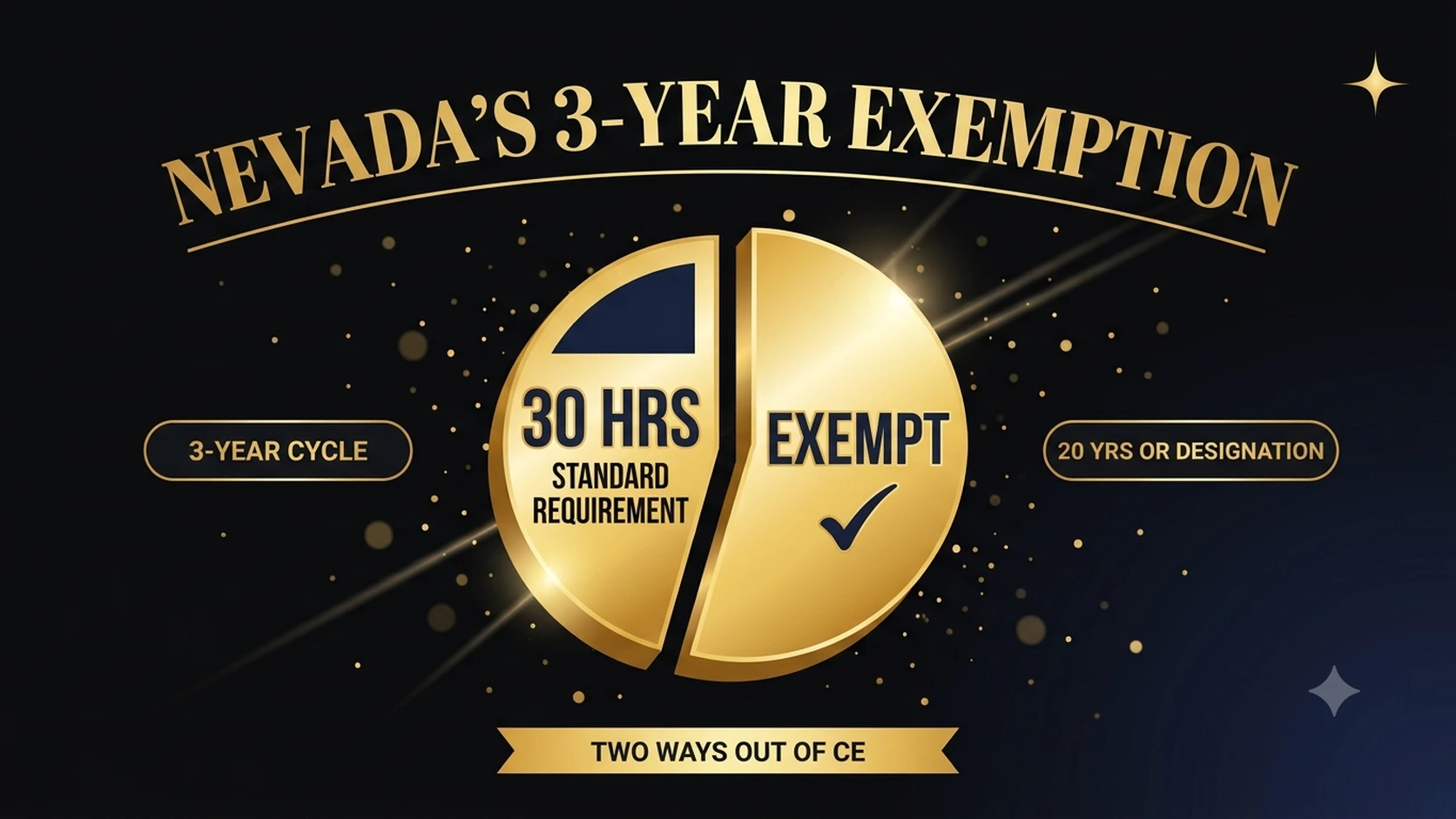
The baseline: 30 hours, 3 of them ethics, every three years
Nevada requires resident producers to complete 30 total hours of continuing education, including 3 hours of ethics, within each 3-year license term — a longer cycle than the 2-year period most states covered on this site use, which changes how a producer should pace their CE rather than assuming the familiar biennial rhythm applies here too.
The license renews on the first day of the month following the anniversary of the original issue date, every 3 years. Nevada's Division of Insurance recommends completing all required hours at least 60 days before that expiration date, giving providers time to report completions through Sircon before the renewal deadline arrives.
No carryover, and no repeating a course within the same term
Nevada does not allow excess CE hours earned beyond the 30-hour requirement to carry forward into the next 3-year term — hours completed past what the current term needs are simply not banked for later, unlike states such as California or Oklahoma that allow a capped carryover.
Nevada also does not allow the same course to be credited twice within one term. A producer who takes a fast, familiar course to knock out hours quickly should track which specific courses they've already completed this term, not just the total hour count, since a repeated course won't count toward the requirement a second time in the same 3-year window.
The exemptions that actually eliminate the requirement
Nevada Administrative Code 683A.330 exempts a producer from continuing education entirely under two separate paths. The first is professional designation: a producer who has earned and continues to maintain a Chartered Property Casualty Underwriter (CPCU), Chartered Life Underwriter (CLU), Certified Insurance Counselor (CIC), Certified Financial Planner (CFP), or Chartered Financial Consultant (ChFC) designation does not need to complete Nevada's CE hours.
The second path is experience-based: a producer with 20 years of continuous experience earning their primary source of income in the business of insurance — selling, marketing, underwriting, adjusting, practicing law, managing, or regulating in the field — also qualifies for the exemption. This is a full exemption, not a reduced-hour accommodation, meaning a qualifying producer files for exempt status rather than completing a smaller CE package.
Worked example: a long-tenured producer checking exemption eligibility
A property & casualty producer has held an active Nevada license continuously for 22 years, earning her primary income from insurance sales the entire time, and holds no professional designation. She qualifies for the 20-year continuous-experience exemption under NAC 683A.330 and does not need to track or complete the 30-hour requirement for her upcoming renewal.
A colleague licensed for only 8 years but holding a CPCU designation earned three years ago also qualifies — through the separate designation path, not the experience path. Both producers should still confirm their exempt status directly with the Division before assuming no CE is needed, since maintaining the designation (not just having earned it once) is part of the requirement for that path.
How Nevada's cycle compares to nearby states
A producer also licensed in California or Arizona, both covered elsewhere on this site, should not carry either state's 2-year rhythm over to Nevada — Nevada's 3-year term means a producer juggling all three licenses is tracking two different renewal intervals side by side, not one consistent schedule across all three states.
This is precisely the kind of situation this site's guide to multi-state CE tracking recommends handling with a per-state line item rather than a single mental shortcut: Nevada's term length is the exception here, not the rule most nearby states follow.
What courses can and cannot cover
For producers who do not qualify for an exemption, Nevada's course-approval rules require CE content to cover insurance principles and coverage, applicable insurance laws and regulations, recent coverage changes, or producer duties and ethics. The Commissioner will not approve courses focused on marketing, sales technique, recruiting, prospecting, motivation, or office management, even if a provider markets them as CE-eligible.
Courses offered by a producer or an agency licensed to sell insurance also generally cannot be approved, with an exception for industry trade associations — a detail worth checking if a course is being offered directly by a brokerage rather than an independent or insurer-affiliated CE provider.
Non-resident producers and the practical reality of a 3-year clock
Non-resident producers licensed in Nevada generally satisfy Nevada's requirement by meeting their home state's CE obligations, following the standard reciprocity pattern used across most states — but a producer relocating to Nevada as a new resident, or newly adding Nevada as a non-resident state partway through their home state's cycle, should confirm how Nevada's 3-year clock lines up with whatever cycle they're already tracking elsewhere.
Because Nevada's term is a year longer than the more common 2-year cycle, a producer managing several state licenses should not assume Nevada's renewal falls due at the same interval as their other states — track it as its own line item with its own 3-year clock, exactly as this site recommends for any multi-state CE tracking.
What happens if you miss the deadline
Nevada does not offer a continuing-education grace period, but it does give a narrow late-renewal window: a license renewed within 30 days after its expiration date can be renewed through Sircon for a $250 late fee, still without a full reinstatement application.
Past that 30-day window, a lapsed license can be reinstated any time within one year of expiration for a $435 reinstatement fee, provided outstanding CE is completed. After a full year without renewal or reinstatement, a producer must reapply for licensure from the beginning — pre-licensing education and examination included — rather than reinstating the existing license at all.
A quick audit for a Nevada resident producer
Before assuming the standard 30-hour requirement applies, walk through a short checklist against your own license record rather than your general sense of your career.
- Total continuous years licensed and earning primary income from insurance — 20+ triggers the experience exemption
- Any currently maintained CPCU, CLU, CIC, CFP, or ChFC designation — each independently triggers the designation exemption
- If neither applies: confirm the 30-hour total and 3-hour ethics minimum against your specific 3-year term dates
- List of courses already completed this term, to avoid accidentally re-submitting one for credit
- Confirmation the renewal date is 'first of the month following your issuance-month anniversary,' not simply three years to the day
The bottom line
Nevada's 30-hour, 3-year structure is longer than most states but not more complex — the real thing to check first is whether the 20-year experience exemption or a maintained CPCU/CLU/CIC/CFP/ChFC designation removes the requirement altogether before planning around a course schedule you may not actually need.
Primary and official sources used for this guide
Nevada Division of Insurance — Individual ProducersPrimary/official source for Nevada's 30-hour, 3-year CE cycle and renewal timing.↗Nevada Administrative Code 683A.330 (via Cornell LII)Official regulation text for Nevada's designation-based and experience-based CE exemptions.↗Nevada Administrative Code 683A.335 (via Cornell LII)Official regulation text for Nevada's CE course content and approval standards.↗Source pages can change. Check the current text and effective date before relying on an hour requirement, a reporting deadline, or a course approval.
Written for licensed agents, not issued by a regulator. Insurance License CE Desk has no connection to any state department of insurance or CE provider. Hour requirements, ethics credits, and compliance deadlines are set state by state and do change, so your department of insurance, or the CE tracking vendor it uses, has the final word on what your transcript needs.