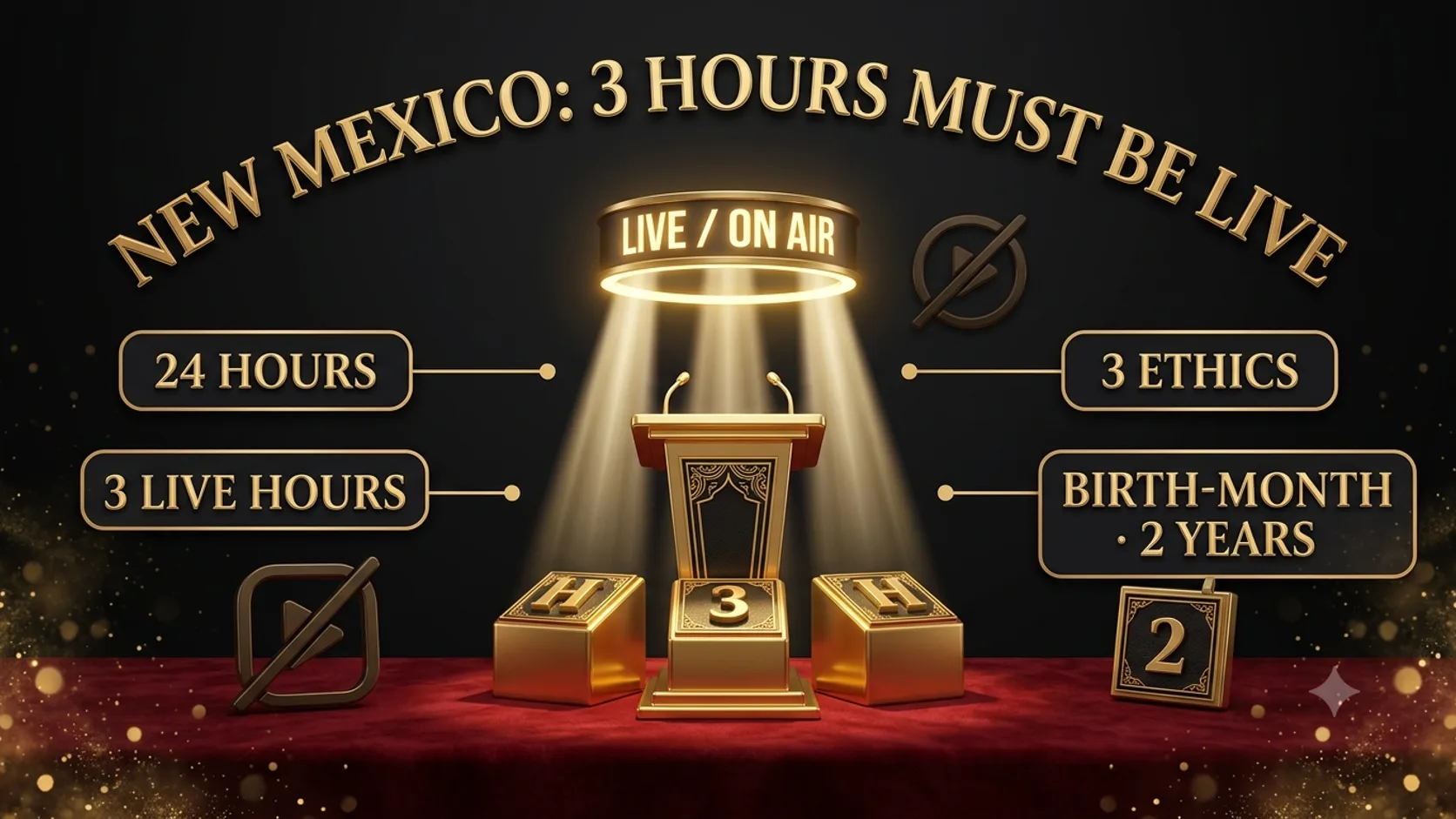
24 hours, 3 ethics, and a 3-hour live-instruction floor
New Mexico requires 24 CE hours per two-year compliance period for resident producers holding a life, health, property, casualty, or personal lines license, with 3 hours in ethics. The New Mexico-specific rule is a live-instruction minimum: at least 3 of the 24 hours must be completed in a physical classroom or in a webinar that lets the licensee interact with a live instructor in real time — a recorded video with a quiz at the end does not qualify for that portion.
The live-instruction floor is separate from the ethics requirement on paper, but a single 3-hour live ethics webinar satisfies both at once, which is how most producers handle it. A producer who completes all 24 hours through recorded self-study has not met the requirement no matter how current the content, and the shortfall does not show up as a smaller number — the record simply reads non-compliant.
The birth-month cycle and birth-year parity
New Mexico keys the license term to the producer's birth month rather than the issuance date. The term ends on the last day of the birth month, every two years, with the calendar year matched to the birth year: born in an even year, renew in even years; born in an odd year, renew in odd years.
This means a producer cannot infer their deadline from when they were first licensed, and two producers who took the exam the same week can have renewals two years apart. The New Mexico Office of Superintendent of Insurance (OSI) license lookup shows the exact expiration date, and it is worth checking once rather than assuming.
No carryover, the three-year repeat window, and the line match
New Mexico does not allow excess credit hours to carry forward into the next compliance period — hours beyond 24 are lost at the end of the term, so there is no benefit to completing 30 in one cycle. A specific course also may not be repeated for credit more than once within three years of the original completion date, a window longer than the two-year renewal term, so a producer who took a course late in the last cycle should confirm three full years have passed before relying on it again.
Every course counted has to be approved for a line of authority on the producer's own license. A life-only producer gets no credit for a property course, and a property-only producer gets none for a life course. Annuity best-interest training and long-term care training tied to those products are handled separately from the 24-hour count and should be confirmed against a current OSI bulletin before the first sale.
Penalties: $50 for missed CE, graduated fees for a late renewal
Failing to complete the CE requirement for a compliance period draws a $50 late penalty on its own, separate from anything on the renewal side. The base producer renewal fee is $60. A producer who completes CE and renews within 30 days of expiration pays $60 plus a $90 late fee — $150 total. From day 31 through day 365, the late component drops to $120 on top of the base fee.
File continuing education more than a year past the deadline and the consequence escalates from money to a re-test: the producer has to pass the licensing exam again for the line. Past one year with no reinstatement action at all, the only path is a brand-new license application.
How completions are reported, and what to keep
New Mexico-approved providers report course completions electronically, and the producer's CE record on the state system is what OSI verifies at renewal. NIPR checks that record before it will let a renewal application through, so a producer whose provider has not yet reported may find the renewal blocked even though the coursework is done.
The certificate each course issues is worth filing for a few years past the end of the cycle. It is the quickest way to fix a provider that reported late or under the wrong subject, and it is what OSI asks for if a record is questioned. A New Mexico producer should also confirm the live course posted as classroom or live-webinar credit, not self-study, since a miscoded live course leaves the 3-hour live-instruction floor unmet even when the total is right.
Non-resident producers
A non-resident licensed in New Mexico relies on their home state's CE requirement, so long as the home state has one and the producer stays in good standing there. The 24-hour count and the live-instruction floor are resident rules and do not stack on top of home-state compliance.
The reciprocity is for the general hour requirement only. A non-resident should still confirm whether any New Mexico-specific product course applies to a particular sale before relying on a home-state course to cover it.
Worked example
A property-and-casualty producer born in March of an even year has a term ending March 31 in even calendar years. He schedules a single 3-hour live ethics webinar — covering both the ethics carve-out and the live-instruction floor at once — plus 21 hours of self-study P&C content.
He finishes in January so the OSI record shows compliance well before the deadline. That timing keeps him clear of both the $50 CE penalty and the $90 late-renewal fee, which would each apply if his credits posted after March 31, regardless of when he actually finished the courses.
The bottom line
New Mexico's 24-hour, 3-ethics structure is standard, but the 3-hour live-instruction minimum and the birth-year parity in the renewal cycle are the two details producers miss. Book at least one live course each cycle, confirm the exact expiration date on the OSI lookup, and finish early — the $50 CE penalty and the graduated late-renewal fees both trigger on the record date, not the completion date.
Primary and official sources used for this guide
New Mexico Office of Superintendent of Insurance — Continuing EducationPrimary/official source for New Mexico's 24-hour requirement, live-instruction minimum, carryover rule, and birth-month cycle.↗NIPR — New Mexico Resident Renewal (Individual)Renewal detail for New Mexico residents, including the $50 CE penalty, graduated late-renewal fees, and the re-test rule after one year.↗Source pages can change. Check the current text and effective date before relying on a threshold, waiting period, or required form.