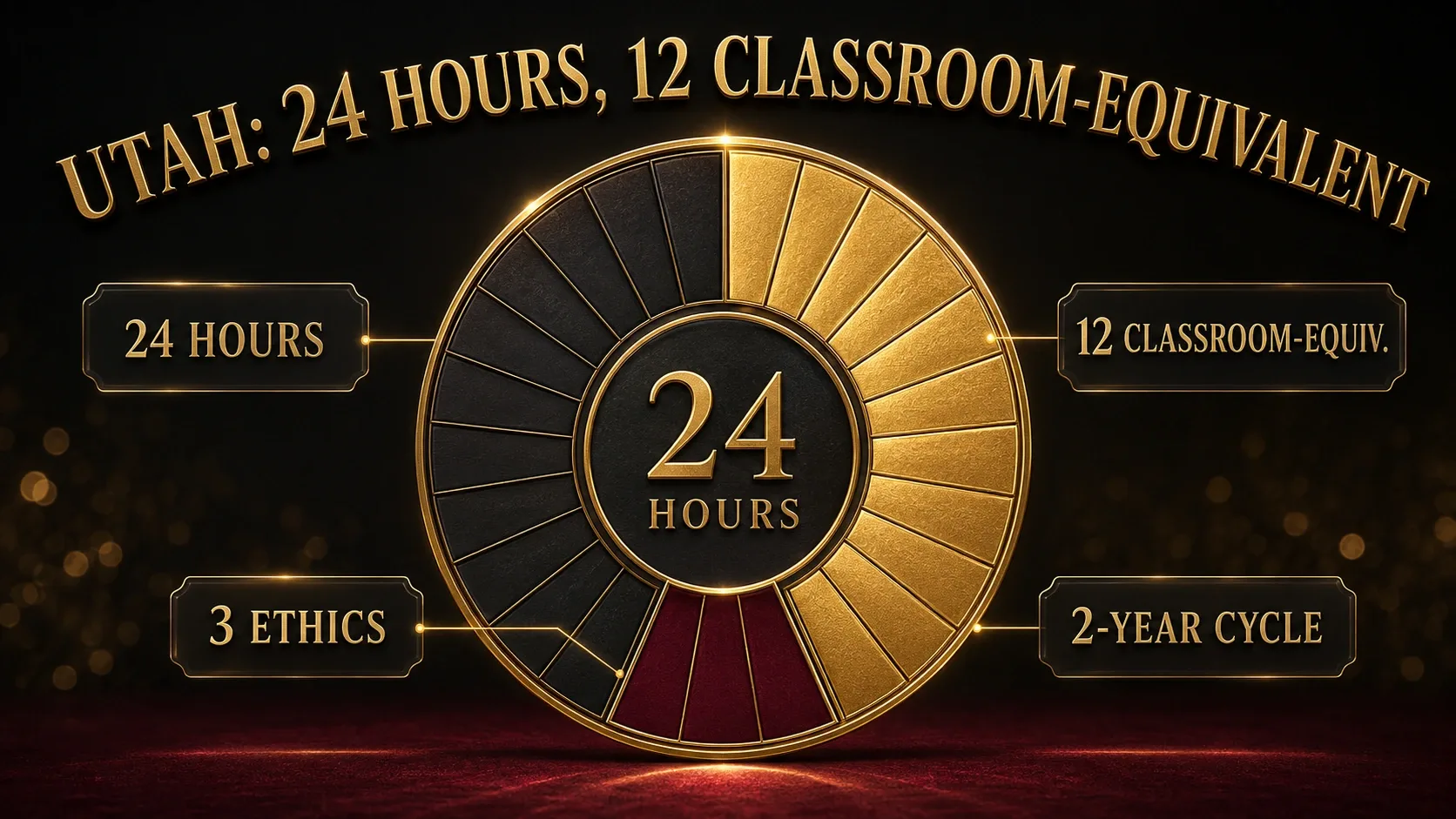
The baseline: 24 hours, 3 ethics, 12 in a classroom format
Utah requires resident producers and adjusters to complete 24 hours of continuing education during each two-year license term, with 3 of those hours specifically in ethics. The distinctive Utah rule sits on top of that number: at least 12 of the 24 hours must be completed in a classroom, or in an online course the state treats as classroom-equivalent — genuinely interactive delivery with instructor contact or timed, monitored progression, rather than a read-and-click self-study module.
That 50% classroom-equivalent floor is the rule most likely to catch a producer who books an all-self-study catalog to finish quickly. A transcript can show 24 completed hours and still be non-compliant in Utah because the classroom-format portion was never satisfied. When you build the schedule, filter the course catalog for the classroom or classroom-equivalent designation first and fill the self-study portion second, not the other way around.
The cap on insurer-provided hours, and no repeats
Utah caps how much of the requirement can come from one type of provider: no more than 12 hours may be from courses provided by an insurer. A producer whose carrier offers a full slate of free internal CE can use it, but only for half the requirement — the remaining 12 hours have to come from an independent approved provider. A captive-agency producer who assumes the carrier catalog covers everything will be 12 hours short at renewal.
A course also cannot be taken for credit more than once inside the same two-year renewal period. Repeating last cycle's ethics course is fine; repeating it twice in the current cycle is not. Utah does not allow excess hours to carry forward either, so completing 30 hours in one cycle banks nothing against the next — front-loading past 24 accomplishes nothing here.
The June 2026 long-term care training repeal
Utah previously required producers selling long-term care insurance to complete an initial LTC training course plus ongoing LTC-specific hours, mirroring the pattern most states still use. That separate LTC training requirement was repealed effective June 1, 2026, so producers who hold LTC authority no longer track a distinct LTC training deadline in Utah.
Annuity best-interest training is a different matter and still applies. A producer must complete the NAIC-model annuity best-interest course before the first annuity sale, and that requirement is rooted in the product suitability rules rather than the CE hour count. Confirm the current version against a Utah Insurance Department bulletin before selling annuities, because the model language has been revised more than once.
Renewal timing and the no-grace-period rule
The Utah license term ends on the last day of the month the license was originally issued, every two years. Two producers licensed in different months have different deadlines even in the same year, so the reliable move is to read the exact expiration date off the individual license record rather than assume a shared statewide date.
Utah has no CE grace period: an incomplete CE record blocks the renewal outright, with no short window to finish afterward and keep the license active. Because course providers report completions to Sircon or NIPR on their own schedule rather than instantly, finishing a few weeks before the deadline — not on it — is what keeps a routine reporting lag from turning into a lapse.
If the license lapses
A Utah producer who misses the renewal has one year from the expiration date to reinstate the same license through NIPR or Sircon. Reinstatement requires completing the full 24 hours (12 for a title-only license), including the 3 ethics hours, and paying a $125 reinstatement fee on top of the roughly $75 renewal fee. During the lapse the producer cannot transact insurance business.
Miss that one-year window and the license is gone. The producer reapplies as a brand-new applicant, which means sitting the licensing exam again and submitting to a fresh fingerprint-based background check — a months-long process, not a paperwork fix. Utah does allow a CE waiver for a lapse caused by military service or a documented long-term medical disability, requested through the department.
How completions are reported, and what to keep
Utah-approved course providers report completions electronically to the state's licensing system, and the producer's CE transcript on the Sircon or NIPR portal is what the department checks at renewal. A producer should confirm the transcript shows the full 24 hours — including the classroom-equivalent and ethics breakdown — before filing, rather than assuming every provider reported on time.
Hold on to the certificate of completion for each course for a few years after the cycle closes. Utah runs periodic CE audits, and if a provider drops a course or files it under the wrong subject, the certificate is what the department accepts to correct the record. Pay particular attention to whether classroom-equivalent courses posted as classroom-equivalent rather than self-study, since that is the categorization error most likely to leave a Utah transcript short.
Non-resident producers
A producer licensed in Utah as a non-resident satisfies the CE obligation by keeping their home-state license current, provided the home state imposes CE of its own. The 24-hour count, the classroom-equivalent floor, and the insurer-hours cap are resident rules and do not apply on top of home-state compliance.
That reciprocity covers the general hour requirement. A non-resident selling a specialized product line in Utah should still confirm whether any Utah-specific course version — historically for products like long-term care partnership policies — applies to that particular sale.
Worked example
A resident producer licensed in life and health, with her term ending on the last day of March in an even year, plans her 24 hours as: a 3-hour classroom-equivalent ethics webinar, 9 more hours of interactive classroom-equivalent coursework to reach the 12-hour classroom floor, and 12 hours of self-study product CE for the balance.
She keeps the insurer-provided portion to 8 hours so she stays well under the 12-hour cap, and schedules everything to finish by late February — about a month early. That buffer lets provider reporting post to her Sircon transcript before the March deadline, and gives her time to chase down any course that posts under the wrong category.
The bottom line
Utah's hour count is standard, but two Utah-specific limits shape the schedule: the 12-hour classroom-equivalent minimum and the 12-hour cap on insurer-provided courses. Build the plan around course format and provider type, not just the total, and finish early — with no grace period, a reporting lag near the deadline is the most common way a complete 24 hours still ends in a lapse.
Primary and official sources used for this guide
Utah Insurance Department — Continuing EducationPrimary/official source for Utah's 24-hour requirement, classroom-equivalent minimum, insurer-hours cap, and no-repeat rule.↗Utah Insurance Department — Renewals & ReinstatementsOfficial source for Utah's renewal fee, the one-year reinstatement window, the $125 reinstatement fee, and the military/disability CE waiver.↗Source pages can change. Check the current text and effective date before relying on a threshold, waiting period, or required form.