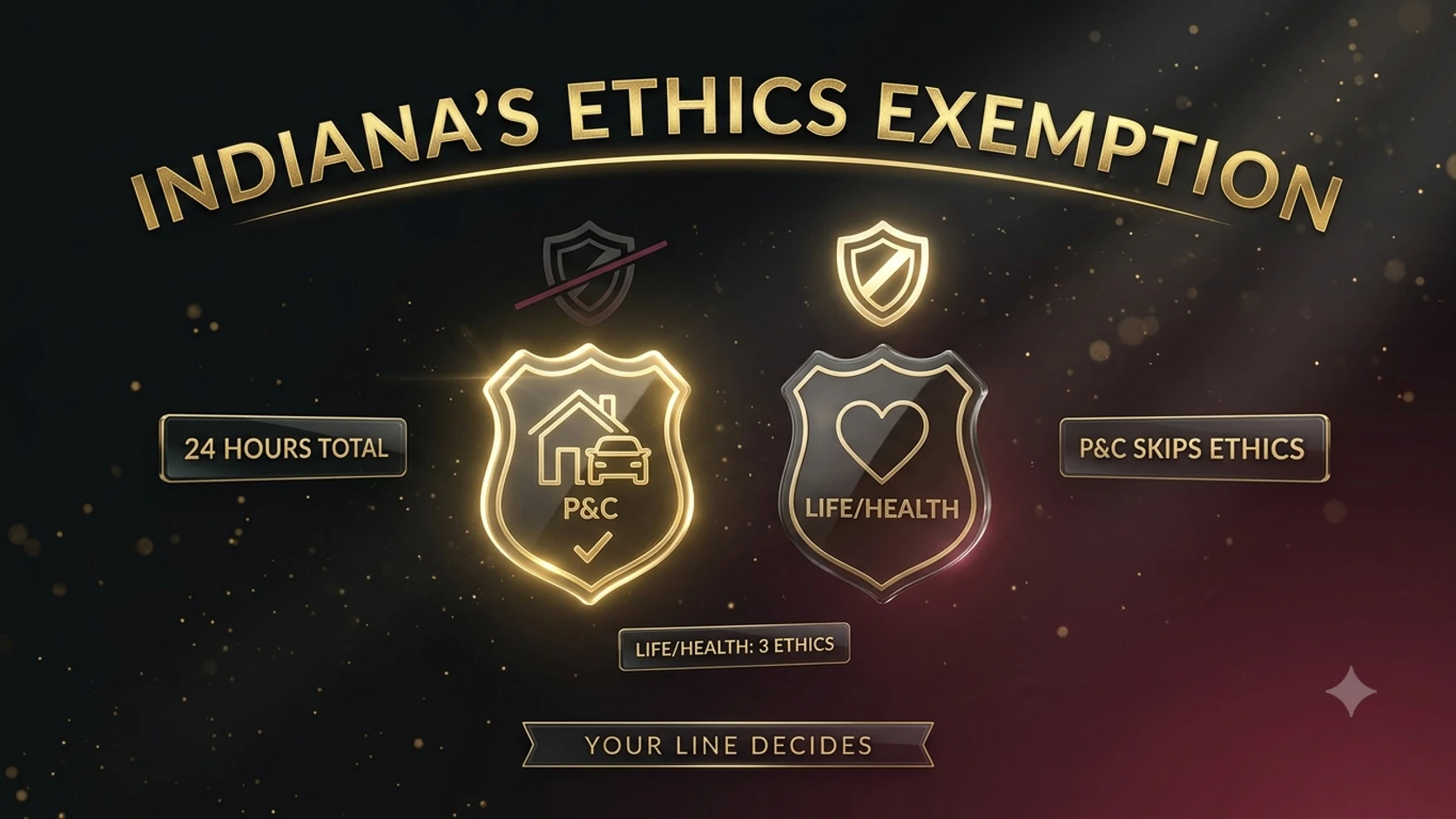
24 hours for everyone, but ethics only for certain lines
Indiana producers must complete 24 hours of continuing education credit every two-year renewal cycle, on a license term running to the last day of the producer's birth month. Where Indiana genuinely diverges from most states in this comparison set: the 3-hour ethics requirement is specifically tied to certain lines of authority — Life, Health, Variable Life & Annuity, or Life, Accident & Health — rather than applying universally to every producer regardless of license type.
Property & casualty producers in Indiana are explicitly not required to complete the 3-hour Ethics requirement that their life- and health-licensed counterparts owe. This is a meaningful structural difference from the large majority of states, where the ethics carve-out applies uniformly across all lines.
What this means for a P&C producer's 24 hours
Because P&C-only producers skip the ethics-specific 3-hour requirement, their full 24 hours can be satisfied entirely through general property & casualty-relevant coursework without needing to specifically carve out any hours as ethics-designated. This doesn't reduce their total hour count — it's still 24 hours — but it does remove one structural constraint that life/health producers face.
A multi-licensed producer holding both P&C and one of the ethics-triggering lines (life, health, variable life & annuity) should confirm which side of that line applies to their specific combination of authorities, since holding even one ethics-triggering line brings the 3-hour requirement into play for the full license.
Carryover and repeat-course rules
Indiana allows licenses renewing on or after January 1, 2022 to carry over a maximum of 12 hours to the next license term. Excess Ethics or Long-Term Care credits specifically may not be applied as carryover credits, consistent with the pattern seen broadly across states — general excess hours can bank forward, but specialty-designated hours (ethics, LTC) reset each term for the producers who owe them.
Renewal timing
All CE credit hours must be completed BEFORE submitting the license renewal application, with the renewal date falling on the last day of the licensee's birth month, biennially — the standard birth-month cycle.
Worked example: two Indiana producers with different obligations
One Indiana producer holds only property & casualty authority. Her 24-hour CE requirement can be satisfied entirely through P&C-relevant general coursework, with no mandatory ethics-designated hours required by the state (though nothing prevents her from taking an ethics course voluntarily).
A colleague at the same agency holds a life and health license instead. His 24-hour requirement must specifically include 3 hours of ethics-designated coursework, on top of which he completes 21 additional hours of general life/health-relevant CE to reach his 24-hour total — a structurally different requirement despite an identical overall hour count.
What P&C producers should do with their 'freed-up' hours
While Indiana's ethics exemption for property & casualty-only producers removes a mandatory 3-hour category, it doesn't reduce the state's own broader regulatory expectation that producers stay current on professional standards — many P&C producers voluntarily choose to take an ethics-adjacent course anyway, both because it's generally considered good practice and because many P&C producers eventually add a life or health line, at which point the ethics requirement would apply going forward.
A practical approach for a P&C-only Indiana producer is using their full 24 hours to deepen genuinely useful P&C-specific knowledge — emerging product lines, regulatory changes specific to property and casualty coverage, claims-handling updates — rather than treating the absence of a mandatory ethics carve-out as simply 3 fewer hours to worry about.
Non-resident producers: home-state compliance usually satisfies Indiana
A producer who holds an Indiana license as a non-resident — meaning Indiana isn't their home state — generally doesn't need to separately complete Indiana's 24-hour CE structure at all. Non-resident producers are exempt from Indiana's CE requirement as long as they've met their home state's CE requirements and submit documentation showing resident-state compliance to the Indiana Department of Insurance.
That documentation typically comes from the National Insurance Producer Registry's Producer Database, which centralizes each producer's licensing and CE-compliance history across every state they hold authority in — practically, this means a non-resident producer usually doesn't need to assemble separate paperwork for Indiana specifically, since the same NIPR record used for other states' compliance checks generally covers what Indiana's exemption process requires.
The exemption has a specific carve-out for long-term care: a non-resident producer who hasn't completed LTC training in their home state still must complete Indiana's regular LTC training requirement, though they remain exempt specifically from Indiana's Partnership Long-Term Care Program training. This reciprocity structure also means the P&C ethics exemption described above applies specifically to Indiana residents — a non-resident P&C producer's obligation is governed entirely by whatever their home state requires, not by Indiana's line-specific ethics carve-out.
The bottom line
Indiana's line-specific ethics exemption for property & casualty producers is a genuine structural difference from most states, but it applies only as long as a producer's license doesn't include an ethics-triggering line — a detail worth reconfirming any time a producer's license scope changes, including when a P&C-only producer later adds a life or health line.
Indiana's line-based exemption structure is a useful reminder that CE rules aren't always a single flat formula applied uniformly — sometimes a requirement depends entirely on the specific combination of authorities a producer holds, which is exactly why checking a rule against one's own actual license, rather than a general summary, matters most in states built this way.
Indiana producers should also confirm this exemption applies specifically to the ethics-hour requirement itself, not to any other line-specific CE obligation that might separately apply depending on the exact combination of authorities held, since the exemption described here is narrowly about the 3-hour ethics carve-out and not a broader exemption from CE generally.
Primary and official sources used for this guide
Indiana Department of Insurance — Producer Continuing EducationPrimary/official source for Indiana's line-specific ethics exemption for P&C producers.↗ExamFX — Indiana Insurance Continuing Education RequirementsSecondary source for Indiana's non-resident CE exemption and the LTC carve-out.↗Source pages can change. Check the current text and effective date before relying on an hour requirement, a reporting deadline, or a course approval.
Written for licensed agents, not issued by a regulator. Insurance License CE Desk has no connection to any state department of insurance or CE provider. Hour requirements, ethics credits, and compliance deadlines are set state by state and do change, so your department of insurance, or the CE tracking vendor it uses, has the final word on what your transcript needs.