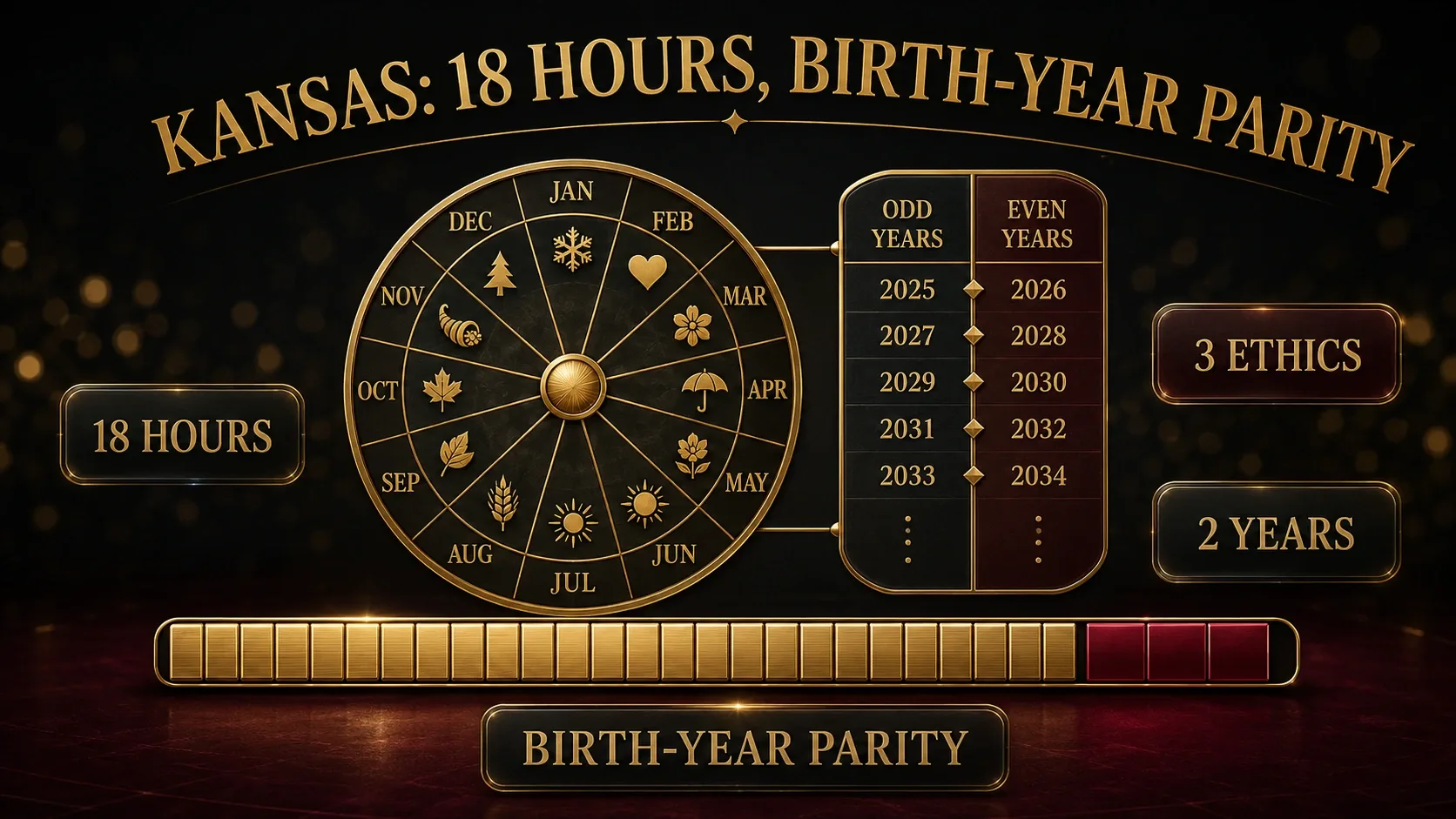
18 hours, 3 ethics — lower than the national norm
Under K.S.A. 40-4903, each licensed Kansas insurance agent must biennially obtain a minimum of 18 continuing education credits, including at least 3 hours of instruction in insurance ethics, which may also cover regulatory compliance. That leaves 15 general hours in any line of authority the producer holds.
The 18-hour figure is the Kansas-specific point, and it cuts both ways. A producer moving from a 24-hour state should not over-buy six hours they do not need, and a producer moving from Kansas to a 24-hour state should not assume the 18 they are used to will be enough at the new state's renewal.
The automatic suspension for a late CE report
Kansas does not treat a missed CE deadline as a fee-and-move-on matter. If the report showing proof of CE completion is not received by the agent's biennial due date, the agent's qualification and every corresponding license are suspended automatically — for 90 days, or until the producer demonstrates completion, whichever comes first.
On top of the suspension, the commissioner assesses a $100 penalty for each license suspended. A multi-line producer who holds separate licenses can be looking at several hundred dollars in penalties, plus a suspension that stops all business, from a single CE report that posted a day late.
The 10-day, $104, and 91-day thresholds
On the renewal side, Kansas gives a producer who completed CE on time a 10-day window after license expiration to late-renew with no penalty fee. From day 11 through day 90, the late fee is $104. After day 91, the license cannot be renewed — the producer restarts the licensing process as a new applicant.
A separate reinstatement path exists for a license that lapsed because CE was not met: a $100 reinstatement fee plus the $4 renewal fee, available within 12 months, with the reinstatement fee itself applying out to four years past expiration for fee-only lapses. The two paths are easy to confuse, and the fee schedule depends on why the license lapsed.
One-time flood and annuity training
A Kansas producer who sells flood insurance must complete a one-time flood training course tied to the National Flood Insurance Program, and a producer who sells annuities must complete a one-time annuity suitability course before the first annuity sale. Both are lifetime requirements tied to the product line rather than recurring per-cycle courses.
These are easy to miss because they do not appear on a generic "total CE hours" summary — they attach to the specific product authority, not the hour count. A producer who added annuity activity mid-career is the most common person to overlook the annuity course.
How completions are reported, and what to keep
Kansas-approved providers report completions to the Department of Insurance electronically, and the producer's CE record is what triggers — or prevents — the automatic suspension. Because the suspension keys on the report being received by the due date, a producer needs the provider to have reported, not merely to have issued a certificate.
If a provider's report is late and the automatic 90-day suspension has already posted, the course certificate is what the Department accepts to lift it — demonstrating completion ends the suspension early rather than waiting out the full 90 days. Keep certificates for every license line for a few years, since a multi-line producer facing several simultaneous suspensions has to clear each one.
Non-resident producers
A non-resident licensed in Kansas satisfies the requirement through their home state's CE rules, provided the home state has a requirement and the producer stays in good standing there. The 18-hour count and the 3-ethics carve-out are resident rules.
The one-time flood and annuity courses are tied to the product being sold and can apply to a Kansas sale regardless of residency — confirm against a Kansas Department of Insurance bulletin before selling those products in the state.
Worked example
A producer born in an odd year, with an odd-year renewal, holds both a life license and a property/casualty license. He completes a 3-hour ethics course and 15 hours of general content — 18 total — and confirms the provider filed the CE report six weeks before his birth-month deadline.
Had he waited and the report posted a day late, both licenses would have suspended for 90 days and he would owe $200 in penalties — $100 per license — even though the coursework itself was finished on time. The early filing, not the early studying, is what protects him.
The bottom line
Kansas's general requirement is a light 18 hours with 3 ethics, plus the one-time flood and annuity courses that ride on product authority. The reason to finish early anyway is the enforcement: a late CE report is not a fee, it is an automatic 90-day suspension of every license the producer holds, with a $100 penalty attached to each one.
Primary and official sources used for this guide
Kansas Department of Insurance — Continuing EducationPrimary/official source for Kansas's 18-hour requirement, the 3-hour ethics carve-out, and the one-time flood and annuity training.↗Kansas Statutes § 40-4903 — Continuing EducationThe Kansas statute setting the 18-credit biennial minimum, the automatic 90-day suspension for a late report, and the $100-per-license penalty.↗Source pages can change. Check the current text and effective date before relying on a threshold, waiting period, or required form.